
Social Discovery: Moving Beyond UDDI with FOAF-based Ego-centric Networks
User's Social Profile -- Based Web Services Discovery
The paper introduces SC-WSDS, a decentralized web service discovery framework that leverages a user's ego-centric social network and an extended FOAF (Friend-Of-A-Friend) ontology. By filtering for "close" friends and analyzing their past service invocation histories, the system provides highly relevant service recommendations that outperform traditional centralized UDDI registries.
TL;DR
The paper addresses the long-standing inefficiency of centralized Web Service registries (like UDDI) by proposing a decentralized discovery process. By modeling a user's ego-centric social network and extending the FOAF (Friend-Of-A-Friend) vocabulary to track service usage, the authors create a system that recommends services used and "vetted" by a user’s most similar friends.
Background: The Failure of Centralization
In the traditional Service Oriented Architecture (SOA), discovery relies on the UDDI registry. However, UDDI has become a bottleneck: it lacks semantic richness, requires manual updates, and often returns results that are functionally correct but practically useless for the user's specific context. The authors argue that Web 2.0 and social structures provide a better "recommendation engine" than any centralized database ever could.
The Core Insight: Close Relationships & Past Invocations
The researchers identified two critical gaps in previous "Social Web Service" research:
- Manual Exploration: Users shouldn't have to manually browse their friends' profiles.
- Lack of Semantic Closeness: Not all friends are equal. A recommendation from a "close" colleague is worth more than one from a casual acquaintance.
1. Modeling the Social Profile
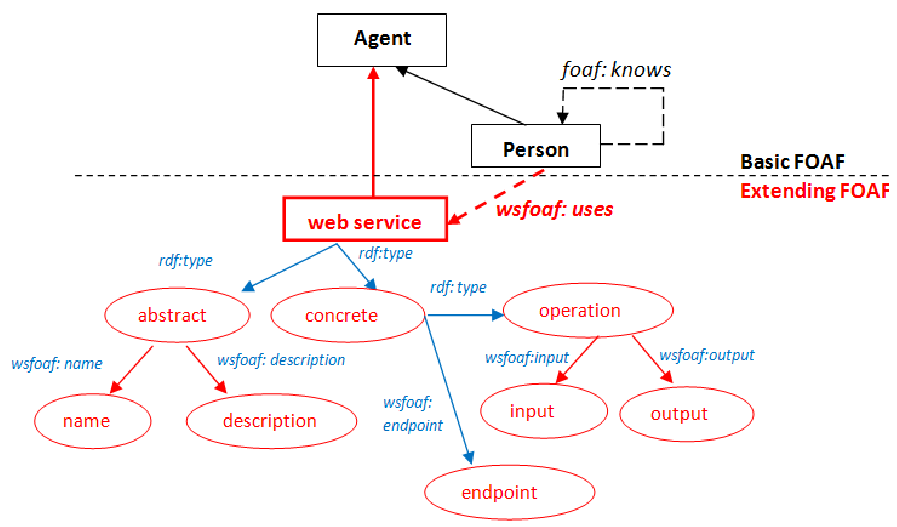
The authors use an extension of the FOAF model. Because standard FOAF only describes people and their simple "knows" relationships, the authors introduced the wsfoaf namespace. This allows the system to store:
- Static Data: Name, age, personal info.
- Dynamic Usage: Interactions between the user and specific services via the
foaf:usestag.
2. The Similarity Degree (SD)
To automate the discovery, the system calculates a Similarity Degree using the Jaccard coefficient: By setting a threshold (), the system identifies "best friends" whose service invocation histories are most likely to be relevant to the current user.
The Discovery Process: URPI-Disc Algorithm
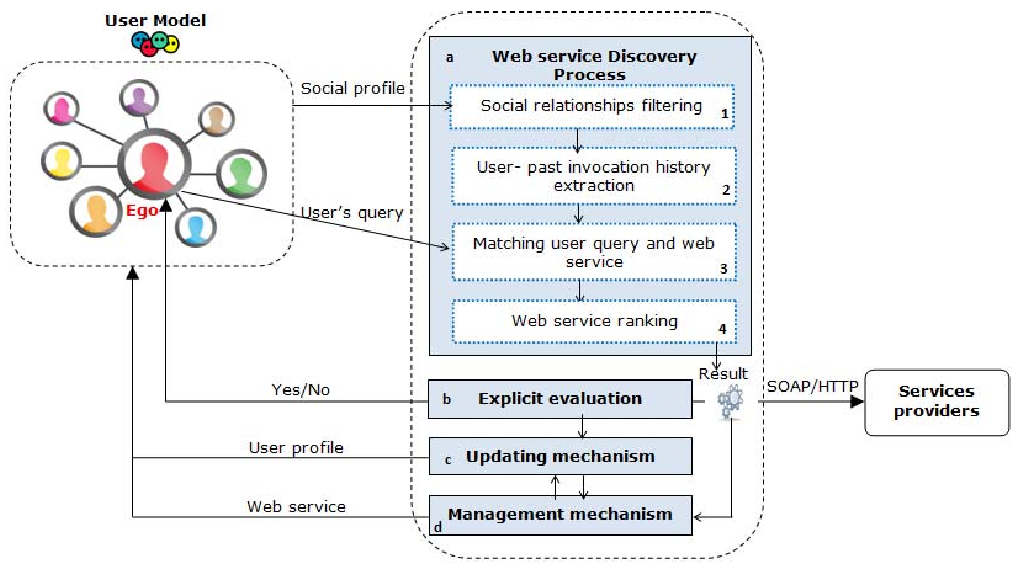
The proposed URPI-Disc (User’s Relationships and Past Invocation) algorithm follows a streamlined workflow:
- Filter: Extract only the "close" friends from the ego-centric network.
- Harvest: Scrape the
wsfoafdata from those friends' RDF profiles. - Match: Compare the user's query keywords against the service names and descriptions found in those profiles.
- Rank: Return services sorted by the friend's Similarity Degree.
Experimental Validation
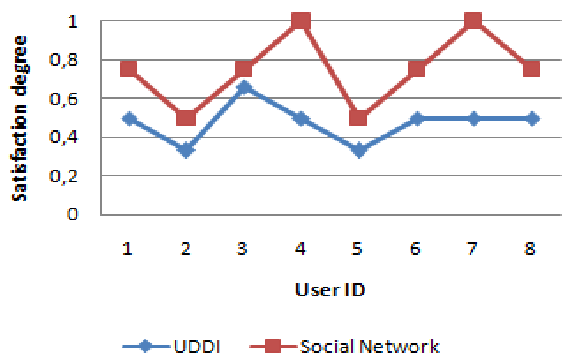
The authors built a prototype system (SC-WSD) using the Jena API and SPARQL queries. They compared their social-based approach against a standard jUDDI registry using 15 web services across categories like Weather, Currency, and Travel.
- User Satisfaction: 8 test users consistently reported higher satisfaction with social results.
- Effectiveness: Evaluation metrics (Precision, Recall, and F-measure) showed a clear advantage for the social network discovery process.
Critical Analysis & Conclusion
Takeaway
The shift from centralized registries to socially-aware ego-centric networks brings "human" intelligence into the technical discovery process. Using historical data (past invocations) as a proxy for service quality is a pragmatic and effective solution to the "low precision" problem of keyword searches.
Limitations & Future Work
The current "Similarity Degree" is purely structural (based on common friends). The authors acknowledge that Trust (reputation and reliability) is a missing dimension. Additionally, while the system effectively handles simple queries, future iterations will need to address service composition (combining multiple social services to solve a complex query).
As social metadata becomes more standardized, the ability of our software agents to "ask a friend's profile" for a recommendation will likely replace the need for traditional service yellow pages.