
UTE: Decoding the "Financial Pulse" through Hybrid User and Topic Embeddings
15694_User and Topic Hybrid Context Embedding for Finance-Related Text Data Mining.
This paper introduces a User and Topic Hybrid Embedding (UTE) framework tailored for finance-related text mining on social networks like Sina Weibo. By learning joint vector representations of users and financial topics from historical posts, the authors propose a "UTE-ContextLSTM" architecture that significantly improves financial sentiment analysis performance.
TL;DR
Financial microblogs are minefields of noise and subjectivity. A neutral statement about "futures regulation" might be a bullish signal if coming from a specific expert, or a bearish one if the market sentiment is overwhelming negative. This paper introduces UTE-ContextLSTM, a framework that learns the "DNA" of users and topics to provide a multidimensional context for sentiment analysis, achieving a high accuracy of 89.1% in the volatile finance domain.
The Problem: The "Context Blindness" of Sentiment Analysis
Most sentiment analysis models treat every post as an island. However, in finance, the source (User) and the subject (Topic) carry massive weight.
- User Preference: A famous bull may sound neutral while actually signaling optimism.
- Mainstream Voice: The collective attitude towards a topic (e.g., Apple stock, Bonds) acts as a background "thermal map" for individual posts.
Without these two anchors, models often miss subtle irony, domain-specific nuances, or the sheer weight of expert opinion.
Methodology: The Architecture of Hybrid Context
The authors propose a dual-layered approach: learning representations (embeddings) and then applying them through a sophisticated neural architecture.
1. Learning UTE (User and Topic Embedding)
Using a modified Skip-gram model, the authors maximize the probability of words given a user or a topic. The key innovation is the Hybrid Embedding (UTE): Here, serves as a pivot to balance the user's linguistic style with the topic's "common sense."
2. UTE-ContextLSTM Architecture
The classifier doesn't just look at words. It uses:
- Local Context: A Bi-LSTM processes the sentence, but an Attention Mechanism uses the UTE vector to focus on specific keywords that matter for that user/topic.
- Global Context: Max and Average pooling across topic embeddings to capture the "vibe" of the conversation.
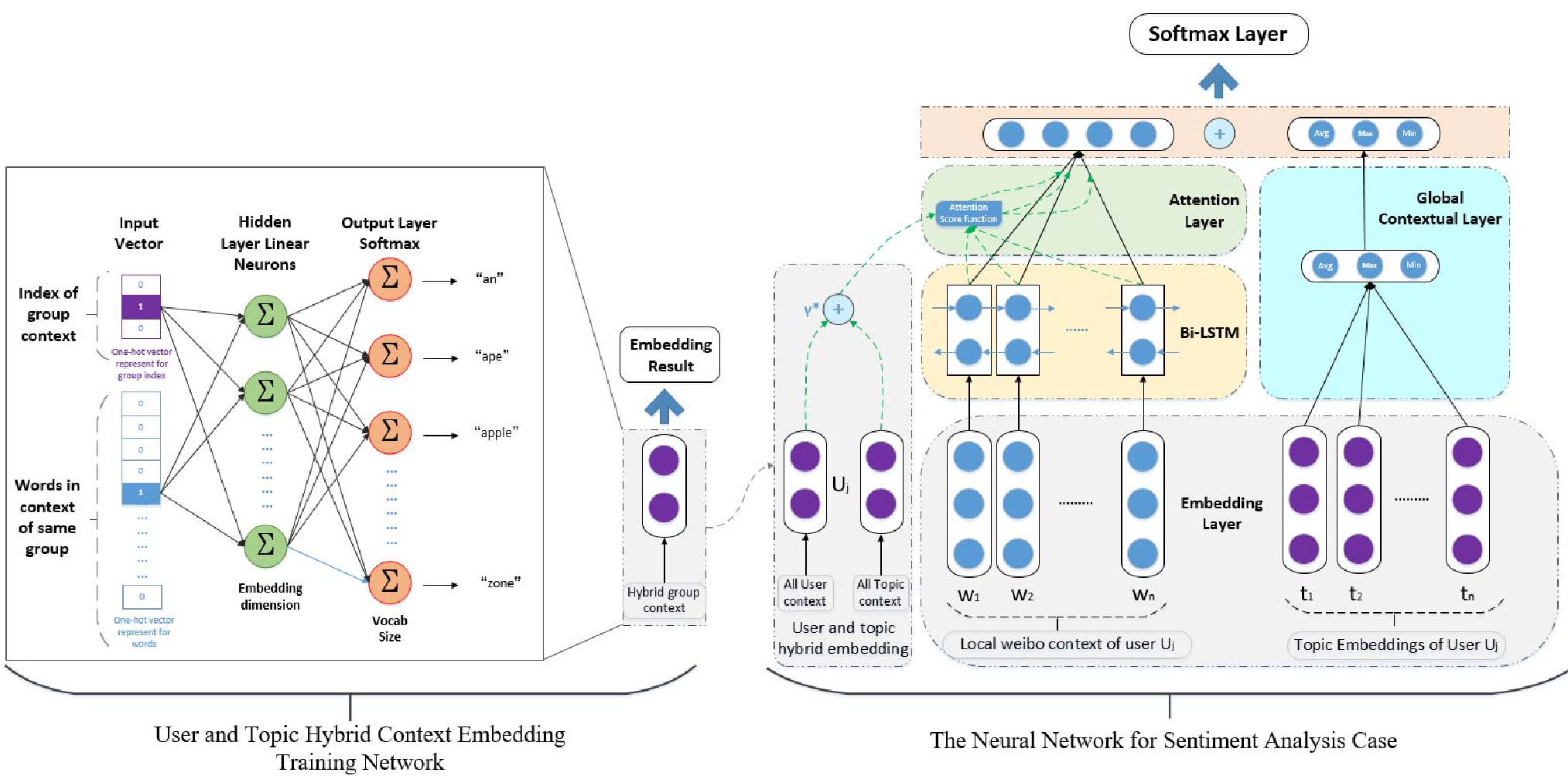 The model bridges the gap between local word sequences and global user/topic metadata.
Experiments & Deep Insights
Intrinsic Quality: Can Embeddings "Understand" People?
The authors used Birch clustering on the learned user embeddings and mapped them to real-world attributes. They discovered three distinct clusters:
- Professional Media: High post counts, neutral/formal style.
- Individual Experts: Frequent, long-form content with high follower counts.
- General Users: Sporadic investors with conversational language.
This proves that the embedding space isn't just random math; it captures the sociological structure of the financial social network.
Performance: Why UTE Wins
The model was tested against standard CNNs and LSTMs. The inclusion of UTE and global context led to a significant jump in performance.
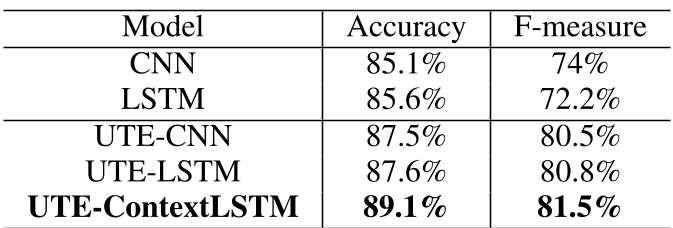
Interestingly, the optimal was found to be 0.4, suggesting that while the user's personal style is important, the Topic's mainstream voice (60% weight) is actually the more powerful signal in financial sentiment.
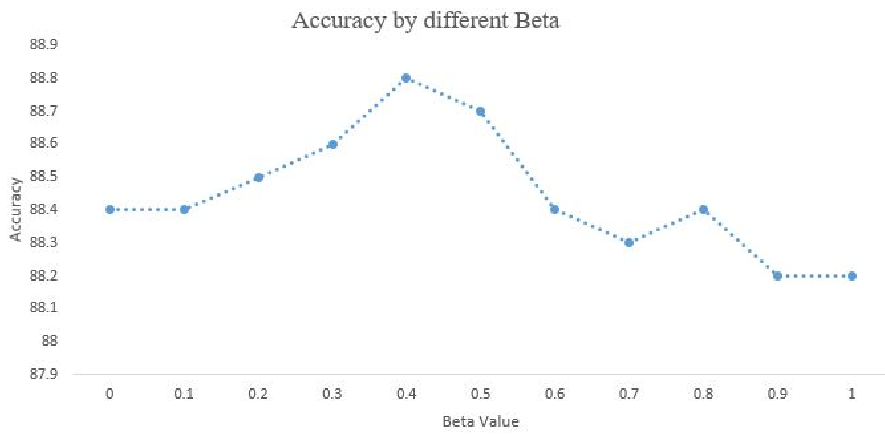
Critical Analysis & Conclusion
The UTE-ContextLSTM is a robust reminder that "meaning" is not just in the words—it’s in the contextual intent.
Takeaways:
- Financial Knowledge Graphs: Applying this to real market indexes is the next frontier.
- Limitations: The model relies on a "Single-Pass" clustering for topics, which might struggle with rapidly evolving or overlapping financial events (e.g., a "tech stock" that becomes a "meme stock").
- Future Impact: This could revolutionize algorithmic trading by filtering "noise" (amateur posts) from "signal" (expert analysis) more effectively than simple keyword filters.