
MSGA: Decoding the DNA of Trust in Electronic Banking through Multi-Objective Data Mining
Analysing user trust in electronic banking using data mining methods
This paper presents a novel variable selection framework to predict and analyze user trust in electronic banking. The authors propose the Multi-objective Selection Genetic Algorithm (MSGA), which integrates soft-computing techniques like Delta Test and Mutual Information (k-NN and Parzen window) to identify core socio-demographic and financial predictors of trust.
TL;DR
In the wake of global financial instability, banks are desperate to reclaim customer trust. This paper introduces a Multi-objective Selection Genetic Algorithm (MSGA) designed to sieve through massive banking databases. By combining evolutionary computation with information theory, the authors identified the precise variables—ranging from profitability metrics to digital behavior—that define whether a user trusts a digital platform. The result is a model-agnostic variable selection engine that outperformed standard benchmarks and earned top marks from industry experts.
Problem & Motivation: The Trust Deficit in a Digital Age
The Spanish financial sector, particularly after 2008, faced a paradox: consumers were increasingly using electronic banking to save costs, yet over 55% reported a decline in trust. To manage this precarious relationship, banks need to understand why customers trust them.
However, financial databases are "noisy" and "high-dimensional." Including too many variables in a predictive model leads to the Curse of Dimensionality and overfitting, while including too few misses the subtle behavioral "tells" of a loyal customer. Existing Wrapper methods (which select variables while training a specific model) are too slow, while most Filter methods fail to balance the trade-off between model simplicity and accuracy.
Methodology: The Core Engine (MSGA)
The authors suggest that variable selection is not just a search problem; it is a Multi-objective Optimization Problem (MOP). They aim to minimize two conflicting objectives:
- Prediction Error (Validation error estimated via non-parametric methods).
- Model Complexity (The total number of variables used).
1. The Selection Heuristics
Instead of building a full neural network for every variable combination, the authors used:
- Delta Test (DT): A non-parametric tool that estimates the minimum Mean Squared Error (MSE) achievable without overfitting by looking at "nearest neighbors" in the data.
- Mutual Information (MI): Specifically using k-Nearest Neighbors (k-NN) to measure how much information a subset of variables provides about the "Trust" outcome.
2. Genetic Innovation
The proposed MSGA improves upon the standard NSGA-II (Nondominated Sorting Genetic Algorithm) by introducing:
- A New Selection Operator: In genetic "tournaments," one parent is chosen for its accuracy, while the other is chosen for its simplicity (low variable count).
- A Crop Operator: A hard constraint () that automatically prunes solutions that exceed a maximum number of variables, ensuring the final results are interpretable for human bank managers.
 Figure 1: The transition from traditional bank branches to electronic channels and the multi-variable input space (Socio-demographic vs. Economic-financial).
Experiments & Results: Expert-Validated Precision
The researchers tested their algorithm on a real-world dataset of 946 e-banking users from a Spanish savings bank, analyzing 34 strategic variables.
- Algorithmic Performance: The MSGA using Mutual Information (k-NN) achieved the best optimization scores (0.0297) with a stable standard deviation, indicating high robustness.
- Human Validation: A committee of five bank directors evaluated the selected variables. The MSGA-MI approach received a 6.4 out of 7.0 on a Likert scale.
Experts noted that while standard algorithms (like NSGA-II) highlighted too few variables to be useful, the MSGA provided a "management-friendly" subset. Key variables identified included:
- Customer profitability (2009-2010).
- Total Euro amount of electronic operations.
- Direct deposit status (paychecks/pensions).
- Geographic region and Zip code.
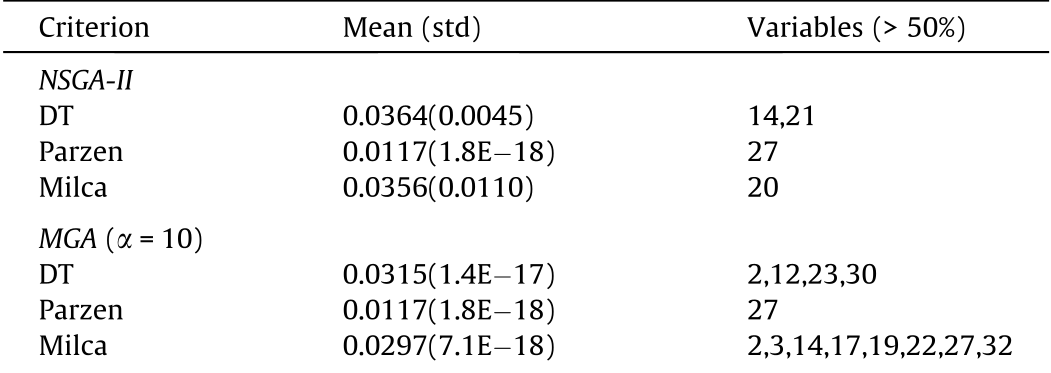 Table 1: Comparative performance of NSGA-II vs. the proposed MGA across different criteria.
Critical Insight: Why Does This Matter?
The takeaway for the AI and Finance community is clear: Simplicity is a feature, not a bug. By using a "Crop Operator," the researchers force the AI to respect the Interpretability-Accuracy trade-off.
In highly regulated industries like banking, a "Black Box" model that uses 100 variables is less valuable than a "Transparent Box" that uses 8 variables. This research proves that soft-computing can bridge the gap between complex data mining and real-world managerial decision-making.
Future Outlook
While the MSGA is powerful, the authors acknowledge that trust is dynamic. Future work should look at how these variable subsets evolve over time (e.g., how "Trust DNA" changes during a new economic recession). Additionally, applying this variable selection to a State Space Model (SSM) or a Temporal Gradient Boosting architecture could provide even deeper insights into the velocity of trust erosion.