
IO-UAR: How User Mobility Turbocharges Information Diffusion in Social Networks
Users’ mobility enhances information diffusion in online social networks
The paper proposes the IO-UAR (In-Out-Unacquired-Acquired-Rejected) model, a novel compartmental framework that incorporates user mobility into information diffusion dynamics within online social networks (OSNs). By applying mean-field theory on scale-free networks, the authors derive a propagation threshold that determines whether information will permanently diffuse or eventually vanish.
TL;DR
Static network models are becoming obsolete in the age of "fluid" social media. This paper introduces the IO-UAR model, which proves both mathematically and empirically that the ability of users to enter and leave a network—user mobility—actually enhances the speed and breadth of information spreading. By testing against real-world Sina Weibo "Super Topics," the model outperforms traditional SIR models by a significant margin.
Problem & Motivation: The Static Network Trap
Most classical diffusion models (like SIR or SIS) assume a "closed system." Imagine a room where no one can leave; information just bounces around until everyone has heard it or forgotten it.
However, platforms like Sina Weibo or Twitter are "open systems." Users follow a football team when it wins (In-flow) and unfollow when it loses (Out-flow). This constant churn changes the network's degree distribution and connectivity. The authors argue that ignoring these dynamics leads to a fundamental misunderstanding of how "viral" content actually behaves.
Methodology: The IO-UAR Framework
The core of the paper is the In-Out-Unacquired-Acquired-Rejected (IO-UAR) model. It classifies users into three states:
- Unacquired (U): Not yet aware of the info.
- Acquired (A): Aware and actively spreading.
- Rejected (R): Aware but refusing to spread (the "boredom" or "saturation" factor).
The "Flowing Pool" Insight
The authors introduce a "flowing pool" (state 0). New users enter as U, and users in any state can exit the network at rate .
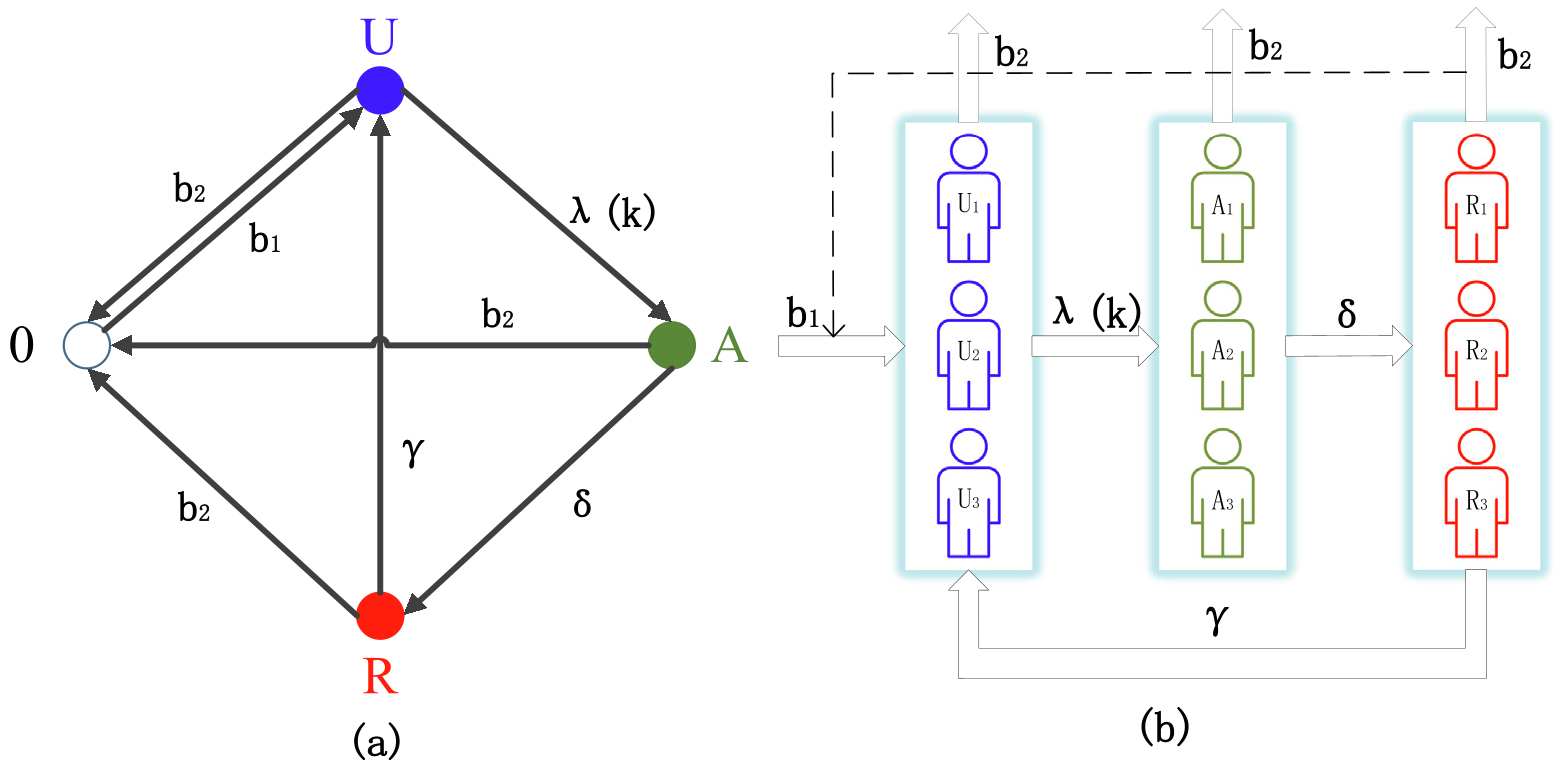 Figure 1: State transition rules showcasing the mobility parameters and .
Using Mean-Field Theory, they derive the propagation threshold : This formula is crucial: it shows is inversely proportional to the mobility rate in the denominator, but the dynamic interaction actually increases the number of "fresh" nodes susceptible to the information.
Experiments & Results
The authors crawled 11,394 users and 83,286 follower relationships from Sina Weibo to build a realistic testbed.
1. The Power of Degree
The study confirms a "Rich-Get-Richer" phenomenon in information. Nodes with higher degrees (more followers) are not only more likely to acquire information but do so significantly faster.
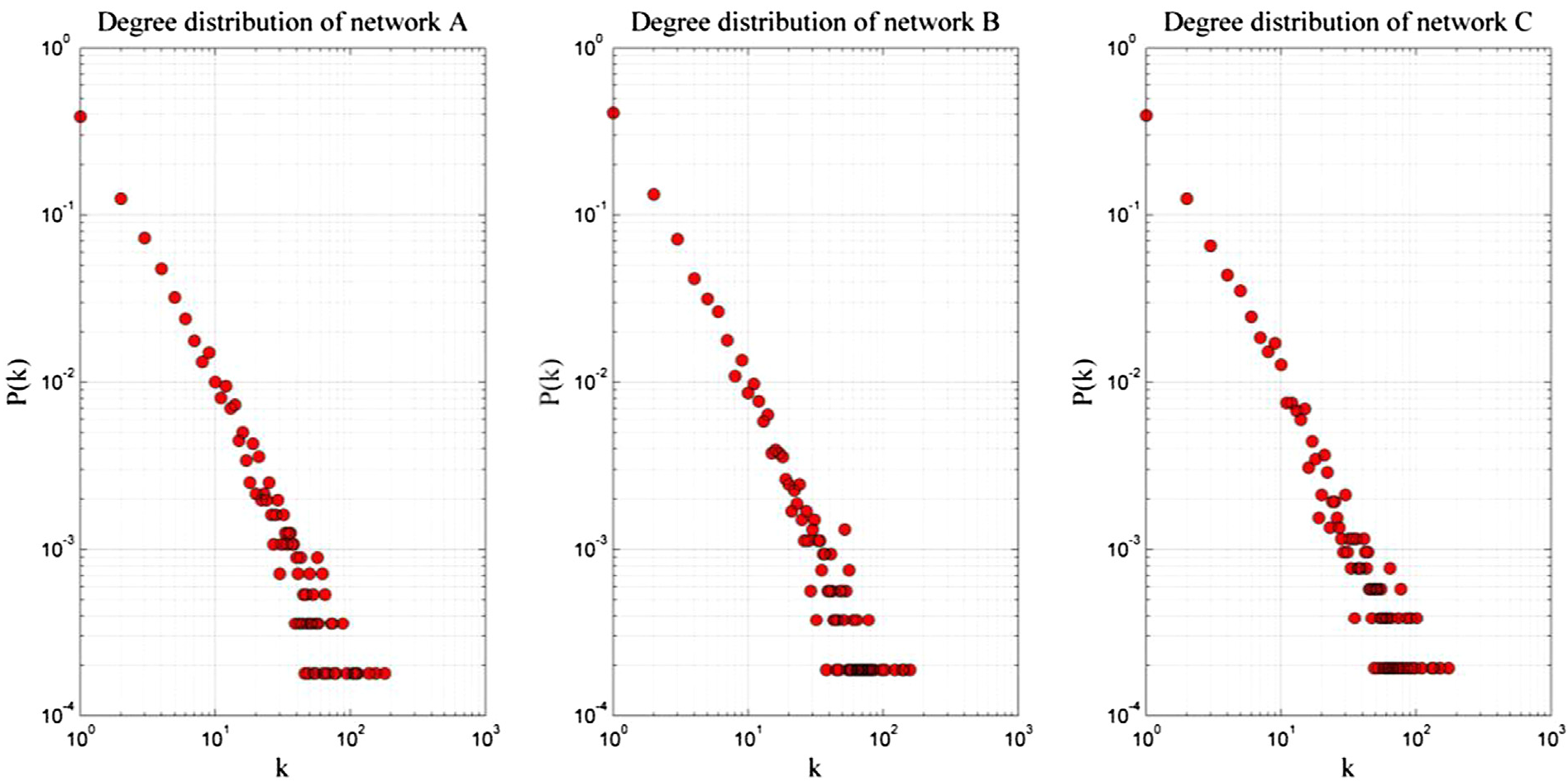 Figure 2: The power-law degree distribution of the Weibo sub-networks.
2. IO-UAR vs. Traditional SIR
The most compelling evidence comes from the "Xiao Mi" Super Topic tracking.
- SIR Model: Predicts that once a topic "dies," the density of active users drops to zero.
- IO-UAR Model: Predicts a "plateau" where new users entering the network keep the topic alive at a steady state (approx. 8.8% density).
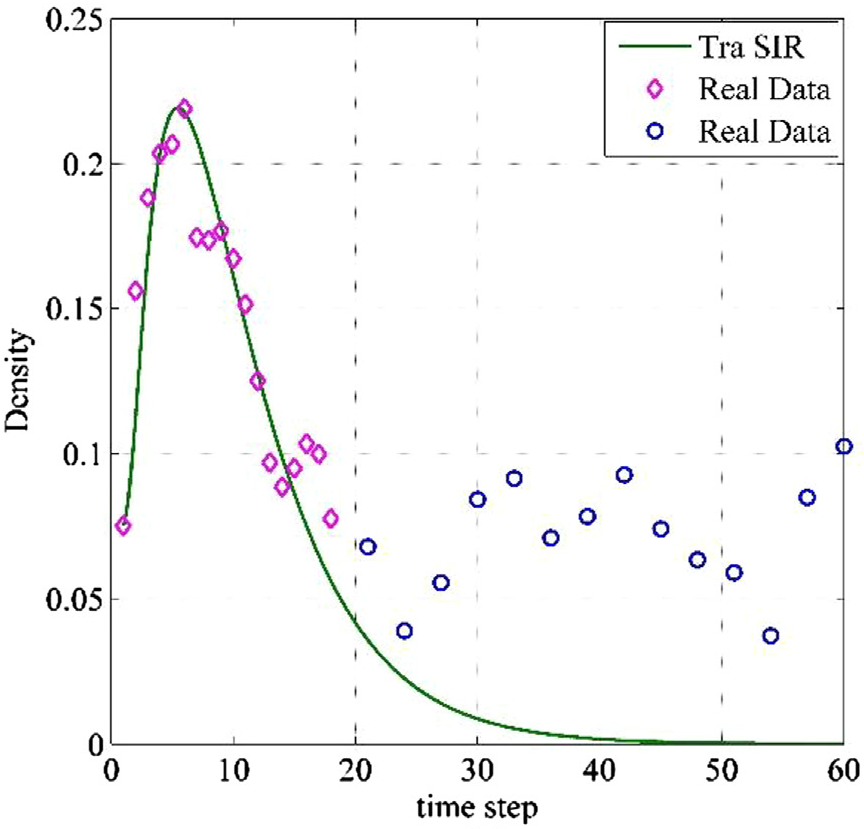 Figure 3: Prediction of the Xiao Mi super topic. The IO-UAR model (solid line) tracks the real-world "long tail" of information much better than the SIR model (dashed line).
The RMSE for IO-UAR was 76.6, while SIR was 107.3, representing a massive improvement in predictive accuracy.
Critical Analysis & Takeaways
Why does mobility help?
It sounds counter-intuitive—if users leave, shouldn't diffusion stop? The authors argue that mobility enhances connections. As users move in and out, they effectively "stir" the social pot, creating new edges and paths for information to travel that didn't exist in a static snapshot.
Limitations
- Symmetry Assumption: The paper assumes the rate of users entering equals the rate of users leaving (). In real-life "viral" events, inflow usually dwarfs outflow initially.
- Data Constraints: Due to API limits, only 200 followers per user were crawled, which might underrepresent the "super-hubs" of the network.
Final Conclusion
The IO-UAR model is a significant step toward "Biological Reality" in social network analysis. For marketers and policymakers, the message is clear: the flow of the crowd is just as important as the structure of the crowd.