
Deciphering the Rumour Machine: Why We Support, Refute, or Joke About Falsehoods on Reddit
Toward understanding how users respond to rumours in social media
This paper presents a multi-dimensional framework to analyze user responses to social media rumours, specifically categorizing users based on psychological motivations. Using Reddit data and a case study on a long-standing political rumour, the authors demonstrate that users can be reliably classified into "Support", "Refute", or "Joke" categories using a combination of social network analysis (SNA) and text mining.
TL;DR
Researchers from Dalhousie University and the University of São Paulo have moved beyond simple "rumour detection" to analyze the humans behind the screen. By analyzing nine years of Reddit data, they identified three core ways users interact with rumours: supporting them for self-enhancement, refuting them for fact-finding, or joking about them for social bonding. Their automated model can identify these roles with 80% accuracy, revealing that humor is often the primary driver of rumour interaction.
Background: Beyond Detection
In the arms race against "fake news," most academic effort is spent on detecting it. But detection is only half the battle. To stop a rumour, we must understand its "social fuel." This paper positions itself in the intersection of psychology and data science, asking: Who are the people keeping these stories alive?
The "Why" Behind the Post: Psychological Archetypes
The authors draw on the psychological theories of Bordia and DiFonzo to define three distinct personality types in the rumour ecosystem:
- SUPPORT (The Believer): Driven by self-enhancement. Their comments are often short, lack evidence, and serve to reinforce their worldview.
- REFUTE (The Fact-Finder): Driven by fact-finding. These users provide long, thoughtful explanations and external links to debunk the claim.
- JOKE (The Socialite): Driven by relationship-building. They use sarcasm and humor to interact with others, often mocking the premise of the rumour itself.
Methodology: Mapping the Conversation
The researchers built a pipeline to ingest years of Reddit comments, focusing on a particularly persistent rumour: "Obama is a Muslim."
1. Visualizing the Flow
Using the RumourFlow tool, they mapped how interest in a rumour spikes over nearly a decade. This longitudinal view shows that rumours don't just die; they hibernate and resurface.
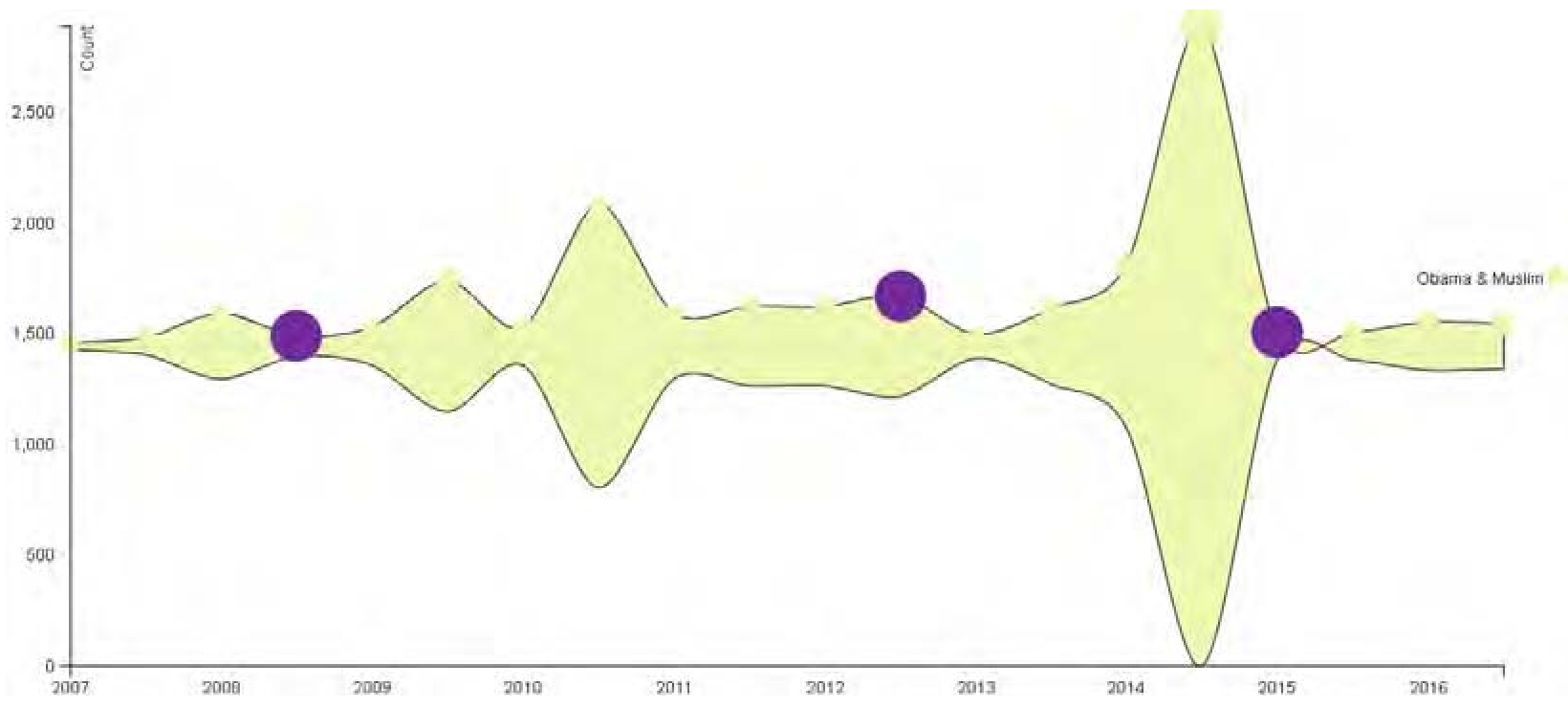 Fig 1: The lifecycle of the "Obama is a Muslim" rumour on Reddit, showing submission frequency and comment volume over 9 years.
2. Social Network Analysis (SNA)
By analyzing "who replies to whom," the authors discovered that the JOKE category acts as the social glue. They receive the most responses and bridge the gap between "Believers" and "Fact-finders."
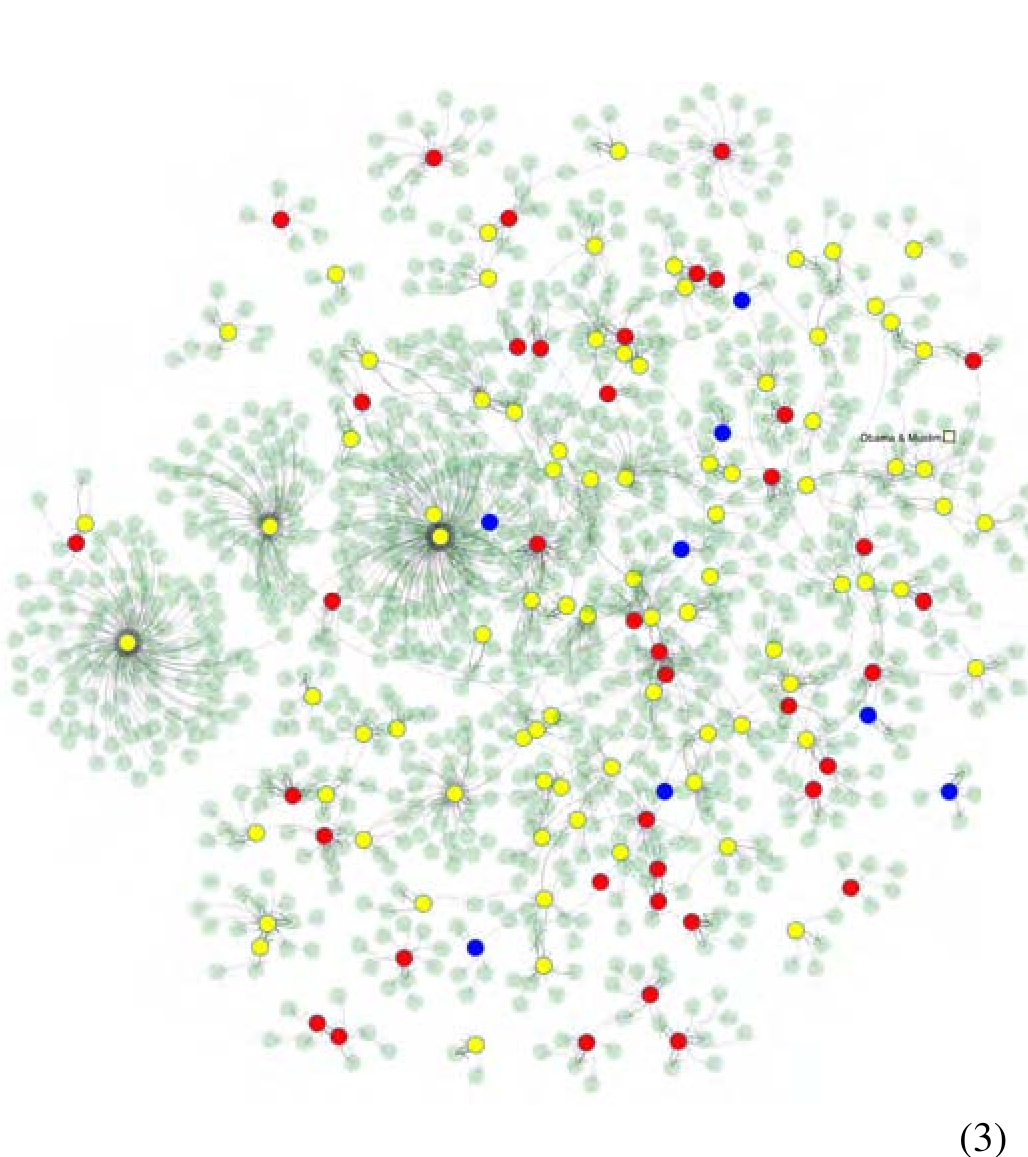 Fig 2: A network graph showing interactions between JOKE (Yellow), REFUTE (Red), and SUPPORT (Blue) users. Note the high density of connections among the JOKE category.
Key Findings & Data Insights
- Automated Classification: By using TF-IDF vectors and a Naive Bayes classifier, the system reached 80% accuracy in identifying a user's role based purely on the text of their comments.
- The Power of Visuals: Rumours that included an image or a link to an external source (even if the source was dubious) received significantly more engagement than text-only posts.
- Sentiment Trends: The "REFUTE" group showed the highest subjectivity and polarity, indicating that fact-finding is an emotionally charged and intense activity.
| Category | Polarity | Subjectivity |
|---|---|---|
| SUPPORT | 0.484 | 0.680 |
| REFUTE | 0.747 | 0.753 |
| JOKE | 0.638 | 0.705 |
| (Data showing that debunkers are often more expressive and opinionated than supporters.) |
Critical Insight: The "Joke" Paradox
The most fascinating finding is the role of the "Joker." While joking is technically a way of refuting a false rumour (usually via sarcasm), it actually keeps the rumour in the public eye. Because "JOKE" posts are highly engaging and receive many replies, they inadvertently help the Reddit algorithm keep the rumour "hot."
Conclusion & Future Outlook
This work demonstrates that rumour-spreading is not a monolithic behavior. If we want to clean up social media, we cannot treat a sarcastic joke the same way we treat deliberate disinformation.
Limitations: The study focused on a single, highly politicized, and already-debunked rumour. Future work must investigate if these same patterns hold for "Grey Rumours"—those where the truth is still unknown or emerging in real-time.
Takeaway: To combat misinformation, platform designers should focus not just on the "truth value" of a post, but on the interaction patterns it triggers. High-engagement sarcasm might be just as influential as the rumour it seeks to mock.