
Leveraging ACM Metadata: Bridging the Gap in Educational Resource Discovery
Using ACM DL paper metadata as an auxiliary source for building educational collections
This paper introduces a transfer learning framework designed to expand the "Ensemble" digital library collection by harvesting computing education resources from diverse sources like YouTube and SlideShare. It utilizes high-quality ACM Digital Library (DL) metadata as an auxiliary source to train robust text classifiers capable of identifying relevant educational content across different domains.
Executive Summary
TL;DR: The "Ensemble" project, part of the NSDL, addresses the challenge of scaling digital libraries by using the ACM Digital Library (DL) as an auxiliary source. By applying Transfer Learning and Bootstrapping, the researchers developed a system that can accurately identify "Computing Education" resources on platforms like YouTube, even when the data formats and vocabularies differ significantly from traditional academic papers.
Academic Context: This work sits at the intersection of Digital Library (DL) curation and Machine Learning. Rather than treating collection building as a manual harvesting task, it frames it as a Cross-domain Text Classification problem, specifically focusing on the "Feature-Representation-Transfer" paradigm.
The Bottleneck: Scaling Beyond the Harvest
Digital libraries like Ensemble rely on metadata harvesting from specific providers. However, the internet is teeming with high-quality educational content on platforms like YouTube or SlideShare that lack structured academic metadata.
The primary challenge is two-fold:
- Label Scarcity: Manually labeling thousands of YouTube descriptions to train a classifier is expensive.
- Domain Shift: A classifier trained on formal academic abstracts (ACM) often fails when applied to informal, noisy descriptions on social media.
Methodology: Transfer Learning & Bootstrapping
The authors tackle the domain shift by leveraging the ACM Computing Classification System (CCS). They specifically focused on the "Computing Education" category to build the initial model.
1. Feature-Representation-Transfer
To minimize the difference between source (ACM) and target (YouTube/Ensemble) domains, the authors looked for "Common Significant Words." Using Information Gain (IG) and Chi-squared (CS), they identified terms that are vital in both contexts—such as algorithm, programming, and curriculum—while filtering out domain-specific noise.
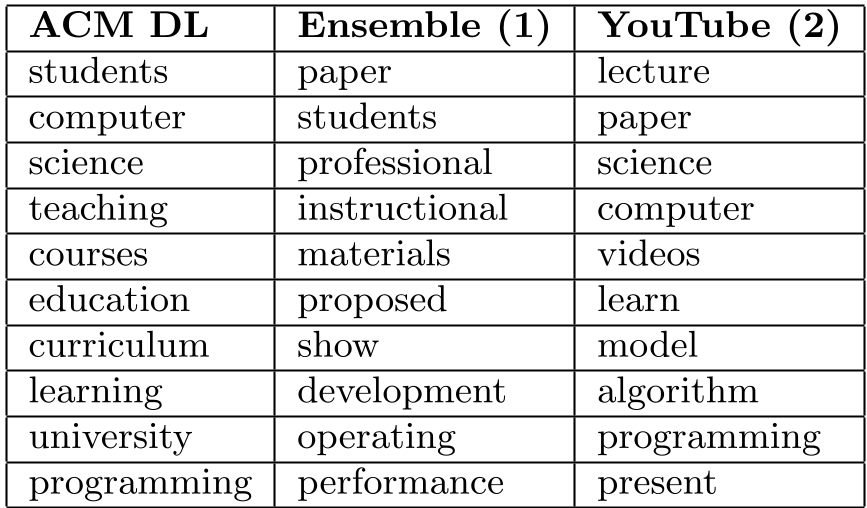 Table showing the top vocabulary matches between academic metadata and social media descriptions.
2. The Bootstrapping Loop
The core innovation is the iterative improvement process:
- Pre-train: Use ACM metadata to build a Naive Bayes classifier.
- Predict: Apply the model to a small subset of the target domain (e.g., YouTube crawler results).
- Retrain: Add the high-confidence positive results into the source dataset and re-calculate the feature weights.
- Repeat: Each iteration "tunes" the classifier to the target domain's nuances.
 (Placeholder: Please refer to Figure 2 in the paper for the specific bootstrapping flow).
Experimental Validation
The evaluation focused on three primary datasets: ACM DL (1.7M records), Ensemble (590 ground truth records), and YouTube (660 harvested records).
| Iteration | Classifier Accuracy | New Records Identified |
|---|---|---|
| 1 | 78.36% | 34 |
| 2 | 78.74% | 34 |
| 3 | 79.12% | 36 |
The results demonstrate that while the initial shift from ACM to YouTube causes an accuracy drop, bootstrapping creates a steady upward trajectory in both precision and the number of new records correctly identified.
Critical Insight & Future Outlook
The paper proves that academic metadata is not just a descriptive tool—it's a latent knowledge base that can bootstrap AI systems in less-structured environments.
Limitations: The reliance on Naive Bayes and bag-of-words features, while efficient, may miss the deep semantic context provided by modern Large Language Models (LLMs). Furthermore, the recall remained a challenge compared to precision.
Next Steps: Moving forward, the research points toward Online Learning and deployment on Hadoop/Solr clusters. This suggests a future where digital libraries are not just passive repositories, but active agents constantly "crawling and classifying" the web to update their collections autonomously.
Conclusion
By treating the ACM Digital Library as "auxiliary data," Chen and Fox have provided a blueprint for how specialized digital libraries can escape their silos and incorporate the vast world of open educational resources.