
DTrace for Malware Detection: Repurposing System Tracing for Cyber Defense
Using Dtrace for Machine Learning Solutions in Malware Detection
This paper introduces a behavior-based malware detection framework for Windows that leverages DTrace for dynamic system-call tracing. By processing system-call sequences into frequency-based features, the authors implemented Decision Tree and Random Forest classifiers to distinguish malicious processes from benign ones.
TL;DR
This research pioneers the use of DTrace, a professional performance analysis tool, as a data collection backbone for Windows malware detection. By capturing system-call sequences and applying Random Forest classifiers, the authors achieved an F1-score of 91% on balanced datasets, providing a new pathway for behavior-based defense that circumvents traditional code obfuscation.
Context: The Evasion Arms Race
In the world of cybersecurity, signature-based detection is increasingly obsolete. Malware authors utilize "packers," encryption, and obfuscation to change the file's appearance without altering its function. The academic consensus has shifted toward behavior-based detection, focusing on what a program does (system calls) rather than what it looks like (static bytes).
The authors identify a gap: while tools like strace are common in Linux research, Windows has lacked a native, high-performance tracing framework suitable for generating ML-ready datasets—until the recent introduction of DTrace to the Windows ecosystem.
Methodology: From Raw Traces to Feature Vectors
The research workflow follows a rigorous pipeline:
- Dynamic Tracing: Executing malware within a VirtualBox sandbox.
- Syscall Extraction: Using DTrace scripts to record every
Nt...call, mapping them to specific Process IDs (PIDs) and timestamps. - Frequency Analysis: Converting linear sequences into a "Bag-of-Syscalls." Instead of just looking at the order, they count how many times a process calls specific functions like
NtDeviceIoControlFile.
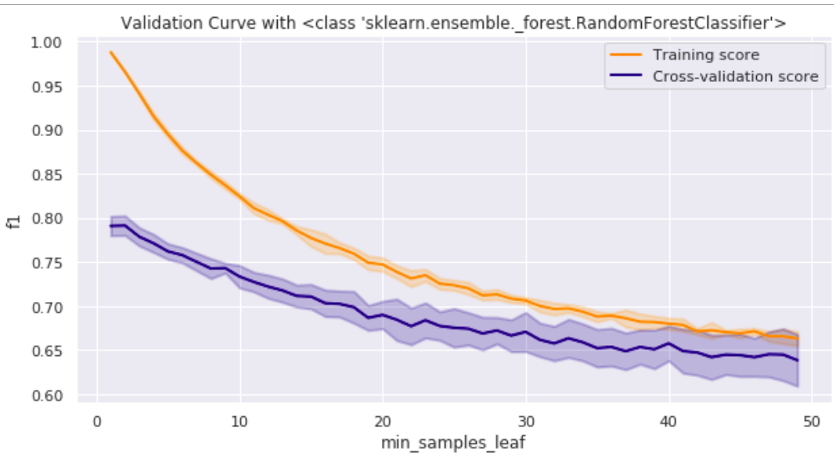 Fig 1: Validation Curve for Random Forest tuning, showing the model's sensitivity to leaf node constraints.
Experiments and The Imbalance Trap
The authors tested several classifiers, including SVM, KNN, and Naive Bayes. The results were clear: Tree-based ensembles (Random Forest and Decision Trees) significantly outperformed other methods.
Performance Metrics
A critical finding of this paper is the impact of Class Distribution. When the dataset was balanced (344 samples total), the F1-score soared to 91%. However, with the full imbalanced dataset (6573 malicious vs. 153 benign), the Random Forest's F1-score plummeted to 22%, even while Accuracy remained high (97%). This highlights a common pitfall in malware research: high accuracy in an imbalanced set often just means the model is "guessing" the majority class.
| Classifier | F1-score (Balanced) | F1-score (Imbalanced) | Accuracy |
|---|---|---|---|
| Random Forest | 91 | 22 | 97% |
| Decision Tree | 91 | 46 | 97% |
Critical Insight & Future Directions
The strength of this work lies in its infrastructure: demonstrating that DTrace can automate the collection of complex telemetry in Windows.
However, as a "Senior Academic Editor," I observe two main challenges for future work:
- Feature Evolution: Simple frequency (counting calls) ignores the temporal context. Malware often performs a series of benign-looking calls that only become malicious in a specific order. Moving toward N-grams or RNNs/LSTMs is the logical next step.
- Sandbox Evasion: The authors admitted that some modern malware can detect the VirtualBox environment and remain dormant. Future iterations will need "stealthier" sandboxing or hardware-assisted tracing.
Conclusion
This paper successfully bridges the gap between system administration tools (DTrace) and machine learning. It provides a robust baseline for Windows behavior analysis, proving that even with simple frequency features, dynamic tracing can pinpoint malicious activity with high precision under the right data conditions.