
CLICT: Fusing Content and Triadic Structures for Robust Community Detection
Using link and content to detect social communities
The paper introduces CLICT (Community detection using Link and Content Triangles), a three-step framework that integrates structural link data with textual user content for social network partitioning. It leverages content similarity to expand networks and uses the Triangle Participation Ratio (TPR) to refine community boundaries.
Executive Summary
In the realm of social network analysis, identifying "communities" is often hindered by the inherent messiness of real-world data—noisy links, accidental follows, and missing connections. CLICT (Community detection using Link and Content Triangles) is a sophisticated framework that addresses these issues by treating user-generated content (UGC) not just as metadata, but as a primary structural driver. By combining spectral clustering with a triangle-based refinement strategy, this work achieves SOTA-level performance in uncovering hidden social structures.
Problem & Motivation: The "Noise" in our Social Fabric
Most community detection algorithms operate on a "Link-Only" paradigm. However, the authors identify two critical failures in this approach:
- Link Noise: In platforms like Twitter or Flickr, the cost of "following" is near zero, leading to many meaningless edges that don't represent actual community affiliation.
- Detectability Threshold: When a network is sparse, structural information alone is insufficient to distinguish a community from random background noise.
The authors' key insight is that content (what users say, tags they use) provides the necessary "glue" to validate or suggest links, while triangles (the tendency for a friend of a friend to be a friend) act as the ultimate litmus test for community cohesion.
Methodology: The CLICT Pipeline
The CLICT algorithm is structured into three distinct phases:
1. Network Expansion via Content Weighting
The algorithm doesn't just look at who you are connected to, but who you should be connected to.
- Edge Creation: For every node, the top content-similar nodes are identified. If links don't exist, they are added.
- Hybrid Weighting: Edges are weighted by a fusion of structural similarity () and content similarity (). The authors tested several combinations, finding that the Salton Index and Jaccard Similarity (SIJ) often yielded the best results for binary tag data.
2. Initial Partitioning
The expanded, weighted graph is processed using the k-way spectral clustering method. This maps nodes into a -dimensional Euclidean space based on the Laplacian matrix's eigenvectors, allowing for a mathematically stable initial grouping.
3. Refinement via Triangle Participation Ratio (TPR)
This is the "secret sauce" of the paper. A well-defined community should be dense in triangles. The authors define the Triangle Participation Ratio as the fraction of nodes in a community that belong to at least one triangle within that same community.

The algorithm iteratively moves nodes between communities if the move increases the overall TPR of the partition, effectively "polishing" the noisy edges away.
Experiments & Results
The authors validated CLICT on two distinct datasets: Flickr (dense, overlapping tags) and Facebook (ego-networks, rich profile data).
Key Findings:
- Triangles Matter: Compared to CODICIL (which uses links and content but no triangle refinement), CLICT showed a significant boost in F1-score. This confirms that local triadic closure is a powerful signal for community boundary refinement.
- Content is Critical: The "LICOT" baseline (using only links/triangles) lagged behind CLICT, proving that textual similarity can bridge gaps where physical links are missing.
- Similarity Metrics: For binary data (like photo tags), Jaccard similarity outperformed Cosine similarity.
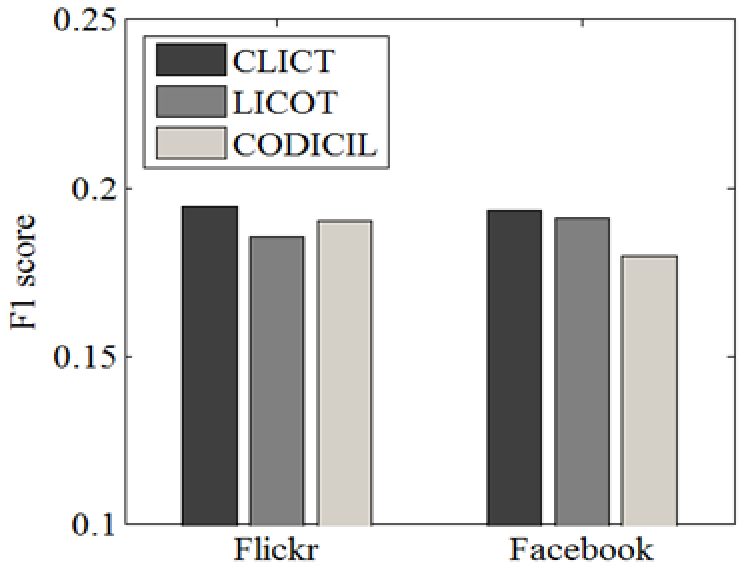 Figure: CLICT demonstrates superior F1-scores across different thresholds compared to link-only or non-refined hybrid methods.
Critical Analysis & Conclusion
Takeaway: CLICT proves that community detection is not just a global optimization problem but a local structural one. By forcing nodes into "triangled" communities, it filters out the high-frequency noise typical of social media.
Limitations:
- Complexity: The complexity for content similarity is a bottleneck for truly massive graphs (millions of nodes).
- Parameter Sensitivity: The choice of (new neighbors) and (weighting balance) requires domain knowledge of the specific social network's density.
Future Outlook: The integration of Graph Embedding techniques (like Node2Vec or GraphSAGE) could potentially replace the manual content similarity step, allowing the triangle refinement logic to work on learned latent features.