
RoBERTa in the Courtroom: Scaling Transformer-Based QA for Legal Documents
Using transformers to improve answer retrieval for legal questions
This paper presents a high-performance Question Answering (QA) system for the legal domain using the RoBERTa architecture. The authors fine-tune RoBERTa-Base on the PRIVACYQA dataset and propose a dual-stage production pipeline that balances transformer-based accuracy with industrial-scale latency requirements.
TL;DR
Legal research is moving beyond keyword search. This work by Thomson Reuters researchers demonstrates how RoBERTa-Base dramatically outperforms traditional SVMs in retrieving answers from complex privacy policies, achieving a 41% boost in Mean Reciprocal Rank (MRR). More importantly, it provides a blueprint for deploying these heavy models in production via a two-stage architecture.
Background: The Shift to Semantic Law
Historically, legal professionals spent hours sifting through ranked lists of documents based on simple probability. The industry is now shifting toward Question Answering (QA), where the system provides specific passages rather than just document links. However, legal text is notoriously "non-factoid"—answers aren't just single words (like "Paris" or "1776") but nuanced multi-sentence explanations.
Problem: Noise, Imbalance, and Latency
The authors identify three "valleys of death" in legal AI development:
- Class Imbalance: In a typical policy, for every 1 valid answer passage, there are roughly 25 irrelevant ones.
- Data Noise: Legal datasets (like PRIVACYQA) are "dirty"—riddled with URLs, fragmented sentences, and misspellings that distract sensitive neural networks.
- Deployment Reality: You cannot pipe 100,000 document segments through a Transformer for every user query; the latency would be commercially unacceptable.
Methodology: The Two-Stage Pipeline
The core "Insight" here isn't just using a Transformer; it's how they wrap it in a production-ready ecosystem.
1. Cyclic Data Curation
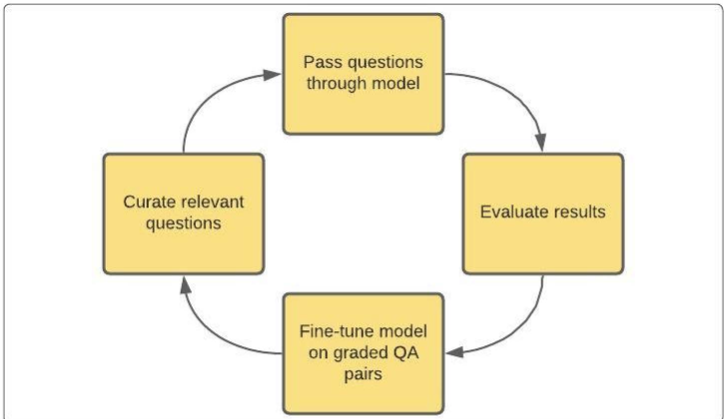
Instead of a static dataset, they use a feedback loop. User queries are run through the classifier, and Subject Matter Experts (SMEs) grade the results. This "Human-in-the-loop" approach ensures the model learns the specific nuances of legal interpretation.
2. The Architecture
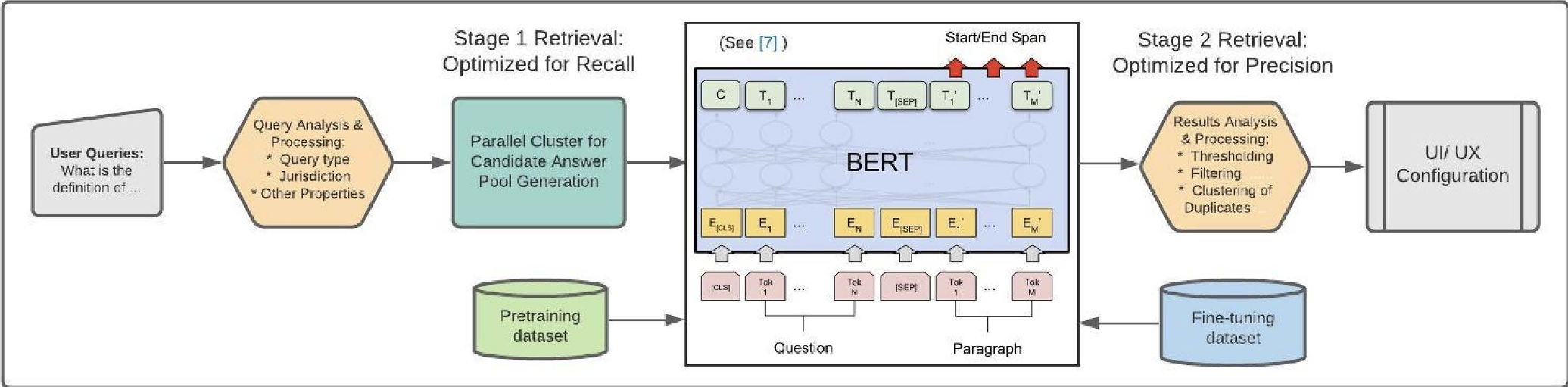
To solve the latency problem, they propose a Dual-Stage Pipeline:
- Stage 1 (Filtering): A parallel data cluster uses computationally efficient term-overlap (like BM25) to narrow millions of passages down to a "Candidate Pool" of 100–1,000.
- Stage 2 (Reranking): The RoBERTa-Base classifier performs deep semantic analysis on only the candidate pool, running on GPU endpoints to ensure sub-second response times.
Experiments & Results
The researchers compared RoBERTa against a Linear SVM (with TF-IDF features) on the PRIVACYQA dataset.
Key Metrics Comparison:
| Metric | SVM | RoBERTa | Improvement |
|---|---|---|---|
| F1-Score | 0.294 | 0.385 | +31% |
| MRR | 0.074 | 0.105 | +41.4% |
Why did RoBERTa win? The SVM relies on exact token matches. If a user asks about "data sharing" but the document mentions "third-party disclosure," the SVM fails. RoBERTa uses latent representations, understanding that these terms occupy the same semantic space.
Critical Insight: The "Simplicity" Paradox
Interestingly, the SVM achieved higher Recall than RoBERTa. The authors note that the SVM is less prone to "overfitting" on the noisy, redundant text of privacy policies. A major takeaway for AI engineers: Data cleaning is more important than model depth. A Transformer fed with "dirty" data (URLs, bad grammar) will struggle to generalize compared to a simple linear model that ignores syntactic nuances.
Conclusion
This research validates that while Transformers are technically superior for legal QA, their success in the real world depends on:
- Stage-1 pre-filtering to handle scale.
- Addressing class imbalance via class-weighting in the loss function.
- Aggressive data cleaning to prevent the model from getting lost in the "noise" of legal boilerplate.
The future of legal AI isn't just bigger models—it's smarter pipelines.