
Socializing SDS: Turning Tweets into Conversational Ice-Breakers
Using Tweets as "Ice-Breaking" Sentences in a Social Dialog System
The paper introduces a social dialog component that generates "ice-breaking" sentences by mining a user's Twitter profile to infer personal interests. By leveraging the principle of homophily and Wikipedia-based categorization, the system identifies relevant tweets and transforms them into engaging conversation starters for Spoken Dialog Systems (SDSs).
TL;DR
Researchers from the Karlsruhe Institute of Technology have developed a system that cures the "social awkwardness" of robots. By analyzing a user's Twitter feed and cross-referencing followed accounts with Wikipedia, the system generates personalized "ice-breaking" sentences. The result? A 100% response rate in user trials, with users finding the personalized topics significantly more appealing than random small talk.
Background: The Social Gap in Robotics
While Spoken Dialog Systems (SDSs) like Siri or bus schedule bots are great at tasks, they suck at human-centered interaction. Humans start conversations with "small talk" to build rapport (homophily). Without this, robots feel like cold tools rather than assistants. The challenge is: how does a robot know what a stranger wants to talk about?
Methodology: The Architecture of Interest
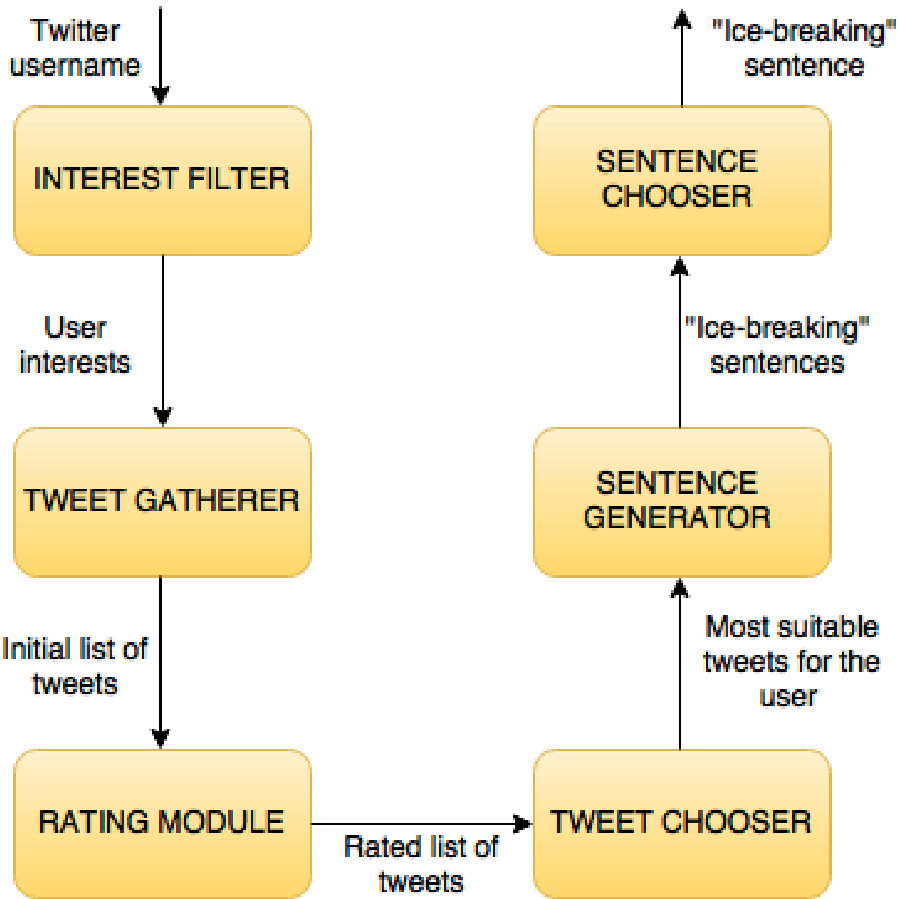
The paper proposes a modular pipeline that treats social media as a "cheat sheet" for a user's personality.
1. Inferring Interest via the Wikipedia Bridge
The system looks at who you follow on Twitter. If an account has >50k followers, it's deemed "important." The system then looks up that account on Wikipedia. By analyzing the Wikipedia categories (e.g., "Sport," "NASA," "Tech"), it identifies your core interests.
2. The Ranking Formula
Not all tweets are created equal. The system uses a specialized ranking formula based on three pillars:
- Interest Score (IS): How often this topic appears in your "following" list.
- User Score (US): How often you've "favorited" tweets from this specific source.
- Time Score (TS): Favoring newer tweets to ensure the conversation feels "fresh."
3. Sentence Generation
Instead of just reading a tweet, the system wraps it in social framing. It filters out messy URLs and hashtags, then prefixes the content with phrases like, "Hey, did you know that..." or "Oh, NASA just tweeted..."
Experiments: Does Personalization Actually Work?
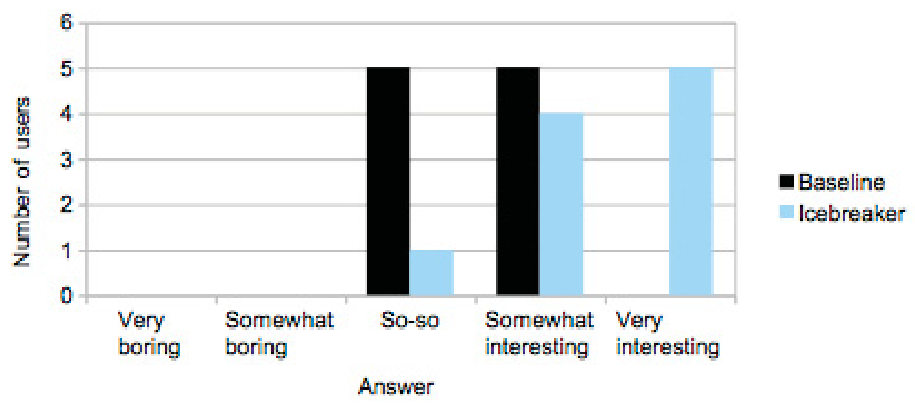
The authors compared their "Icebreaker" system against a baseline that picked random tweets.
Key Findings:
- Interest Retention: The original system scored 4.4/5 in topic interest, compared to 3.5/5 for the baseline.
- Engagement: While the baseline saw 20% of users wanting to end the conversation immediately, 100% of participants using the personalized system said they would continue talking.
- The "Unfamiliarity" Penalty: The study found that sentences containing unfamiliar names or terms significantly lowered appeal, proving that the system's ability to pick familiar interests is its greatest asset.
Critical Insight & Future Outlook
This work demonstrates that context is king. The system’s success isn't just about "socializing"; it's about reducing the cognitive load on the user. By picking a topic the user already knows (extracted via Twitter), the "cost" of starting a conversation drops to nearly zero.
Limitations: The current NLG is rule-based, leading to somewhat repetitive structures. In the age of LLMs, this framework could be exponentially more powerful by using GPT-style models to synthesize the tweet into an even more natural conversational hook.
Takeaway: Future AI assistants won't just wait for your commands; they will "break the ice" using the digital footprints you've already left behind.