
USNB: Breaking the Walled Gardens of Online Social Networks
USNB: Enabling Universal Online Social Interactions
This paper introduces the Universal Social Network Bus (USNB), a middleware solution designed to enable interoperability between siloed Online Social Network Services (OSNSs). By leveraging a service bus paradigm and "Persona" bridges, it allows users to communicate across different platforms (e.g., Facebook to Email) without creating multiple accounts.
TL;DR
The Universal Social Network Bus (USNB) is a middleware prototype that allows users to send messages across different social platforms—such as sending a Slack message from an Email client—without needing an account on the destination platform. By introducing "Personae" that act as protocol translators, USNB achieves social interoperability while respecting user privacy.
Background: The Burden of Multiple Identities
We live in an era of "siloed" social networks. Whether it's the professional focus of LinkedIn or the instant nature of WhatsApp, users are forced to juggle multiple accounts to maintain their "Social Reachability." This fragmentation leads to the Fear of Missing Out (FoMO) and significant management overhead. Prior attempts to solve this, like aggregation services (e.g., Hootsuite), still require users to possess accounts on every platform and hand over their credentials, which creates significant privacy risks.
The Core Insight: Social Reachability
The authors shift the focus from the Social Graph (who you know) to the Social Reachability Graph. They define reachability based on whether a path exists between two users through any social interaction service.
To bridge these gaps, they propose the Universal Social Network Bus (USNB). Instead of forcing every platform to adopt a single standard (which market competition prevents), USNB acts as a "Universal Translator."
Methodology: The Architecture of Interoperability
The system relies on three main components:
- USNB Personae: These are the "bridges." A Persona (e.g., a Twitter Persona) lives in both the USNB ecosystem and the specific OSNS. It translates incoming platform-specific API calls into a unified JSON message format.
- Message-Oriented Middleware (MOM): Using RabbitMQ, the system handles asynchronous communication, ensuring that a message sent from an "offline" service like Email can eventually reach an "online" service like Facebook Messenger.
- Command-Based Interaction: Since third-party developers cannot change the UI of Facebook or Twitter, USNB uses a "Command" syntax (e.g.,
#to={user} Hello!) sent as standard text to trigger the bus logic.
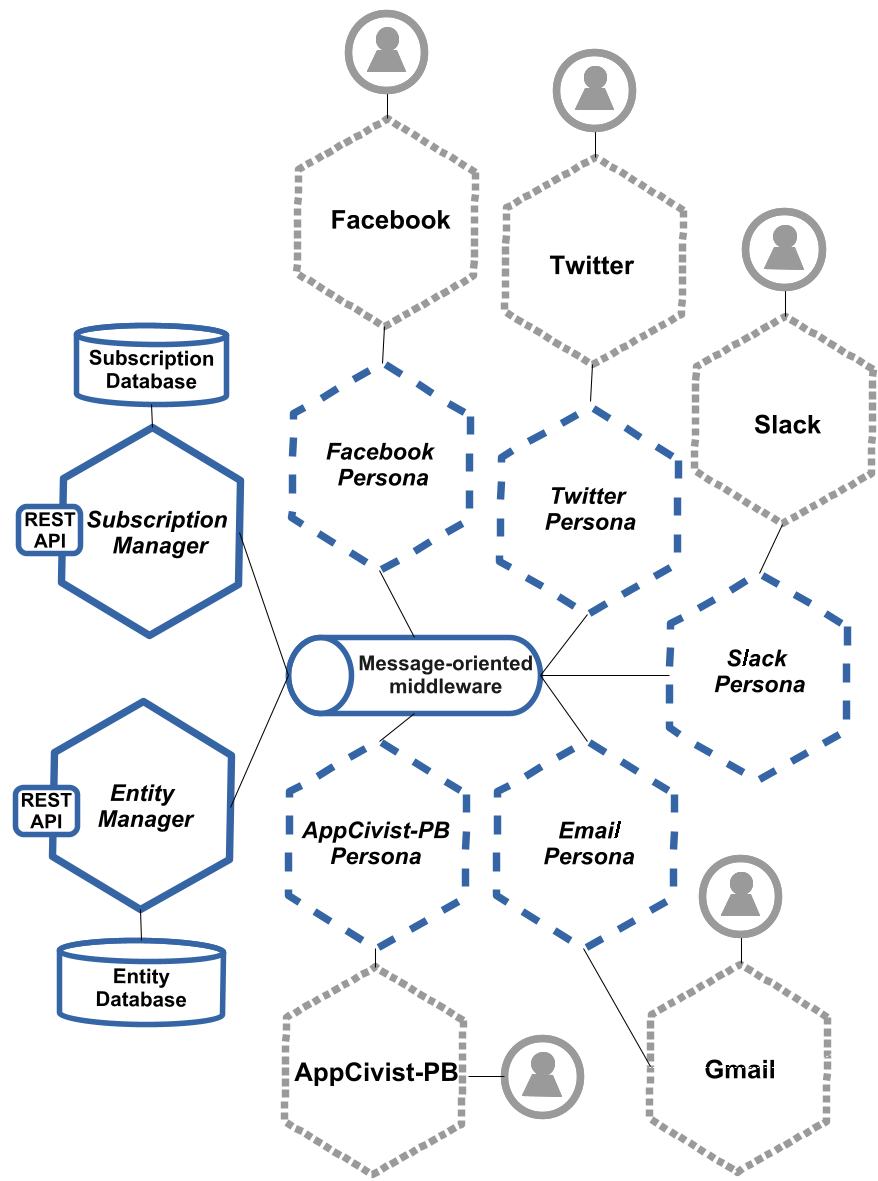 Fig 1: The USNB Prototype Architecture featuring Entity Managers and Personae bridges.
Experimental Validation
The authors conducted a study with 50 participants from 15 countries. Users were tasked with reaching someone on a different OSNS using only their preferred service.
- Success Rate: While the command-line interface had a learning curve (users tried the
#tocommand 2.46 times on average before success), the overall reception was highly positive. - User Sentiment: The "Usefulness" score reached 91.66%, proving that the demand for a unified interaction layer is massive.
- Privacy Advantage: Unlike traditional aggregators, the USNB personae do not ask for user credentials or "Login with Facebook" tokens for the destination service, maintaining a higher level of trust.
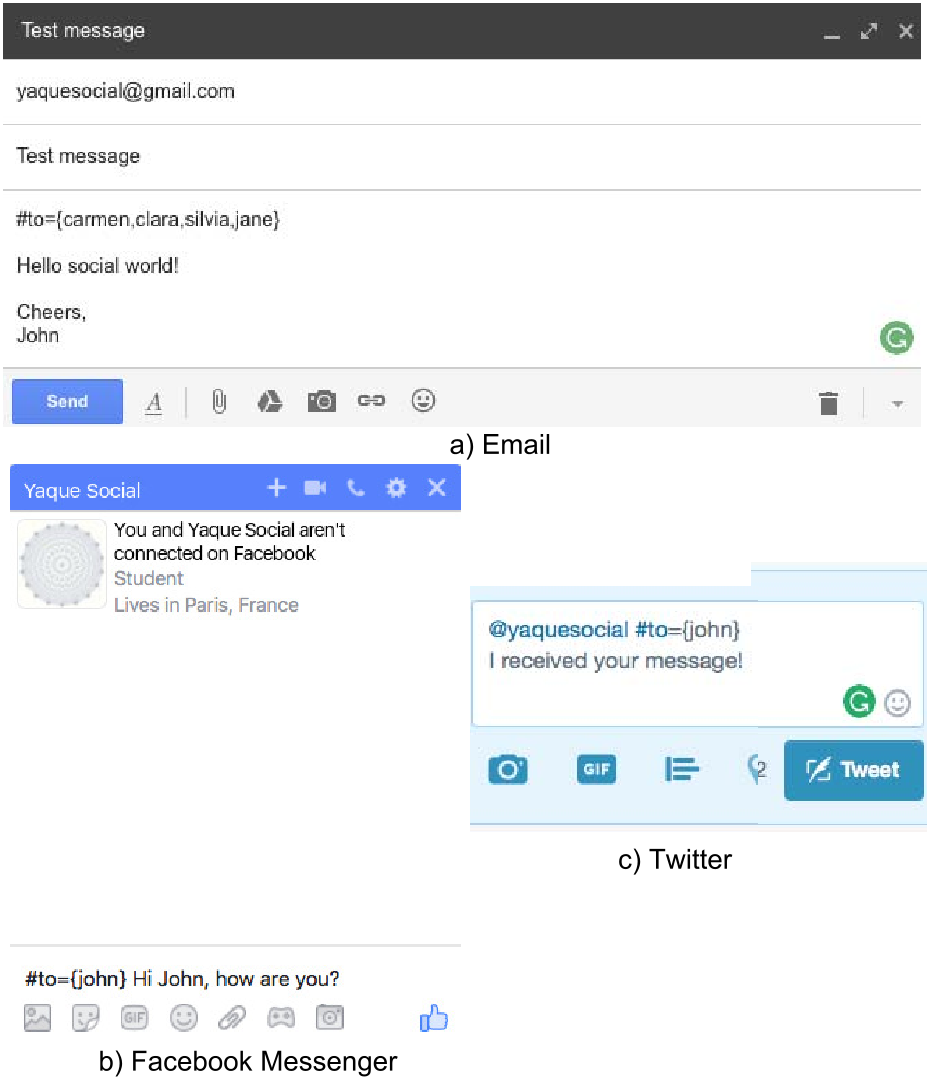 Fig 2: Examples of sending cross-platform messages via Email, Facebook, and Twitter using USNB commands.
Critical Analysis & Future Outlook
Strengths:
- Zero-Account Requirement: The ability to reach a Facebook user without having a Facebook account is a significant step toward "Universal Interaction."
- Privacy-Preserving: By acting as a middleware bus rather than a data scraper, it minimizes the attack surface for personal data leaks.
Limitations:
- API Fragility: The system is heavily dependent on the willingness of OSNS providers to keep their APIs open. As seen with recent changes at Twitter/X and Reddit, "walled gardens" are becoming harder to bridge.
- Interface Constraints: Relying on commands like
#tois less intuitive than a native UI. Future work involving LLMs (Large Language Models) could allow for natural language intent recognition, making the "Personae" much smarter.
Conclusion
USNB proves that the technical barriers to social interoperability are solvable. The challenge remains social and political: will the giants of the OSNS industry allow a "Universal Bus" to disrupt their closed ecosystems? For now, USNB provides a roadmap for a more connected, user-centric digital social life.