
UT-OSANet: A Unified Multimodal Breakthrough in Event-Level Sleep Apnea Diagnosis
UT-OSANet: A Multimodal Deep Learning model for Evaluating and Classifying Obstructive Sleep Apnea
2025-01-01
Summary
Problem
Method
Results
Takeaways
Abstract
This paper introduces UT-OSANet, a multimodal deep learning framework for event-level Obstructive Sleep Apnea (OSA) diagnosis. Leveraging EEG, airflow, and SpO2 signals, it achieves SOTA macro-F1 scores of 0.84–0.85 and high sensitivity (0.93) across five independent large-scale datasets.
## TL;DR
Diagnosing Obstructive Sleep Apnea (OSA) has traditionally been a binary choice: expensive, high-resolution clinical PSG or convenient but inaccurate home screening. **UT-OSANet** shatters this dichotomy. By combining a **Cross-Modality U-Net** with a **Transformer**, and employing a clever **modality masking** training strategy, this model delivers precise, event-level detection of apneas, hypopneas, arousals, and desaturations across any hardware configuration—be it a single EEG channel at home or full-scale monitoring in a lab.
## The Diagnostic Gap: Why Coarse AHI is No Longer Enough
Obstructive Sleep Apnea (OSA) affects up to 25% of certain populations, linked to hypertension, stroke, and cognitive decline. However, the current "gold standard" metric, the **Apnea-Hypopnea Index (AHI)**, is a blunt instrument. It counts events per hour but ignores the nuances of *when* and *how* these events occur—factors critical for modern precision medicine.
Existing AI solutions suffer from **"Modality Rigidity"**: a model trained on airflow and SpO2 fails if a patient’s home sensor only records EEG. Furthermore, most models are validated on small, "clean" datasets that don't reflect the messy variability of real-world clinical and home environments.
## Methodology: The "Local-Global" Hybrid Architecture
UT-OSANet’s architecture is designed to handle the complex, multi-scale nature of physiological signals.
### 1. Cross-Modality U-Net (The "Local" Specialist)
The U-Net backbone acts as a local feature extractor. Unlike standard CNNs that might distort temporal alignment, this module uses 1D convolutions and skip connections to preserve fine-grained temporal information. It captures the immediate "shape" of a breath or an EEG spindle.
### 2. Transformer Encoder (The "Global" Context)
Since a respiratory event in one minute can affect the heart rate or oxygen levels several minutes later, the Transformer uses **Multi-Head Self-Attention (MHSA)** to model long-range temporal dependencies. It learns the "coupling" between modalities—for instance, how a drop in airflow (Apnea) is temporally followed by a dip in SpO2 (Desaturation).
### 3. Modality Dropout: The Robustness Secret
During training, the researchers randomly "mask" modalities. By forcing the model to predict events even when, say, the SpO2 signal is missing, UT-OSANet learns to find redundant information across EEG and airflow. This makes it uniquely "plug-and-play."
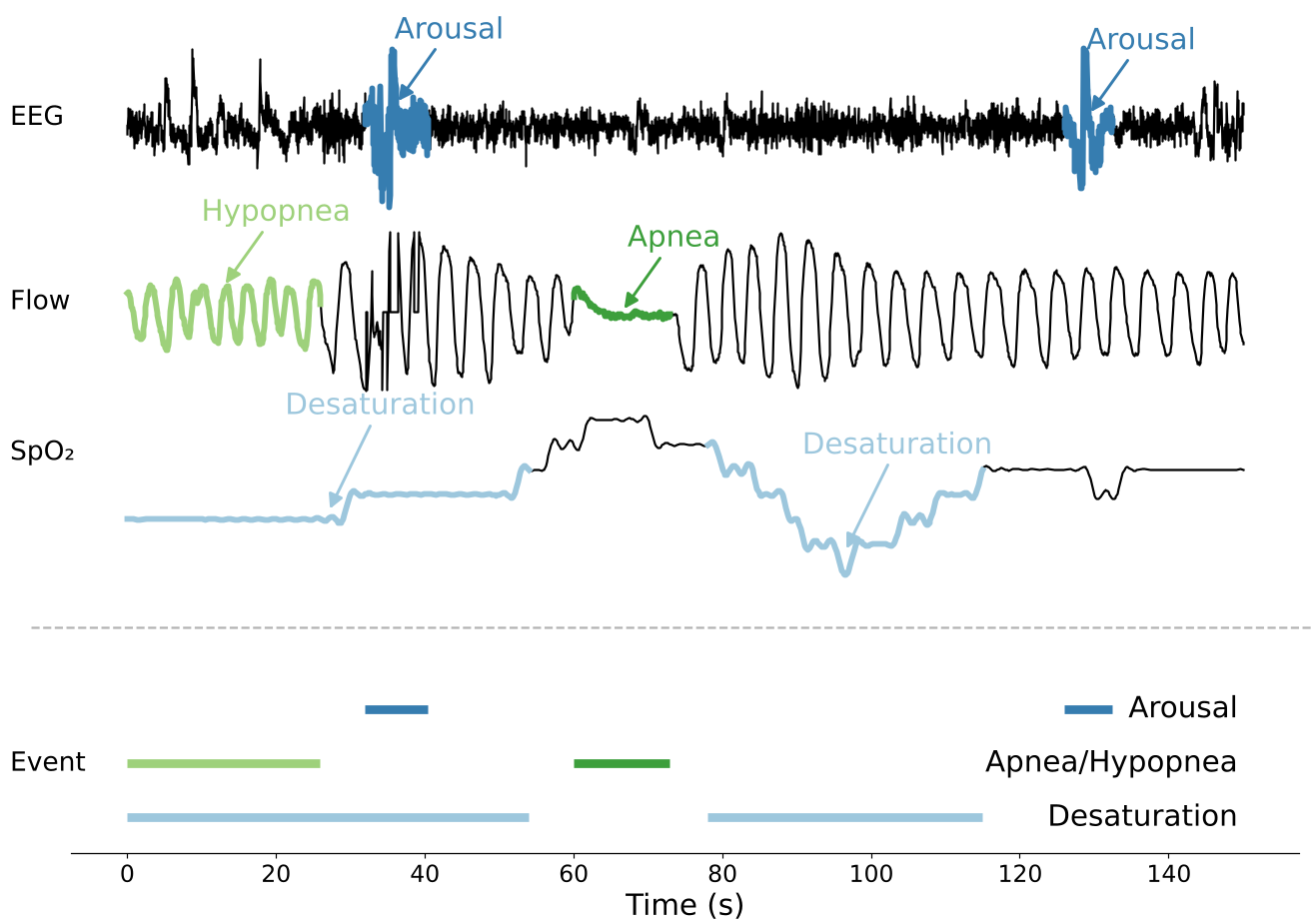
*Fig 1: Synchronized signals showing the temporal coupling between EEG, airflow, and SpO2 captured by the model.*
## Experiments: Scaling to 9,000+ Subjects
The model was put through the ringer using 9,021 recordings from five major independent datasets (MROS, SHHS, MESA, CFS, and HOMEPAP).
- **Clinical Precision**: In clinical settings with full modalities, it achieved **90% accuracy** (MROS) in classifying OSA severity (None, Mild, Moderate, Severe).
- **Home Adaptability**: Using **EEG only** (simulating a wearable headband), the model achieved F1-scores as high as **0.97**, proving that neural signals contain significant "hidden" markers of respiratory distress.
- **Event-Level Resolution**: Unlike models that just give a nightly score, UT-OSANet provides second-by-second labels for four distinct event types, achieving balanced F1-scores of 0.83–0.87.
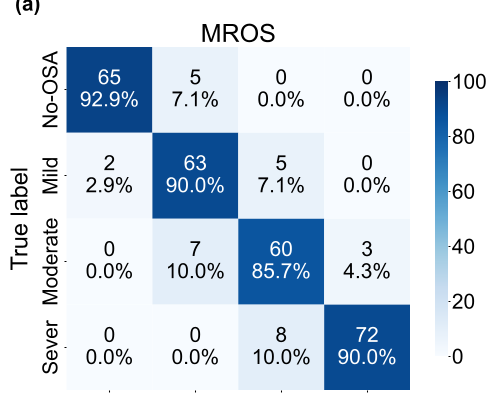
*Fig 2: Confusion matrices demonstrating robust severity classification across multiple heterogeneous datasets.*
## Critical Insights: Why it Works
The synergy between the **U-Net** and **Transformer** solves a classic trade-off: U-Net prevents the "fuzziness" often found in sequence models by locking down the exact start/end times of events, while the Transformer provides the clinical context that prevents false positives (e.g., distinguishing a normal sigh from a hypopnea).
Furthermore, the **t-SNE visualizations** in the paper show that while apnea and desaturation clusters overlap (due to their physiological link), the model effectively separates them from "normal" sleep epochs, justifying the multimodal approach.
## Conclusion & Future Outlook
UT-OSANet is a masterclass in **flexible deep learning**. It addresses the hardware fragmentation of the med-tech industry by providing a single software "brain" that works with whatever sensors are available.
**Limitations**: While performance is high, the model’s accuracy dipped slightly on the HOMEPAP dataset (76%), likely due to the higher noise levels in home-acquired data. Future iterations may need to incorporate explicit "uncertainty estimation" to alert clinicians when signal quality is too low for a reliable diagnosis.
**The Takeaway**: For researchers, this provides a tool to study the *mechanisms* of OSA. For industry, it provides a blueprint for the next generation of high-accuracy, low-friction home sleep monitors.