
Balancing Privacy and Utility: A New Frontier in Social Network Anonymization
Utility-aware social network graph anonymization
2015-06-12
Summary
Problem
Method
Results
Takeaways
Abstract
This paper introduces a utility-aware social network graph anonymization method focusing on identity re-identification attacks. It proposes a novel metric called Utility Preserving Magnitude (UPM) to balance the trade-off between vertex privacy (k-degree anonymity) and structural data utility.
## TL;DR
In an era of massive social data sharing, protecting individual identities while keeping the data "useful" is a zero-sum game. This paper introduces a **Utility-aware Social Network Graph Anonymization** approach that replaces simple "edit distance" metrics with a sophisticated **Utility Preserving Magnitude (UPM)** score. By focusing on shortest paths and neighborhood overlaps, it ensures that an anonymized graph behaves structurally like the original.
## The Core Challenge: Why "Minimal Change" Isn't Enough
Most existing privacy models, such as **k-degree anonymity**, aim to make every vertex indistinguishable from at least $k-1$ others by adding or deleting edges. The standard optimization goal has been to minimize the *total number of edges changed*.
However, the authors point out a critical flaw: **all edge changes are not created equal.** Removing a "bridge" edge that connects two large communities increases the path length significantly more than removing an edge within a dense cluster. If we only count the *number* of changes, we risk destroying the graph's fundamental properties, such as the "Small World" effect or community hierarchies.
## Methodology: The UPM Metric
The authors' primary contribution is the **Utility Preserving Magnitude (UPM)**, a weight factor used to guide the heuristic edge perturbation process.
### 1. Shortest Path Difference (SPD)
SPD measures how much the distance between two vertices changes after a modification. In the case of deletion, the algorithm looks for the "second shortest path." If a second path is nearly as short as the first, the edge is "expendable."
### 2. Neighborhood Overlap (NO)
Based on the intuition that edges within a community are more redundant than those between communities, the NO metric quantifies link strength. High overlap suggests that even if an edge is removed, the local connectivity remains robust.
### 3. The UPM Formula
The metrics are combined into the UPM score:
$$UPM(v, u) = \frac{1}{[SPD(v, u) + NO(v, u)]}$$
The algorithm greedily selects candidates with the **highest UPM** to ensure the "Nearest Graph" requirement is met not just in terms of edge count, but in functional integrity.
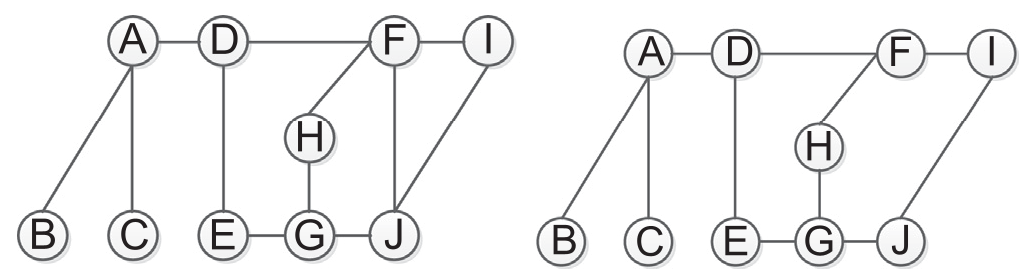
*Fig 1. Visualizing the transformation from an original graph (left) to an anonymized version (right) where degrees are clustered to satisfy k-anonymity.*
## Experimental Insights
The authors tested their approach on diverse topologies, including **Scale-Free (SF)** and **Random Graphs (RA)**.
### Key Findings:
* **Average Path Length (APL):** On the PolBook dataset, the UPM approach significantly outperformed the baseline, preserving the APL much closer to the original values even as $k$ (privacy requirement) increased.
* **Strategy Comparison:** The study found that a **Combined Strategy** (allowing both addition and deletion) provides the best balance for maintaining the **Average Clustering Coefficient (ACC)**.
* **Dataset Robustness:** Random graphs were found to be most robust to anonymization, while structured networks like "Jazz musicians" collaborated in a way that made their structural utility more sensitive to perturbation.
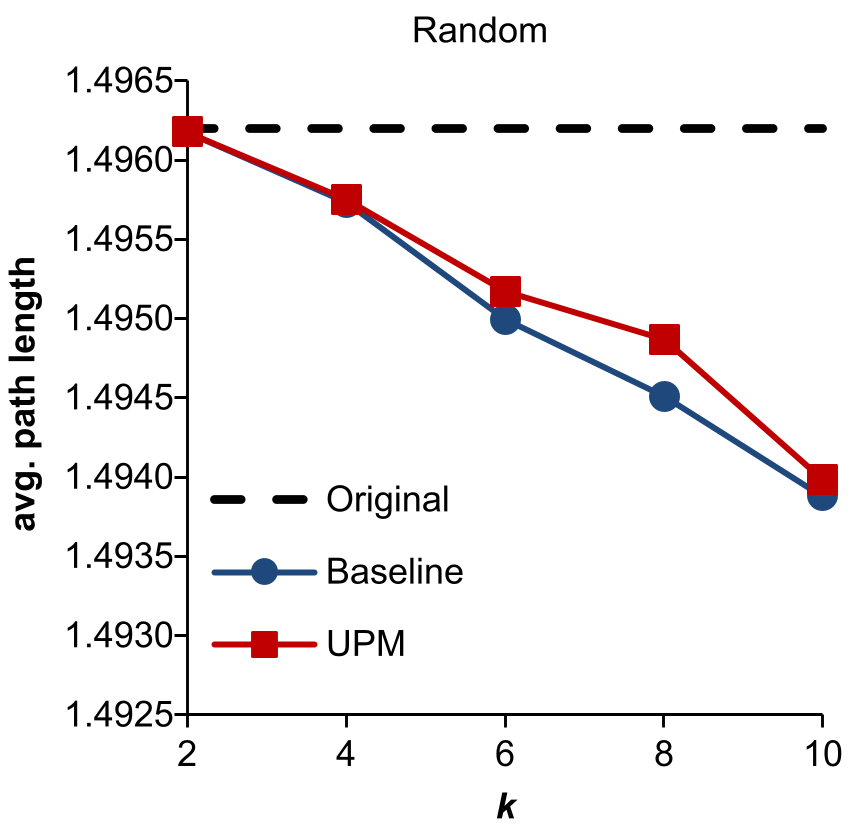
*Fig 2. Comparison of Average Path Length across different datasets. The UPM method (squares) consistently stays closer to the original baseline (dashed line) than the traditional greedy method (circles).*
## Critical Analysis & Conclusion
**Takeaway:** This work successfully shifts the focus from "data volume" (how many edges) to "data topology" (which edges). By utilizing UPM, data publishers can release social networks that remain valid for high-level statistical analysis while strictly adhering to privacy constraints.
**Limitations:** The primary drawback is **computational complexity**. Calculating shortest paths iteratively for all modification candidates is significantly more expensive than simple degree matching. While the authors optimized Dijkstra, the method may struggle with massive graphs (millions of nodes) without further approximation or parallelization.
**Future Work:** The next step in this evolution will likely involve **Graph Embedding** and **Generative Models**, where synthetic graphs are generated to match the latent distributions of the original, rather than perturbing the raw edges.