
Generative Social Structures: Why Rational Choice Doesn't Always Lead to the "Best" Network
Utility and dynamic social networks
This paper presents a dynamic process model of utility-maximizing social actors in networks using multi-agent simulation. By implementing the Jackson-Wolinsky utility function, it identifies how different tie-formation rules (unilateral vs. mutual) and initial conditions generate stable structures like stars, rings, and complete networks.
TL;DR
How do individual choices aggregate into social structures? By simulating "rational" actors seeking to maximize their own utility, Norman P. Hummon reveals that the path to a stable network is often dictated by the rules of engagement (unilateral vs. mutual consent) and pure chance. While economic theory predicts "optimal" stars or complete networks, dynamic simulations show that many groups get stuck in "near-optimal" shared structures.
Problem & Motivation: The Gap Between Math and Reality
In network science, we often talk about SOTA (State-of-The-Art) structures—the most "efficient" way for a group to organize. Economic models, such as the famous Jackson-Wolinsky (1996) theory, use comparative statics to prove that under certain cost-benefit ratios, a "Star" network is the most efficient configuration.
However, these theories often treat the network as a finished product. They ignore the Inductive Bias of the process itself:
- Reachability: Just because a "Star" is efficient doesn't mean a group of independent actors can actually build one starting from scratch.
- Path Dependency: Does the order in which people make friends change the final shape of society?
- Consent: Does requiring mutual agreement to form a bond prevent the group from reaching its theoretical peak efficiency?
Methodology: Simulating the Rational Agent
Hummon utilizes an Agent-Based Model (ABM) where each actor calculates its utility () based on:
- Benefits (): Value gained from direct and indirect ties (decaying with distance).
- Costs (): A fixed penalty for every direct link maintained.
The core of the methodology lies in the Tie Change Rules:
- Unilateral (UA/UD): You can add or drop a friend without their permission.
- Mutual (MA/MD): You can only form a tie if it benefits (or doesn't hurt) the other person.
The Decision Logic
The simulation moves through time using a Discrete Event Model, where actors weigh five options: do nothing, add a specific tie, or delete a specific tie.
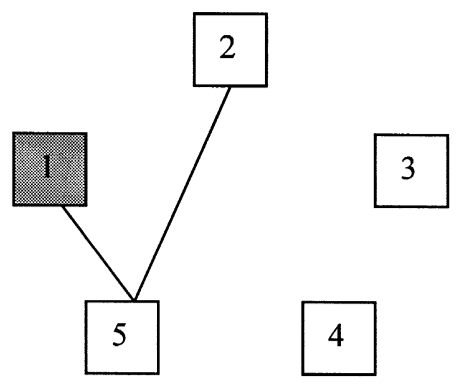 In this example, Actor 1 scans possible network changes to find the one that spikes their personal utility from 0.35 to 0.40.
Experiments & Results: The "Star-First" Hypothesis
By running thousands of Monte Carlo trials, Hummon discovered a fascinating trend: groups often exhibit a "star-first" dynamic. Early on, a leader (a central hub) emerges, forming a star structure. Depending on the costs, this either remains stable or transforms into a "complete" network where everyone is connected.
The Efficiency-Stability Trade-off
One of the most striking findings is that the "Strongly Efficient" star predicted by economists is often unstable for the person at the center.
- The central actor in a star often has a lower utility than the people on the periphery because they bear all the cost of maintenance.
- Under Unilateral rules, this actor would flee the center.
- Under Mutual rules, "Shared" or "Ring" structures (seen as light-gray or dark-gray in the grid maps below) become far more common.
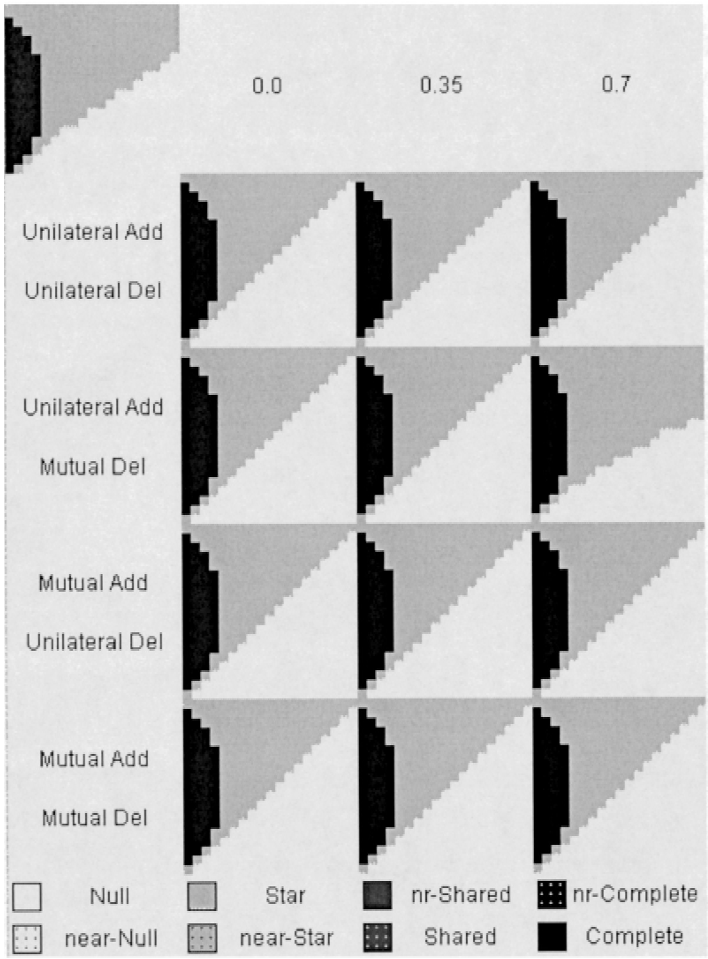 Grid maps showing how group size (N=3 to 10) and rules shift the outcome from Star (light gray) to Complete (black) or Shared (dark gray).
Critical Insight: The Inequality of the Star
The paper introduces a crucial discussion on Side Payments. To keep a star network stable (like an academic department chair or a corporate manager), the peripheral actors must essentially "pay" the central actor to compensate for their high maintenance costs. Without these payments, pure rationality often leads to "Near-Shared" structures which, while less efficient for the group as a whole, are more equitable and stable for the individuals.
Conclusion & Future Work
Hummon’s work proves that Social Process generates Social Structure. The "Optimal" is not always achievable.
- Takeaway for Researchers: When modeling social networks, the "rules of tie formation" are just as important as the utility function itself.
- Limitation: The current model assumes perfect information (every actor knows the whole network), which is rarely true in large-scale social systems.
- Future Prospects: Investigating how "coercive" ties or limited information horizons (local search) might further diverge from theoretical ideals.
Editor’s Note: This paper is a masterclass in using simulation to stress-test abstract economic theories, showing that the "rationality" of the individual and the "efficiency" of the group are often at odds.