
Preserving the Pulse of Social Circles: A Utility-Oriented Approach to K-Anonymity
Utility-Oriented K-Anonymization on Social Networks
The paper introduces a Utility-Oriented K-Anonymization scheme for social networks, utilizing a Hierarchical Random Graph (HRG) model and Hierarchical Community Entropy (HCE). It aims to satisfy k-degree anonymity while minimizing structural distortion, specifically targeting the preservation of community hierarchies rather than just minimizing edge counts.
TL;DR
Releasing social network data for research without leaking individual identities is a delicate balancing act. While k-anonymity is a standard for privacy, its implementation often mangles the network's structure. This paper introduces a breakthrough method that uses Hierarchical Random Graphs (HRG) and Community Entropy to ensure that while nodes become anonymous, the fundamental "shape" and community structure of the social network remain intact.
Background: Why Simple Edge Counting Fails
When we anonymize a graph to prevent Identity Disclosure, we usually modify edges until every node shares the same structural signature (like degree) with at least others.
The fatal flaw in prevailing methods (like Greedy Swap or Probing) is their metric of success: the number of edges modified. They assume that adding an edge between two strangers in the same small community is the same as adding an edge that bridges two completely different social circles. In reality, the latter is far more destructive to the network's utility—it blurs boundaries that researchers need for community detection and influence modeling.
The Core Insight: Community-Aware Utility
The authors argue that the "Utility" of a graph is tied to its Hierarchical Community Structure. To capture this, they leverage the Hierarchical Random Graph (HRG) model.
1. Modeling with HRG
An HRG is a binary tree where leaves are the original nodes and internal nodes represent relationships. Each internal node has a connection probability . This provides a "blueprint" of how communities nest within each other.
2. Hierarchical Community Entropy (HCE)
To quantify the information held in this structure, the authors propose HCE:
This formula views the utility loss as the delta in entropy. If an edge modification drastically changes at a high level of the tree (bridging major communities), the utility loss is high.
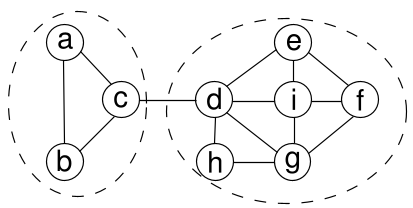 In the figure above, G2 is preferred over G1 because it respects the existing community clusters despite both adding exactly one edge.
Methodology: The HRG-Based K-Anonymization
The algorithm works by estimating a target "nearest" k-anonymized degree sequence and then iteratively applying operations that move the current graph toward while minimizing HCE change.
Key Innovation: The "Edge Shift"
Beyond simple insertion and deletion, the authors introduce the Edge Shift. By moving an edge's endpoint to another node within the same sub-community, the degree of the nodes changes (satisfying privacy needs), but the number of crossing edges between major communities remains constant. This keeps the HCE—and thus the utility—stable.

Experimental Results: Structural Integrity
The authors tested their approach against "Prob." and "Swap" methods on DBLP and Dogster datasets. The results were stark:
- Entropy Preservation: The HCE change ratio for the HRG method was nearly zero (~0.1%), while other methods caused massive structural shifts.
- Topological metrics: Traditional metrics like Clustering Coefficient (CC) and Average Path Length (APL) were preserved much more accurately by the HRG method.
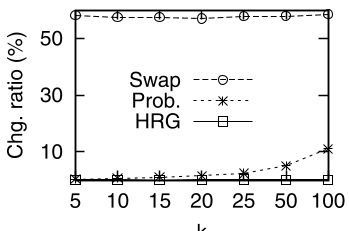 The charts clearly show that as graph size or 'k' increases, HRG (the blue line) remains consistently low in utility loss compared to competitors.
Critical Insight & Conclusion
Most privacy research treats a graph as a flat collection of edges. This paper's strength lies in recognizing that graphs are hierarchical. By prioritizing "Edge Shifts" and monitoring "Community Entropy," we can release data that is both safe for the individual and valuable for the scientist.
Limitations: The greedy nature of the algorithm and the bottom-up construction of HRGs might not always reach the absolute global optimum for extremely large-scale networks. However, the performance-to-utility ratio presented here sets a new benchmark for structural k-anonymity.