
The Privacy Paradox: Can AI Solve "Context Collapse" on Social Media?
Exploring the Utility Versus Intrusiveness of Dynamic Audience Selection on Facebook
This paper introduces Dynamic Audience Selection (DAS), an AI-powered control mechanism for Facebook that allows users to specify post-specific audiences using natural language constraints (e.g., "+ friends who like basketball"). The study evaluates the trade-off between the utility of granular privacy controls and the intrusiveness of algorithmic inferences, comparing it against traditional static controls.
Executive Summary
TL;DR: Researchers from Georgia Tech explored a radical shift in social media privacy: Dynamic Audience Selection (DAS). Instead of choosing "Friends" or "Public," imagine typing + friends who like horror movies - family. While this AI-driven approach significantly reduces self-censorship and makes posting more efficient, it introduces a "creepiness factor"—users worry about algorithmic errors and the platform knowing too much about their social circles.
Academic Positioning: This work bridges the gap between Human-Computer Interaction (HCI) and Social Computing. It moves beyond identifying that "static controls are broken" to evaluating whether AI-driven dynamism is a cure or a new kind of privacy poison.
The Problem: The "Invisible Audience" Curtain
Posting to Facebook today is like speaking from behind a curtain; you know the guest list, but you don't know who is actually sitting in the front row. Current controls are:
- Static: Lists you made three years ago don't apply to a post today.
- Coarse: "Friends" includes your boss, your high school teacher, and your best friend.
- High Friction: Creating a custom list for a single post about a specific hobby takes too much time, leading users to simply self-censor.
Methodology: Designing the "DAS" Prototype
The researchers designed a prototype that adds an "Audience Box" directly beneath the post composer.
The +/- Notation Logic
The core innovation is a simple, expressive syntax for inclusion and exclusion:
+(Inclusion): Target specific traits (e.g.,+ grad students).-(Exclusion): Filter out unwanted segments (e.g.,- relatives).
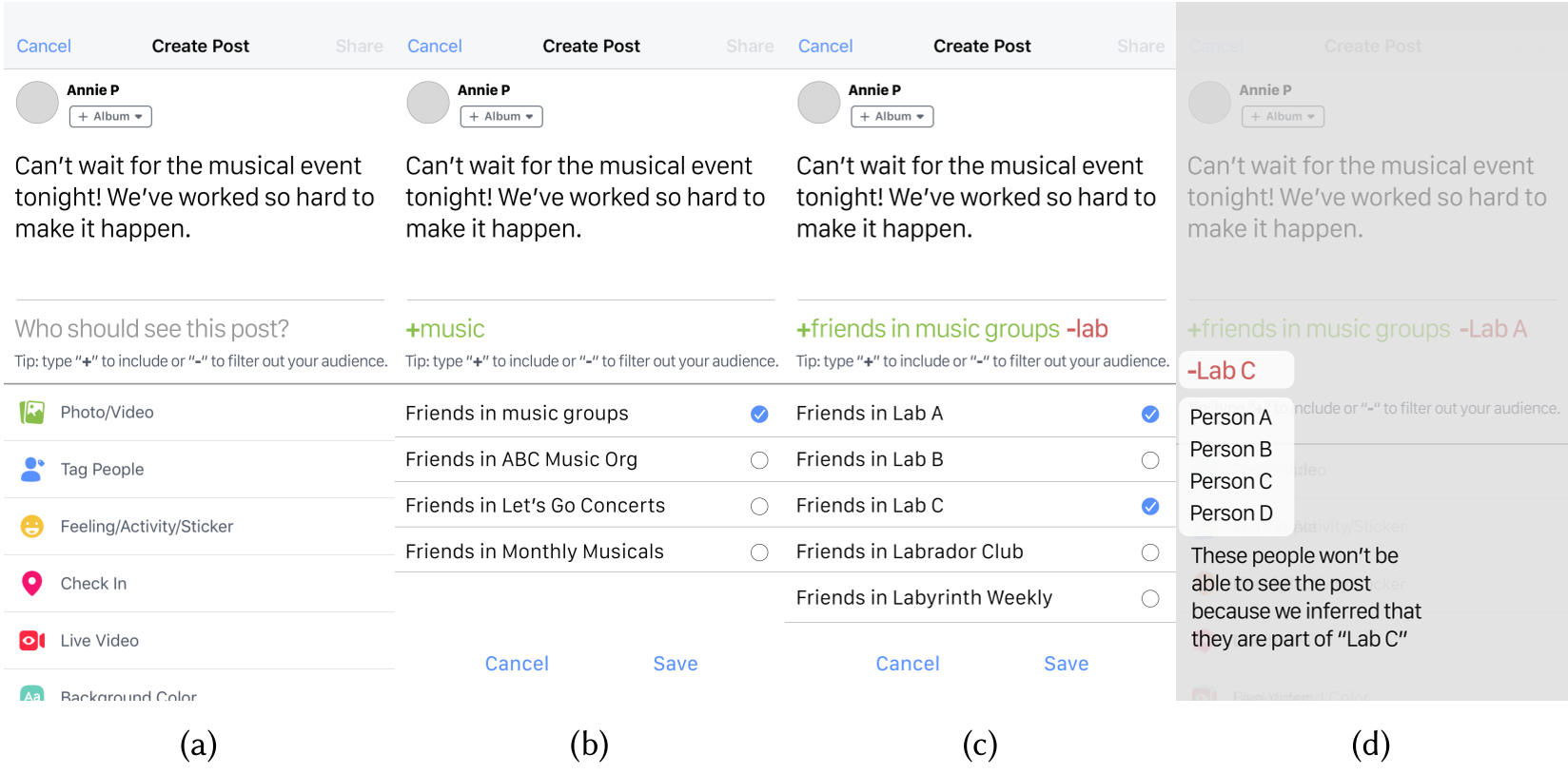
The back-end assumes an AI engine capable of semantic search and trait inference. If you type "people who like basketball," the AI scans interaction data to populate a real-time list, which the user can then "sanity check" before hitting post.
Critical Results: The Utility-Intrusiveness Trade-off
The study revealed a fascinating split in user perception based on the stakes of the post.
1. The Utility Gains (Low-Stakes)
For low-stakes scenarios (e.g., finding friends to watch a TV show), DAS was a winner.
- Enlightenment: Users discovered friends with shared interests they didn't know existed.
- Empowerment: Users felt they could post niche content without "annoying" their broader network.
2. The Creepiness Factor (High-Stakes)
For sensitive topics like mental health or political fundraising, the "Privacy Personalization Paradox" emerged.
- Side-Channels: A user might realize a friend is "politically conservative" only because the AI included them in a specific filter—a revelation the friend might not have wanted.
- Algorithmic Distrust: Participants feared a "false positive" (e.g., their boss being mistakenly tagged in a private mental health post).
Deep Insight: Is DAS a Viable Path Forward?
The paper concludes that while a fully dynamic, post-by-post AI is expressive, it might be too unpredictable for the average user.
The Hybrid Solution: The authors suggest a "low-tech" middle ground. Instead of full dynamism, AI could suggest pre-defined, reusable smart lists. This gives users the scalability of AI with the predictability of static lists.
Limitations and Ethics
One major hurdle is Accountability. If the AI makes a mistake and a sensitive post reaches the wrong person, who is to blame? Furthermore, if Facebook uses these audience-selection inferences to further hone their Ad Targeting algorithms, the "intrusiveness" cost may simply be too high for users to pay.
Final Takeaway
AI can solve the efficiency problem of social media privacy, but it cannot yet solve the trust problem. Future privacy tools must focus on transparency—explaining why a person was included in a group—before users will feel safe handing over the "curtain" to an algorithm.