
V-JEPA 2.1: Bridging the Gap Between World Models and Dense Visual Understanding
V-JEPA 2.1: Unlocking Dense Features in Video Self-Supervised Learning
V-JEPA 2.1 is a state-of-the-art self-supervised learning family for unified image and video representation, introducing a Dense Predictive Loss and Deep Self-Supervision to bridge the gap between global semantic understanding and fine-grained dense features. It achieves SOTA results on benchmarks like Ego4D (7.71 mAP) and NYUv2 (0.307 RMSE), while significantly enhancing performance in robotic manipulation and navigation.
TL;DR
The FAIR team at Meta has released V-JEPA 2.1, a massive upgrade to their self-supervised video modeling framework. By fundamentally rethinking how latent prediction is applied—moving from "masked-only" to "dense" supervision—they have produced a model that finally reconciles high-level action recognition with low-level geometric precision. The result is a 2-billion parameter backbone that dominates across ego-motion anticipation, monocular depth estimation, and zero-shot robotics.
The Problem: The "Global-Local" Trade-off in Video SSL
Historically, self-supervised learning (SSL) has been split into two camps:
- Image-centric (e.g., DINOv2): Great at "dense" tasks like segmentation and depth, but "temporal-blind." They don't understand the physics of a moving world.
- Video-centric (e.g., V-JEPA 2 / VideoMAE): Excellent at action recognition and dynamics, but their features are "noisy." When you look at their internal PCA feature maps, the spatial layout is fragmented.
The authors discovered a critical flaw in traditional JEPA: by only supervising the masked patches, the model uses the unmasked (context) patches as "garbage collectors" for global information, ignoring their local spatial structure.
Methodology: High-Quality Features Through Dense Latent Supervision
V-JEPA 2.1 introduces three architectural shifts to solve the noise problem:
1. Dense Predictive Loss
The core Innovation: instead of only predicting what's missing, V-JEPA 2.1 also supervises the visible context. By applying a distance-weighted L1 loss to the context tokens, the model is forced to ground every token in its specific spatio-temporal location.
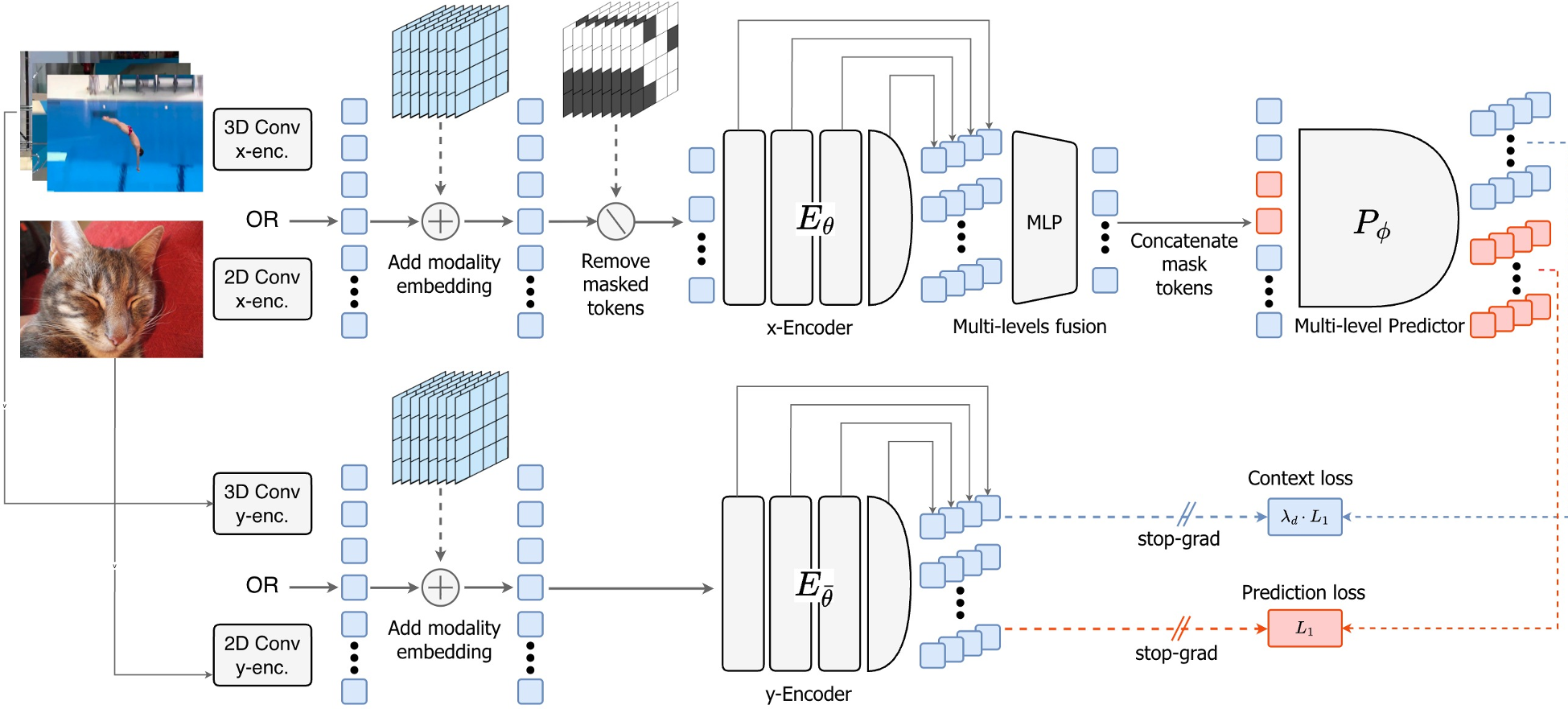 Figure 1: The V-JEPA 2.1 architecture featuring modality-specific tokenizers and the multi-level predictor used for deep self-supervision.
2. Deep Self-Supervision
The authors found that supervision at the final layer isn't enough for 2B+ parameter models. They applied the JEPA objective hierarchically across intermediate layers. This ensures that local geometric information persists throughout the network, rather than getting "pooled away" into global semantics.
3. Multi-Modal Tokenizers
Unlike previous versions that treated images as "static 1-frame videos" (inefficient and biased), V-JEPA 2.1 uses a 2D Conv for images and a 3D Conv for videos. This allows the model to learn from both LVD-142M (images) and YT-1B (videos) natively.
Experiments: SOTA Across the Board
The "magic" of V-JEPA 2.1 is best seen in its PCA feature visualizations. Unlike the noisy maps of its predecessor, V-JEPA 2.1 segments objects (like car wheels or dog heads) with surgical precision using purely self-supervised features.
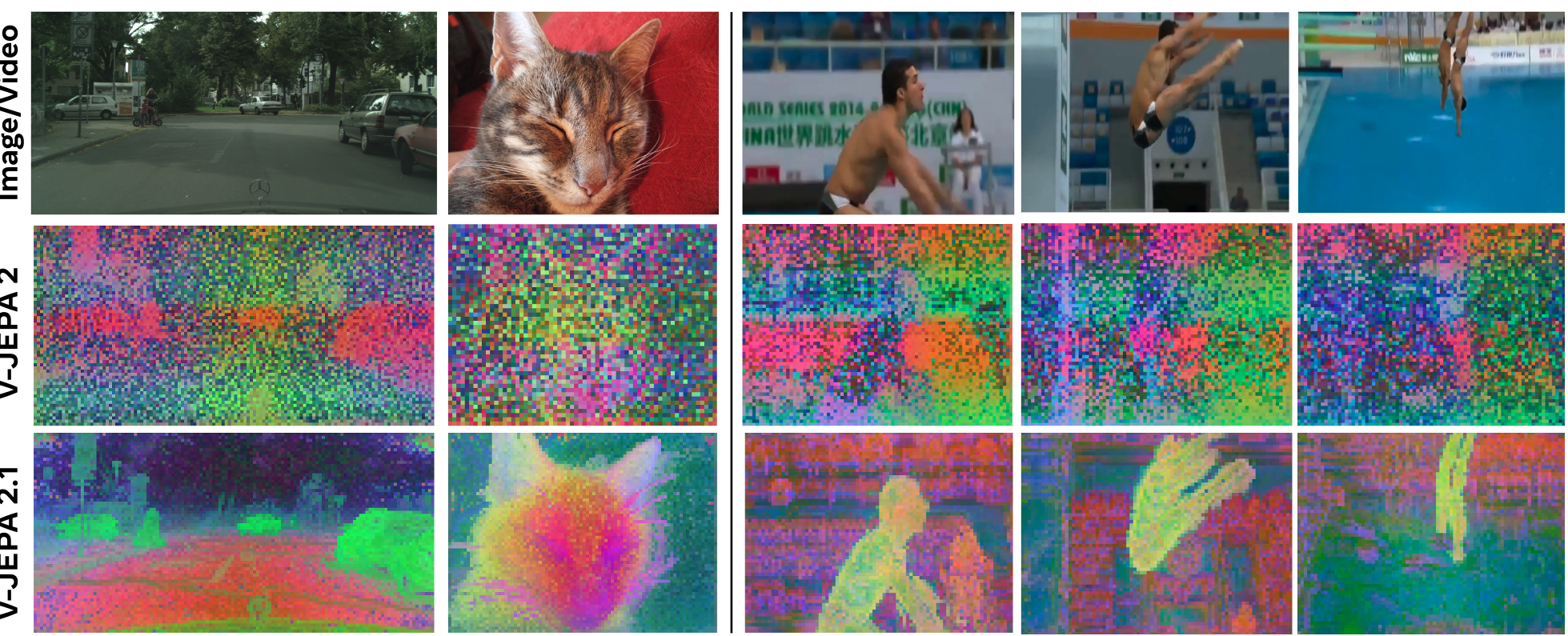 Figure 2: Top PCA components mapped to RGB. Note the semantic coherence and sharp boundaries in V-JEPA 2.1 compared to the previous version.
Key Breakthroughs:
- Robotics: 20% absolute increase in success rate for zero-shot grasping on Franka arms.
- Depth Estimation: Achieved 0.307 RMSE on NYUv2, outperforming specialized image encoders like DINOv3 with a simple linear probe.
- Action Recognition: SOTA 77.7% on Something-Something-v2, proving that adding local precision DOES NOT hurt global understanding.
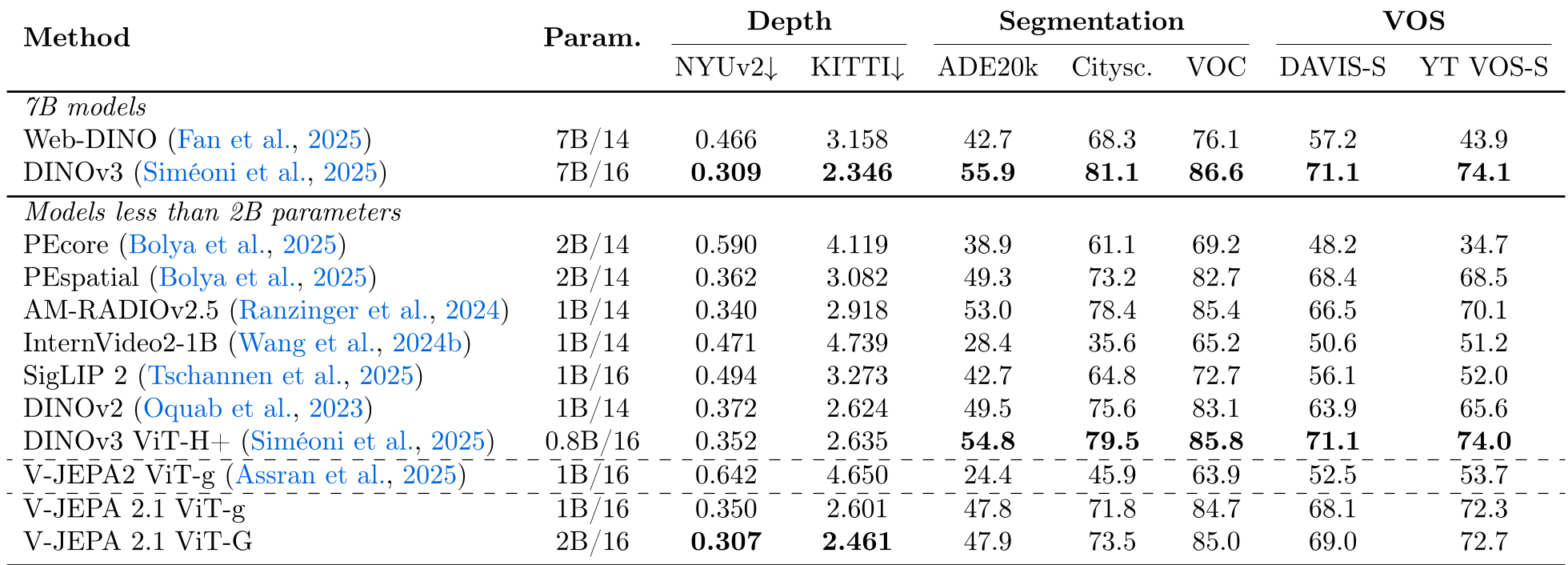 Table 1: Performance comparison across depth, segmentation, and video object segmentation (VOS).
Critical Insight: Why This Matters for World Modeling
The industry is moving toward "World Models" for autonomous agents. A world model needs to predict the future, but you can't predict a robot's hand moving toward a cup if the model doesn't know exactly where the cup ends and the table begins.
V-JEPA 2.1 proves that non-generative (latent) models can be just as precise as generative ones, while being orders of magnitude faster. By replacing a standard VAE with V-JEPA 2.1 features, the authors reduced navigation planning time by 10x (from 103 seconds to 10 seconds).
Limitations & Future Work
While V-JEPA 2.1 is a massive leap, it still stays slightly behind the best image-only encoders on highly cluttered datasets like Cityscapes. The authors suggest that future scaling to 7B parameters and even more curated video data will likely bridge this final gap.
Conclusion
V-JEPA 2.1 is more than just a training update; it's a validation of the JEPA philosophy. It proves that predictive latent modeling is a robust path toward artificial agents that can perceive, reason, and act in the physical world with both semantic wisdom and geometric accuracy.