
[CVPR 2026] V-JEPA 2.1: Bridging the Gap Between Semantic World Models and Dense Perception
V-JEPA 2.1: Unlocking Dense Features in Video Self-Supervised Learning
V-JEPA 2.1 is a family of self-supervised models (ViT-g to ViT-G) that achieves state-of-the-art results in both dense and global visual understanding by predicting masked representations of images and videos. The model reaches SOTA on benchmarks like Ego4D (7.71 mAP) and Something-Something-V2 (77.7% accuracy) while significantly improving monocular depth estimation and semantic segmentation.
TL;DR
V-JEPA 2.1 represents a major evolution in Video Self-Supervised Learning (SSL). By introducing a Dense Predictive Loss and Deep Self-Supervision, this model family (up to 2B parameters) finally solves the "noisy feature" problem inherent in previous masked modeling approaches. It delivers a unified representation that is simultaneously a semantic powerhouse for action recognition and a high-precision engine for depth estimation and robotic planning.
Positioning: This is a SOTA-scaling work that refines the JEPA (Joint Embedding Predictive Architecture) framework, transforming it from a global-only video understander into a versatile backbone for both dense vision and embodied AI.
The Core Conflict: Why Dense Features are Hard
The original V-JEPA and similar masked-modeling approaches (like VideoMAE) had a fundamental flaw: The Registry Effect. Because the loss only penalized the model for its predictions of masked regions, the visible (context) tokens were never explicitly supervised. Consequently, the encoder learned to use these tokens as "global aggregators" or registers rather than localized descriptors.
The result? Feature maps that looked like noise when visualized via PCA, making tasks like monocular depth estimation (RMSE > 0.6) and semantic segmentation (mIoU ~22%) nearly impossible without heavy fine-tuning.
Methodology: The "All-Token" Supervision
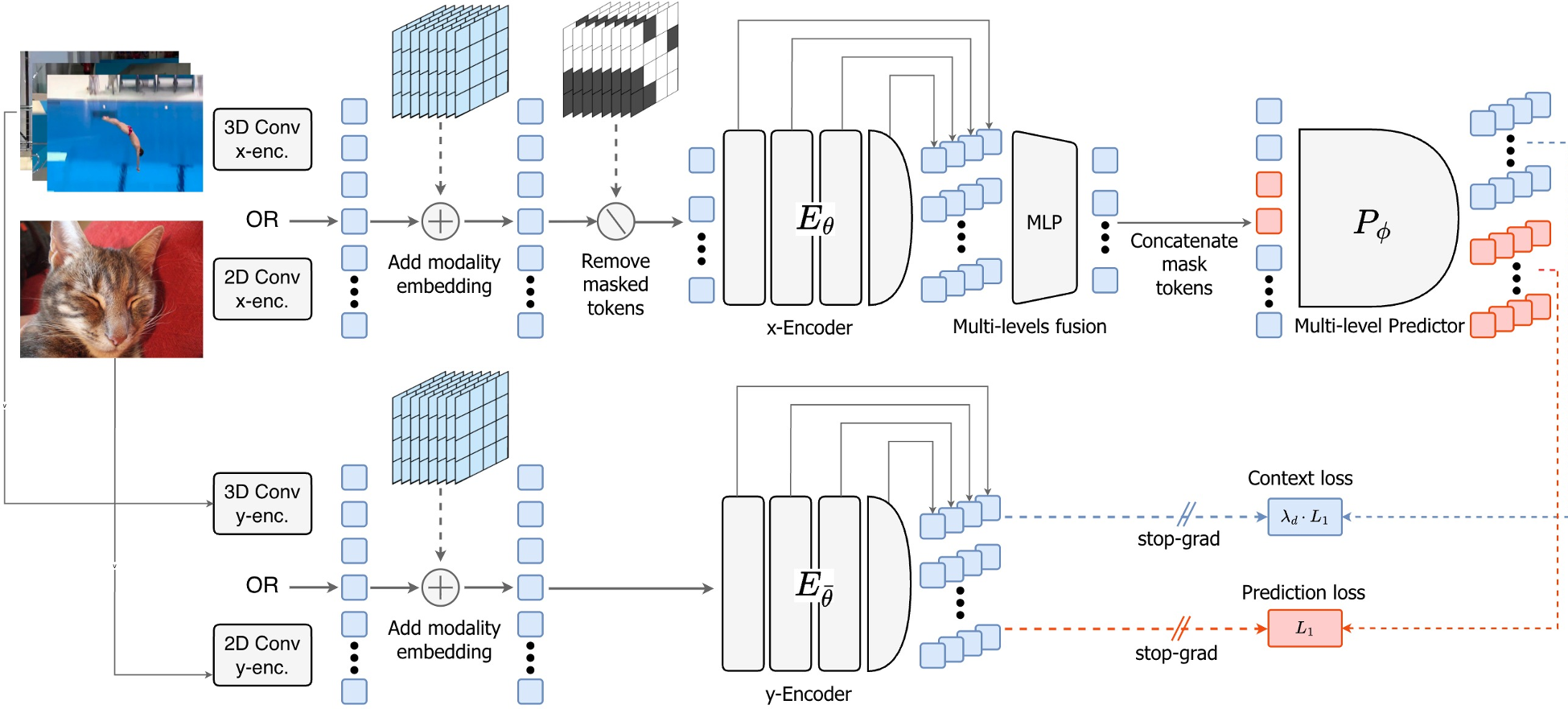
V-JEPA 2.1 introduces three architectural shifts to unlock dense perception:
1. Dense Predictive Loss ()
Instead of just predicting the "hole," the model now predicts the "whole." It applies a loss to the context (visible) tokens too. To prevent the model from finding a trivial "copy-paste" solution, they use a distance-weighted scheme: patches closer to the boundary of a masked region receive higher weight, forcing the model to learn local continuity.
2. Deep Self-Supervision
The training signal is no longer just at the final layer. The authors concatenate features from 4 intermediate levels [12, 24, 36, 48 for ViT-G] and feed them into an MLP. This ensures that fine-grained spatial information doesn't "wash out" in the deeper layers.
3. Multi-Modal Tokenizer
Previous versions treated images as static 16-frame videos—a massive waste of compute. V-JEPA 2.1 uses a 2D Conv for images and a 3D Conv for videos, allowing joint training on massive datasets like VisionMix-163M (combining LVD-142M images and YT-1B videos) with native efficiency.
Experimental Powerhouse: From Pixels to Planning
The results of V-JEPA 2.1 are remarkably consistent across the vision hierarchy.
Dense Task Evolution
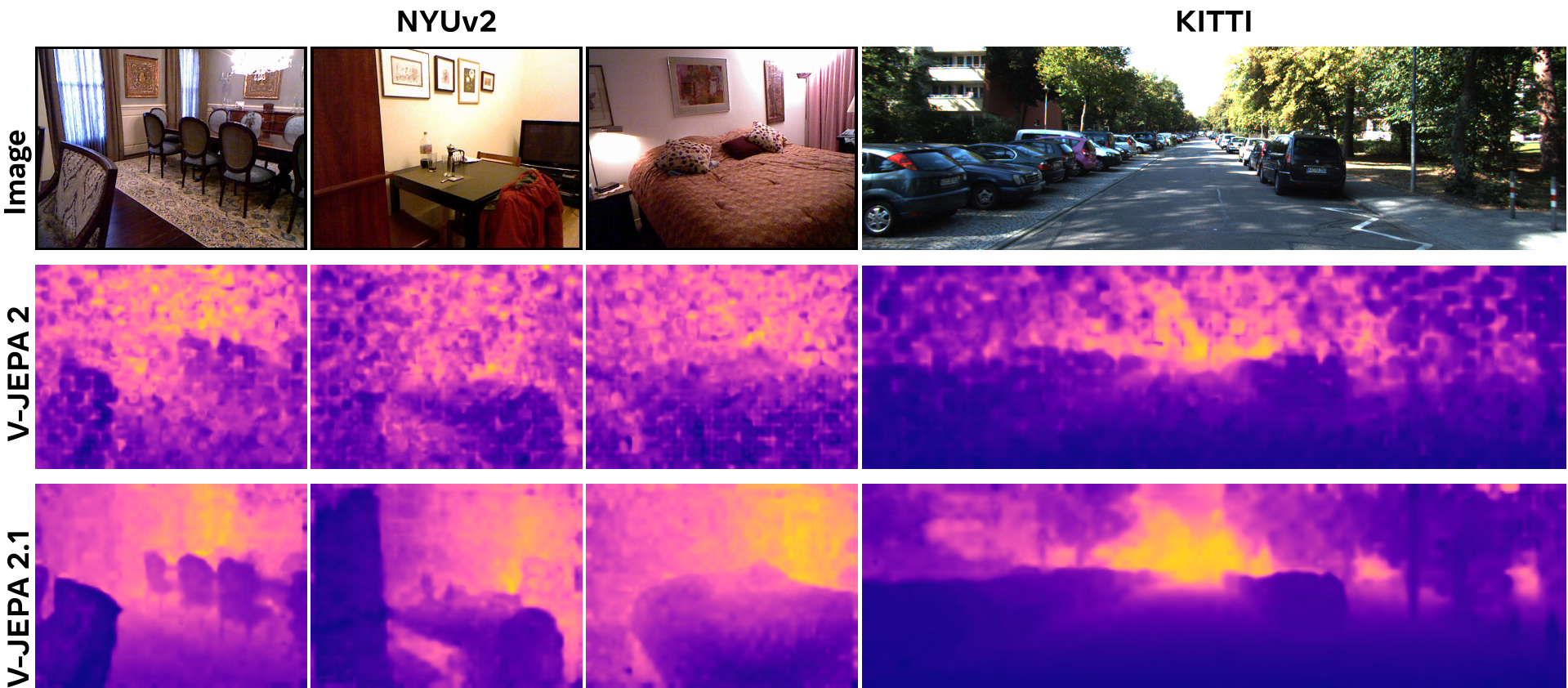
In monocular depth estimation (NYUv2), the improvement is categorical:
- V-JEPA 2 (Old): 0.642 RMSE
- V-JEPA 2.1 (New): 0.307 RMSE This puts a self-supervised video model on par with or ahead of specialized image encoders like DINOv3 for geometric understanding.
World Modeling & Robotics
The high-quality dense features directly translate to better robot performance. In zero-shot grasping on a Franka Panda arm, V-JEPA 2.1 achieved an 80% success rate, a 20% jump over the previous version. Furthermore, it enabled navigation planning 10x faster than VAE-based models by planning directly in a robust latent space.
Global Recognition & Anticipation
Despite the focus on dense features, V-JEPA 2.1 remains a leader in semantics:
- Something-Something-V2: 77.7% Accuracy (New SOTA).
- Ego4D Short-Term Anticipation: 7.71 mAP (35% relative improvement over previous best).
The model's ability to predict "where and when" an interaction will occur in Ego4D validates that the latent space now captures fine-grained dynamics and spatial layout simultaneously.

Critical Analysis & Takeaways
Is it truly the "Ultimate" World Model? V-JEPA 2.1 effectively addresses the structural weakness of the JEPA family. By grounding the "visible" world, it becomes a viable candidate for a foundation model in robotics.
Limitations:
- While competitive, it still sits slightly behind the specialized image encoders (DINOv3) on highly cluttered semantic segmentation (ADE20K), likely due to the domain gap in the training data (YT-1B vs. curated image datasets).
- The computational cost of ViT-G (2B parameters) is significant, though the authors' success with Model Distillation into ViT-B/L largely mitigates this for edge deployment.
Future Outlook: The success of V-JEPA 2.1 suggests that the next frontier is scaling along the data axis (moving into the trillions of tokens equivalent) and integrating multi-step planning directly into the pre-training loop. This model proves that "seeing the details" is the first step toward "predicting the future."