
Decoding the Vaguebooker: Why Loneliness and Histrionics Drive Cryptic Social Updates
User Characteristics of Vaguebookers versus General Social Media Users
This study investigates the predictors of "vaguebooking"—the practice of posting intentionally ambiguous, dramatic social media updates—and general social media acceptance among young adults. Using the Unified Theory of Acceptance and Use of Technology (UTAUT) framework, the researchers identify that while a "need to belong" drives healthy social media integration, vaguebooking is uniquely predicted by loneliness and histrionic personality symptoms.
TL;DR
Not all social media use is created equal. While most people log on to satisfy a healthy Need to Belong, a specific subset of "problematic" use known as vaguebooking—posting dramatic but ambiguous status updates—is fueled by deeper psychological currents. New research reveals that vaguebooking is a digital cry for attention primarily driven by loneliness and histrionic personality symptoms, marking a clear distinction between social integration and social pathology.
The Problem: The "Why" Behind the Mystery Post
We have all seen it: a Facebook friend posts "I just can't believe some people..." or "Today was the last straw," only to respond with "I don't want to talk about it" when asked what's wrong. This is vaguebooking.
While seemingly harmless, these posts violate social norms by bringing private grievances into public spaces. Existing research has long looked at "addiction" to social media, but this study dives deeper into the intent. The researchers recognized a gap: we know social media usage is rising, but we don't fully understand why some users engage in these passive-aggressive, attention-seeking behaviors while others use the platform purely for connection.
Methodology: Mapping the Mind of the User
The researchers surveyed 467 young adults using the Unified Theory of Acceptance and Use of Technology (UTAUT) as a foundation. They specifically isolated three psychological traits to see which would predict general social media use vs. vaguebooking:
- Need to Belong (NTB): The healthy, fundamental human desire for interpersonal attachments.
- Loneliness: The painful discrepancy between desired and actual social support.
- Histrionic Personality Symptoms: An unhealthy need to be the center of attention, characterized by overdramatic emotional expressions.
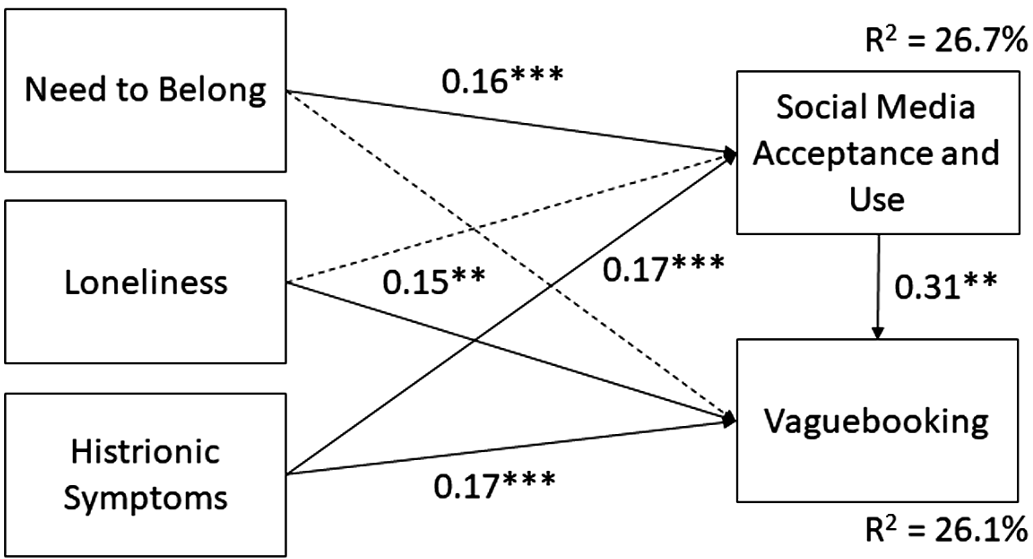 Figure 1: The path analysis model showing the relationship between psychological traits and social media behaviors.
Key Insights: Connection vs. Attention
The results provide a fascinating contrast in motivations:
1. The "Healthy" Path
Users who scored high on the Need to Belong tended to have high general social media acceptance. They treat social media as a utility to strengthen offline bonds. Crucially, NTB was not a predictor of vaguebooking. These users respect social norms and avoid ambiguous drama.
2. The Vaguebooking Profile
Vaguebooking was uniquely predicted by Loneliness and Histrionic symptoms.
- Loneliness acts as the "push": An individual feels isolated and uses a vague post as a low-risk "bid" for support.
- Histrionics act as the "pull": These individuals crave the spotlight. Vaguebooking allows them to manufacture drama and force others to engage with them (e.g., "What happened? Are you okay?").
3. The Histrionic "Double Threat"
Interestingly, histrionic individuals also showed high general social media acceptance. They aren't just vaguebooking; they are using every feature of the platform to be noticed, likely utilizing social media to flirt, perform, and curate a dramatic self-image.
Quantifying the Behavior
The study found significant statistical evidence (Path Coefficients):
- Histrionic Symptoms → Vaguebooking: β = 0.171 (p < .001).
- Loneliness → Vaguebooking: β = 0.151 (p < .05).
- Need to Belong → Social Media Acceptance: β = 0.159 (p < .001).
The data also revealed a gender component: Females were more likely to vaguebook. The authors suggest this may be due to traditional gender roles in the US, where women are "allowed" to be more emotionally expressive, while men are often discouraged from seeking support, leading them away from these public displays of vulnerability.
Critical Analysis & Future Outlook
This work shifts the conversation from how much we use social media to how we use it.
Takeaway: If you see someone vaguebooking, it is likely not a sign of high social integration, but rather an indicator of chronic loneliness or a personality-driven need for validation.
Limitations: The study relied on a self-reported sample of young adults (mostly female), which may restrict the generalizability to older populations or different cultures. Additionally, the cross-sectional nature of the data means we can't definitively say loneliness causes vaguebooking; it could be that the social fallout of vaguebooking eventually leads to more loneliness.
Future Work: Developers and mental health professionals could use these insights to design better digital well-being features. Instead of generic "time limit" reminders, platforms could potentially flag patterns of vaguebooking as early indicators that a user might be struggling with isolation or maladaptive coping mechanisms.