
Crowdsourcing the Genetic Code: Validating Mutation-Gene Relations at Scale
Validating Candidate Gene-Mutation Relations in MEDLINE Abstracts via Crowdsourcing
The paper introduces a crowdsourcing pipeline to validate gene-mutation relations extracted from MEDLINE abstracts. By combining automated NLP tools (EMU and NCBI gene lists) with Amazon Mechanical Turk (MTurk), the authors achieved a consensus accuracy of ~85% in distinguishing valid biological associations from noise.
TL;DR
Biomedical literature is a goldmine for genomic data, but automated tools struggle to link mutations to their correct genes when abstracts are complex. This paper demonstrates that crowdsourcing via Amazon Mechanical Turk can validate these relationships with up to 91% individual accuracy and 85% aggregate accuracy, offering a scalable alternative to expert curation.
Background: The Curation Bottleneck
With the explosion of genome sequencing, our knowledge of mutations (SNPs, indels, etc.) has outpaced our ability to document them in databases like OMIM or dbSNP. Much of this knowledge remains "buried" in MEDLINE abstracts. While we can identify genes and mutations separately using regex and NLP, Mutation Grounding—pairing them correctly—is notoriously difficult. Standard tools see a 20% precision drop when an abstract mentions more than one gene or mutation.
The Motivating Insight
Why not use the "wisdom of the crowd"? The authors hypothesized that while a non-expert might not understand molecular biology, they can perform linguistic pattern matching if the context is presented clearly. By transforming a complex biological problem into a visual, binary-choice task, the researchers bridged the gap between automated speed and human intuition.
Methodology: From Text Mining to Human Intelligence Tasks (HITs)
The workflow involves a "Projective Mapping" strategy:
- Candidate Generation: Using the EMU (Extractor of MUtations) tool and NCBI gene lists, the system identifies all potential gene and mutation mentions.
- The Cross-Product: Every possible gene-mutation pair is treated as a candidate.
- Visual SALIENCY: Instead of asking Turkers to read the whole abstract, the system generates a UI where the specific gene and mutation are highlighted in different colors within the text.
- Quality Control: To filter out "spammers" or low-quality work, they injected "control items" (known answers) and required a 95% approval rating for workers.
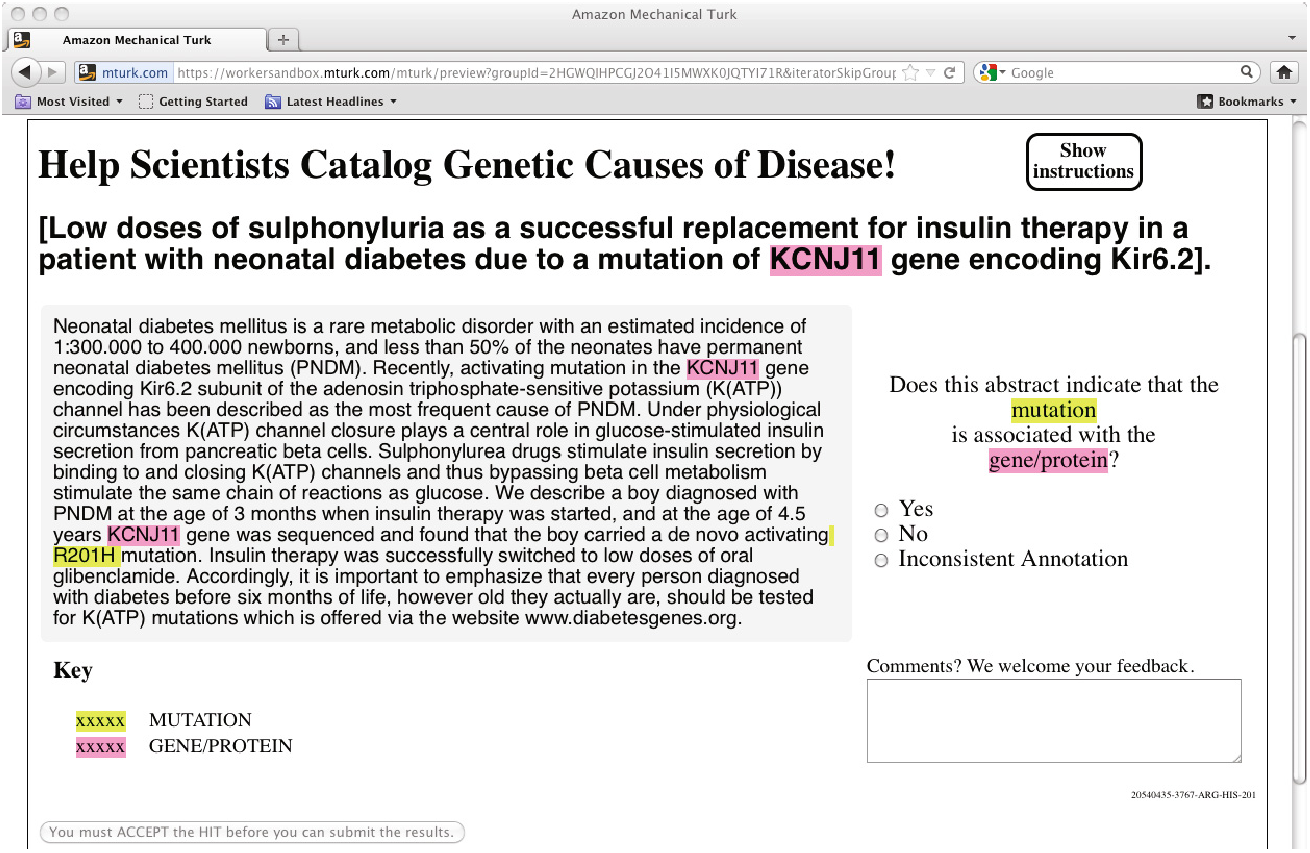 Figure 1: The interface presented to Turkers, simplifying complex biology into a visual verification task.
Experimental Results: Speed vs. Precision
The experiment processed 250 MEDLINE abstracts, generating 1,299 candidate pairs.
- Velocity: The entire set of 8,665 judgments (5 per HIT) was completed in just 36 hours.
- Accuracy:
- Majority Vote: 83.8% accuracy.
- Top Performer: 90.5% (approaching expert levels).
- Naïve Bayes Aggregation: 84.5%.
- The "Hidden" Value: Impressively, 2/3 of the gene-mutation relations found in this study were not present in existing curated databases, proving that literature-based extraction is essential for the future of personalized medicine.
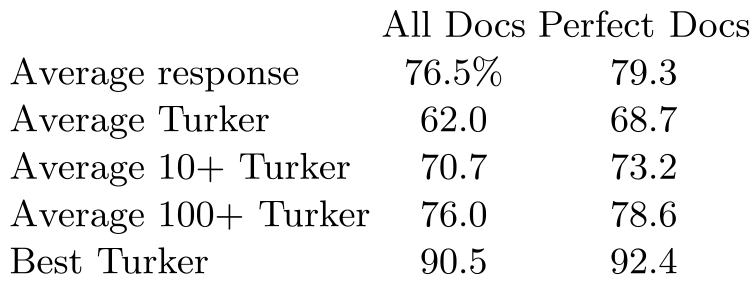 Table 1: Accuracy metrics across different worker pools and document types.
Critical Analysis & Conclusion
The Good: The study proves that complexity can be outsourced. By reducing the "Search Space" for the human (highlighting specifically what to look at), non-experts can perform near-expert levels of relation validation.
The Limitations: Cost-effectiveness is still an issue. At $2.50 per abstract (using 5 Turkers), it is currently 5x more expensive than using "smart undergraduates." However, reducing the redundancy (e.g., using 3 curators instead of 5) and using better weighting algorithms could slash these costs.
Final Takeaway: This work provides a blueprint for Hybrid Intelligence. For tasks that are too hard for current NLP but too voluminous for PhD-level experts, the "crowd" offers a powerful, elastic compute resource for the biological sciences.