
Who Validates the Validators? Solving the Alignment Gap in LLM Evaluations
Who Validates the Validators? Aligning LLM-Assisted Evaluation of LLM Outputs with Human Preferences
The paper introduces EvalGen, a mixed-initiative interface designed to align LLM-assisted evaluation functions (code or prompts) with human preferences. Implemented within the ChainForge toolkit, it uses a human-in-the-loop sampling and grading mechanism to select the most "aligned" evaluators, significantly outperforming fully automated baselines like SPADE in real-world scenarios.
TL;DR
Evaluating Large Language Models (LLMs) with other LLMs is efficient but dangerous. EvalGen is a new mixed-initiative tool that helps developers build automated "validators" (assertions) that actually match their personal quality standards. By grading just a handful of outputs while the AI works in the background, users can bridge the gap between "fuzzy" natural language requirements and rigorous code-based or LLM-based metrics.
Positioning: This work moves beyond "blind automation" to "guided alignment," addressing a critical gap in the LLMOps lifecycle: the inherent untrustworthiness of automated judges.
The Problem: The "Judge" is as Flawed as the "Defendant"
As we move from "vibe-based" prompt engineering to production-grade LLM applications, we need metrics. But writing these metrics is a nightmare:
- Code is too rigid: Writing a regex to catch "conciseness" is impossible.
- LLMs are too fuzzy: Asking an LLM to "be a judge" often results in biased or inconsistent scores.
- Human effort doesn't scale: You can't grade 10,000 outputs to verify your evaluator is working.
The authors identify a core tension: we use LLMs to evaluate other LLMs because humans are slow, but if we don't validate the evaluator, we simply inherit the evaluator's hallucinations.
Methodology: The EvalGen Workflow
EvalGen transforms evaluation from a "writing task" into a "grading task." It operates on the principle that it is easier for a human to say "this is bad" than to write a formal specification of "badness."
1. Mixed-Initiative Synthesis
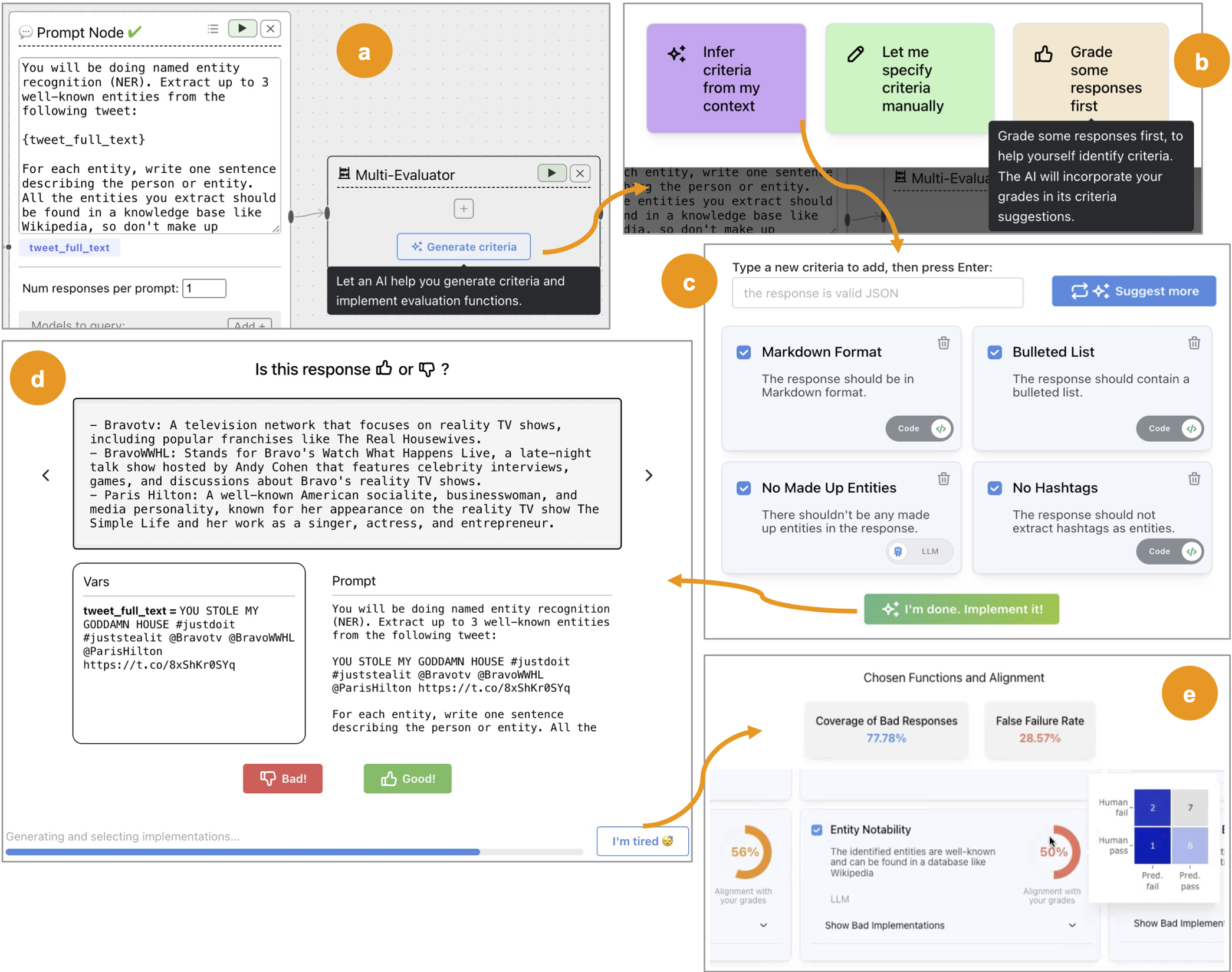
Instead of asking the user to code, EvalGen looks at the prompt and suggests criteria (e.g., "Response should not contain PII," "Tone should be professional").
2. Candidate Generation & Online Alignment
For every criterion, EvalGen doesn't just generate one function—it generates a pool of candidate assertions (Python functions and Grader Prompts).
3. Smart Sampling & Grading
While implementations are generating, the user grades outputs. EvalGen uses an alternating sampling policy to show the user both likely "good" and likely "bad" outputs. This feedback is used to calculate the Alignment Score: Where Coverage is the true negative rate (catching bad outputs) and FFR is the False Failure Rate (wrongly flagging good outputs).
Key Insight: "Criteria Drift"
The most profound finding in this paper isn't the algorithm, but a human behavior the authors call Criteria Drift.
Users think they know what they want (Prior Criteria), but as they see the LLM's weird failures, they redefine their standards (Posterior Criteria).
For example, a user might start by saying "no hashtags," but after seeing a high-quality response that uses a hashtag correctly, they realize their own rule was too strict. This suggests that evaluation is a co-evolutionary process between the human and the model.
Results: Efficiency Meets Accuracy
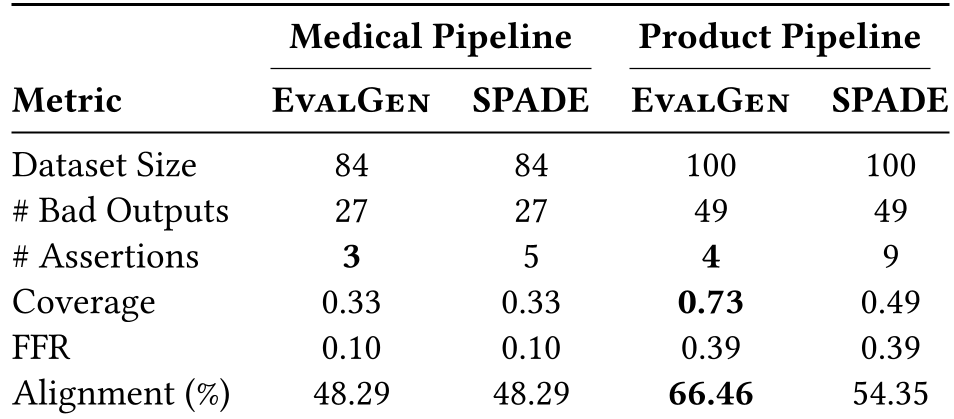
The authors compared EvalGen to SPADE, a fully automated assertion generator. Because EvalGen allows the human to filter out "dumb" criteria suggested by the AI, it achieves significantly better alignment:
| Metric | EvalGen (Human+AI) | SPADE (Pure AI) |
|---|---|---|
| Coverage (Product Pipeline) | 73% | 49% |
| Number of Assertions | 4 | 9 |
| Alignment Score | 66.4% | 54.3% |
Critical Analysis & Takeaways
- Trust is Earned, Not Given: Participants felt the tool "earned trust" by showing a table of results side-by-side.
- Code vs. LLM Evaluators: Developers trust code more for "hard" constraints (word count) but prefer LLMs for "soft" vibes (sentiment). However, code is easier to debug when it fails.
- The Context Trap: Evaluation isn't independent of the output. This raises serious questions for "Generic Benchmarks" like MMLU—if practitioners' criteria change once they see the data, static benchmarks may be less useful than we think.
Conclusion: EvalGen proves that the future of LLMOps isn't fully automated; it's a high-bandwidth collaboration where the AI generates the "how" (code/prompts) and the human provides the "why" (grades).
About the Author: Analysis by a Senior Academic Tech Editor specializing in the intersection of Human-Computer Interaction (HCI) and Large Language Models.