
Deciphering the Social Pulse: A Computational Model for Mood and Social Integration
Validation of a Computational Model for Mood and Social Integration
The paper presents a computational temporal-causal network model to predict mood levels based on social integration, activity participation, and enjoyment. Validated using Ecological Momentary Assessment (EMA) data from the E-COMPARED project, the model achieves a significantly lower RMSE (0.2109) compared to naive dynamic averages (0.2464) in simulating patient mood trajectories.
TL;DR
Mental health is rarely a solo journey; our social environment acts as both a shield and a mirror for our emotional well-being. This paper introduces a computational temporal-causal model that formalizes how social network strength and activity enjoyment drive mood dynamics. By testing against real-world EMA data from 49 patients, the research demonstrates that social integration isn't just a qualitative feeling—it's a predictable, mathematical driver of mental health recovery.
Background: The Social Gap in Internet Interventions
While "e-health" applications for depression are booming, they often treat the user as an island. Clinical research has long shown that social isolation (loneliness) is a primary driver of cognitive decline and mortality. The authors identify a critical gap: the lack of formal, computational frameworks that can explain how social interactions, network quality, and activity enjoyment interact at a granular level to fluctuate daily mood.
Methodology: Formalizing the Invisible
The heart of this work is the translation of psychological theories into Differential Equations. The model accounts for six key states:
- Latent Drivers: Network Strength and Social Integration.
- Behavioral Inputs: Social Interaction and Activities Carried Out.
- Experiential Factors: Enjoyment of Activities and Mood.
The Feedback Loop
The model’s innovation lies in its reciprocal connections. For instance, high Social Integration boosts Mood, but a positive Mood is also required to perceive Activities as enjoyable. This prevents the model from being a simple linear regression and transforms it into a dynamic system that can "spiral" (upward in recovery or downward in depression).
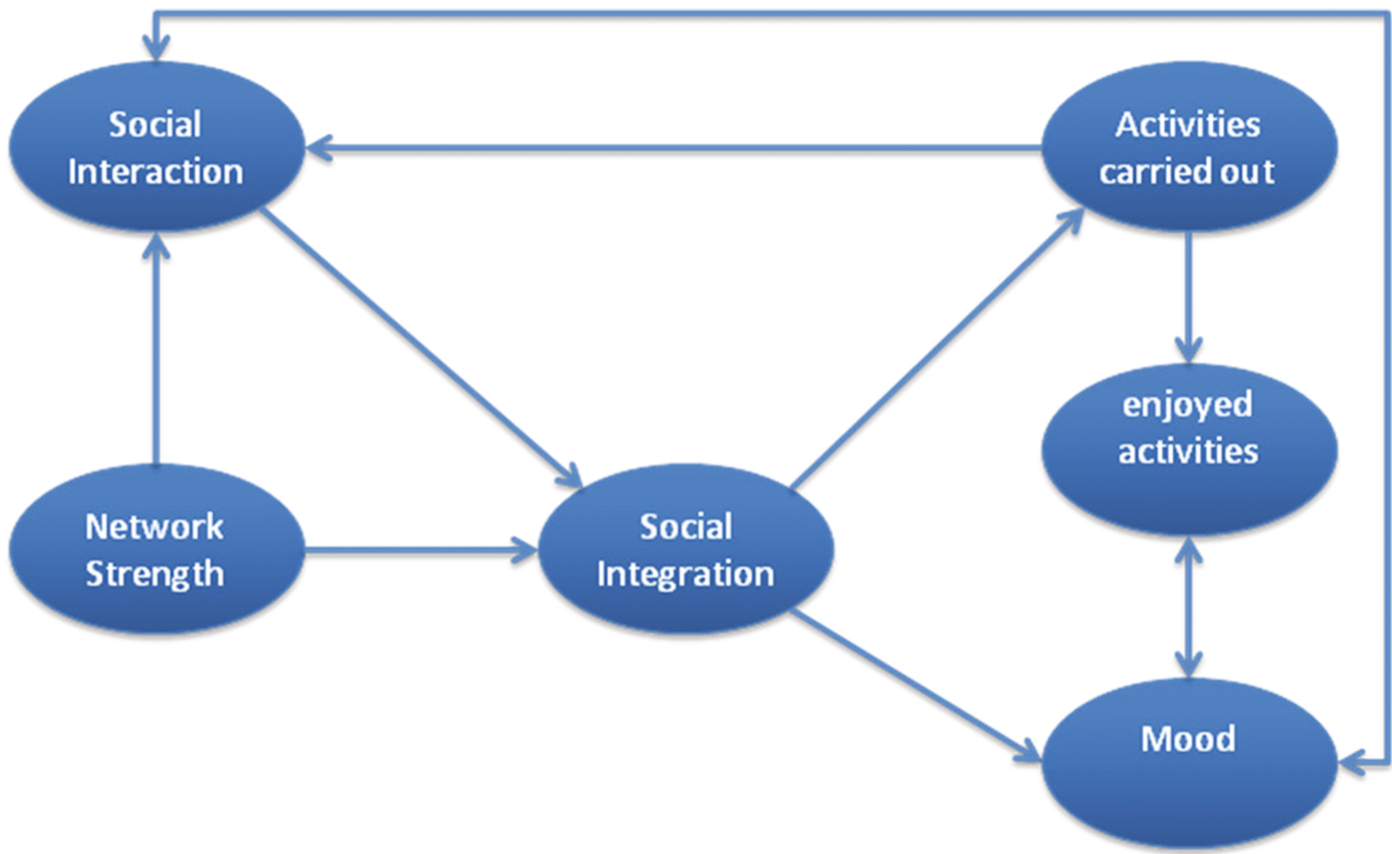 Figure 1: The conceptual temporal-causal network showing the interplay between social factors and mood.
The formalization uses an Advanced Logistic Sum Function, ensuring that activation values stay within a normalized [0, 1] range, mimicking the biological saturation limits of human emotion and social capacity.
Validation with Real-World Data
The authors utilized data from the E-COMPARED project, where 49 depressed patients provided daily mood ratings and semi-weekly reports on social interaction and activity enjoyment via a mobile app (Ecological Momentary Assessment).
Performance vs. Naive Baselines
The model was compared against three "naive" approaches:
- Average EMA: Predicting mood simply by averaging other social scores.
- First Week Constant: Assuming mood stays at the initial baseline.
- Global Average: Using the mean of the first and last weeks.
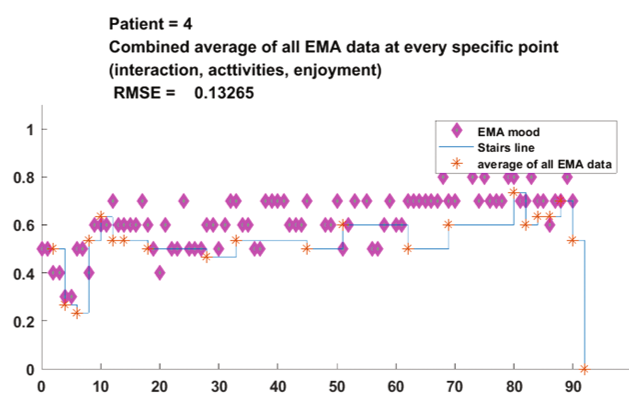 Figure 2: Performance comparison for Patient 4. The Top Right quadrant shows the proposed model accurately trending with the actual mood trajectory.
Key Insights and Critical Analysis
The results provide a nuanced view of Mental Health AI:
- Dynamic Superiority: The model significantly outperformed simple behavioral averages. It "understands" that the relationship between activity and mood is delayed and mediated by integration.
- The "Stability" Challenge: Interestingly, fixed-value predictors (like the first-week average) performed well for some patients simply because their mood remained chronically stable during the study. This highlights a limitation: the model's complexity is most beneficial for patients undergoing active recovery or decline, rather than those in a stagnant state.
- Quantifying the Qualitative: By setting weights (e.g., for the impact of activity enjoyment on mood), the researchers offer a blueprint for how psychologists can "tune" digital therapies for different personality types.
Conclusion: Toward Human-Aware Interventions
This paper serves as an essential bridge between behavioral science and computer science. While the dataset was small, the significance of the results (p < 0.05) proves that computational modeling of social integration is viable.
Future Outlook: The next step in this evolution is the inclusion of "passive" social data—using smartphone logs (call frequency, GPS movement) to feed these differential equations automatically. This would pave the way for an AI "Guardian" capable of detecting social withdrawal before a patient even realizes their mood is dropping.
Disclaimer: This analysis is based on the paper "Validation of a Computational Model for Mood and Social Integration" by Abro and Klein.