
Validating Kinect v2: A Low-Cost Revolution for Clinical Balance Assessment
Validation of Static and Dynamic Balance Assessment Using Microsoft Kinect for Young and Elderly Populations
This study validates the Microsoft Kinect v2 sensor as a cost-effective clinical tool for assessing static and dynamic balance. By measuring whole-body Center of Mass (CoM) excursion and velocity across young and elderly populations, the research demonstrates high correlation with "gold-standard" 3D motion capture systems.
TL;DR
Researchers have validated the Microsoft Kinect v2 as a reliable alternative to $100,000+ laboratory motion capture systems for assessing balance in both young and elderly subjects. By calculating the whole-body Center of Mass (CoM) instead of just individual joint points, the Kinect v2 achieved excellent consistency with professional-grade sensors, potentially opening the door for objective balance testing in any local clinic or home.
The "Precision vs. Price" Dilemma in Geriatrics
Falls are a leading cause of injury and mortality among the elderly. To prevent falls, clinicians need to measure postural stability. However, we currently face an "all-or-nothing" situation:
- Subjective Scales: Quick but prone to human error and lack of detail.
- Force Plates & MoCap: Highly accurate but prohibitively expensive and technically complex.
The study's primary motivation was to determine if the Kinect v2—equipped with Time-of-Flight (ToF) depth technology—could bridge this gap by providing objective biomechanical data without the high price tag.
Methodology: Beyond Simple Joint Tracking
The authors didn't just look at where the "waist" was. They employed a Segmental Method, dividing the human body into 15 segments (head, thorax, pelvis, upper/lower limbs, feet).
The Setup
Participants performed two types of tasks while simultaneously being recorded by an 8-camera infrared system (BTS) and a single Kinect v2:
- Single Leg Stand (SLS): Static balance (Eyes Open/Closed).
- Voluntary Ankle Sway: Dynamic balance where the body oscillates like an inverted pendulum.
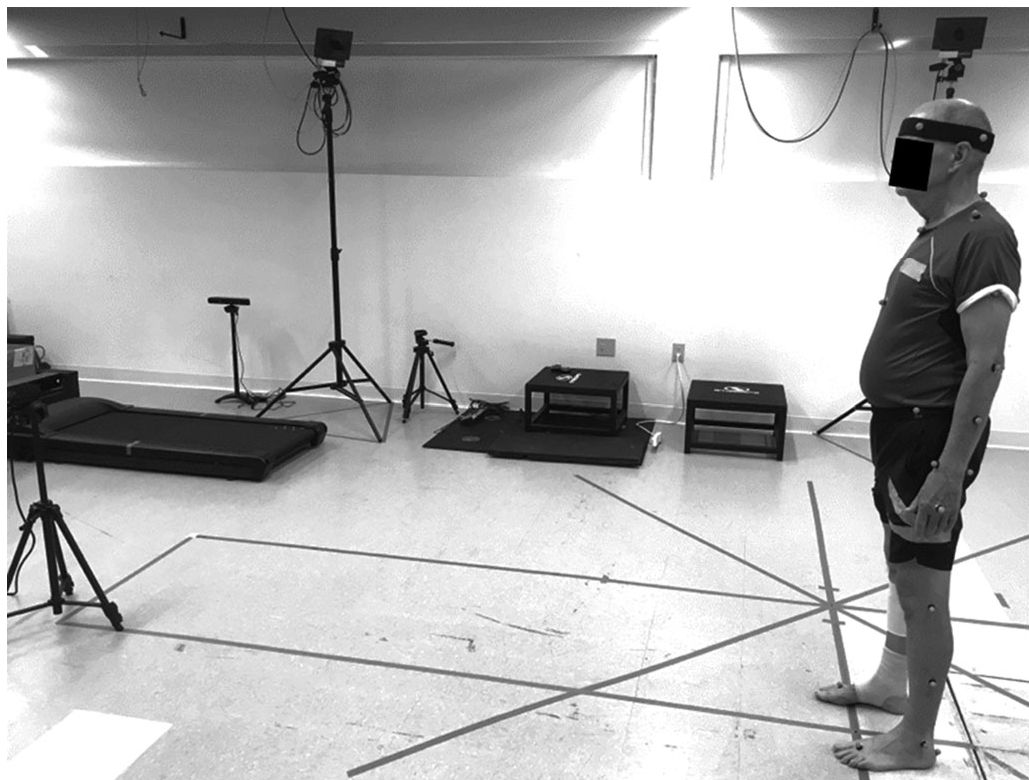 Figure 1: Comparison of the BTS (Marker-based) and Kinect (Markerless) skeletal models and the experimental workspace setup.
Key Findings: Can the Kinect Keep Up?
The results were surprisingly robust. When comparing the two systems, the researchers looked at two metrics: Relative Consistency (ICC 2,k) and Absolute Agreement (Lin's ).
- High Precision in Core Metrics: For Anteroposterior (A/P) and Mediolateral (M/L) excursions, the Kinect v2 showed excellent consistency () across all groups.
- Dynamic Superiority: Interestingly, the system performed exceptionally well during the Dynamic Ankle Sway task, showing almost perfect concordance for excursion metrics.
- Elderly Population Performance: Despite expectations that older movement patterns might confuse the sensor, the Kinect effectively tracked the elderly group (who, in this study, were fit from a 12-week training program).
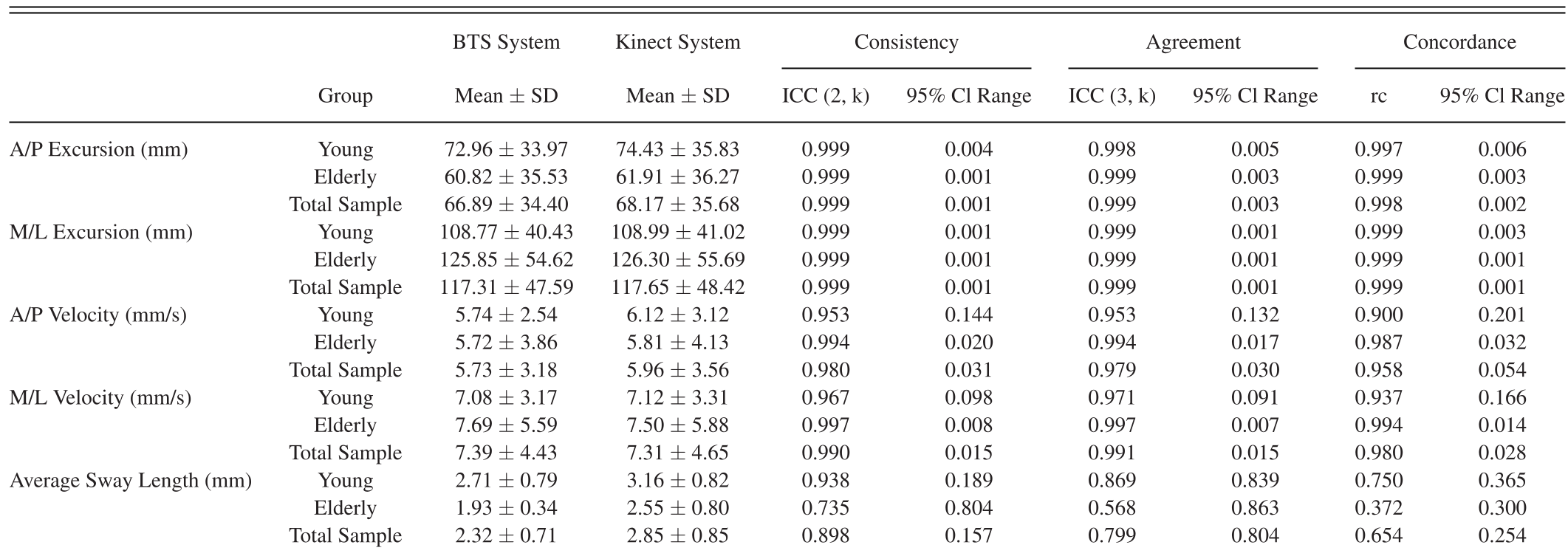 Table IV: Comparison of BTS and Kinect during Ankle Sway tasks, showing 0.999 consistency for excursion.
Critical Insights & Limitations
Why it Works
The shift from Kinect v1 (structured light) to Kinect v2 (Time-of-Flight) significantly reduced the "jitter" and depth inaccuracies that plagued earlier research. By focusing on Center of Mass (CoM) rather than raw joint positions, the method smoothes out the local tracking errors of individual joints, providing a more stable biomechanical indicator.
The Catch
- The "Eyes Closed" Challenge: The elderly group struggled to maintain a single-leg stance with eyes closed for the required duration, limiting the data for that specific high-difficulty task.
- Upper Limit of Velocity: While the Kinect handles slow postural sway well, it is yet to be validated for high-velocity movements or "near-fall" recoveries.
Conclusion: The Future of Home-Based Rehab
This study confirms that for standard clinical tests like the SLS, the Kinect v2 is more than just a toy. It is a scientifically valid tool. We are moving toward a future where a senior can perform a balance check in their living room, and their physical therapist can receive objective metrics (like excursion velocity) via the cloud, allowing for data-driven interventions long before a fall occurs.
Takeaway: The democratization of biomechanical analysis via low-cost sensors is no longer a "future" goal—it is technically feasible today.