
Theoretical Pitfalls of the Hotelling Trace: Why the ROC Surface (VUS) is Superior for Three-Class Tasks
The Validity of Three-Class Hotelling Trace (3-HT) in Describing Three-Class Task Performance: Comparison of Three-Class Volume Under ROC Surface (VUS) and 3-HT
The paper critically evaluates the Three-Class Hotelling Trace (3-HT) and the Volume Under the ROC Surface (VUS) as metrics for three-class classification performance. It demonstrates that while VUS aligns with psychophysical and decision-theoretic foundations, 3-HT fails to distinguish between cases of perfect global classification and scenarios where only a single pair of classes is separable.
TL;DR
In medical imaging and diagnostic evaluation, moving from binary (Yes/No) to three-class (e.g., Normal/Benign/Malignant) classification is notoriously difficult. This paper exposes a fatal flaw in the widely used Three-Class Hotelling Trace (3-HT): it can signal "perfect" performance even when a model completely fails to distinguish between two of the classes. The authors champion the Volume Under the ROC Surface (VUS) as the only metric that remains theoretically consistent with decision theory and human psychophysics.
The "Perfect Failure" Paradox
In binary classification, the Area Under the Curve (AUC) and the Hotelling Trace are mathematically linked and intuitive. However, as we move to three classes, the L-class Hotelling Trace—derived from Linear Discriminant Analysis (LDA)—becomes a dangerous metric.
The authors reveal a core structural flaw: The 3-HT is essentially the sum of eigenvalues. In a three-way task, it can be expressed as the sum of pairwise Signal-to-Noise Ratios (SNRs).
- The Problem: If just one pair of classes is perfectly separated, the SNR for that pair goes to infinity.
- The Result: The 3-HT becomes infinite, effectively claiming the entire system is "perfect," even if the other class pairs are completely overlapping and indistinguishable.
Methodology: VUS vs. 3-HT
To prove this, the authors compare 3-HT against their proposed Volume Under the ROC Surface (VUS).
1. The VUS Framework
The VUS is not just an ad-hoc volume calculation. It is rooted in:
- Decision Theory: It maximizes expected utility and satisfies the Neyman-Pearson criterion.
- Psychophysics: It is mathematically equivalent to the "percent correct" in a procedure where an observer must correctly categorize three objects (one from each class) simultaneously.
2. Experimental Design
The authors utilized a "Two-Signal Task Model" where images A and B contained different signals for different classes. By adjusting signal magnitudes ( and ), they could independently control how "easy" it was to separate specific classes.
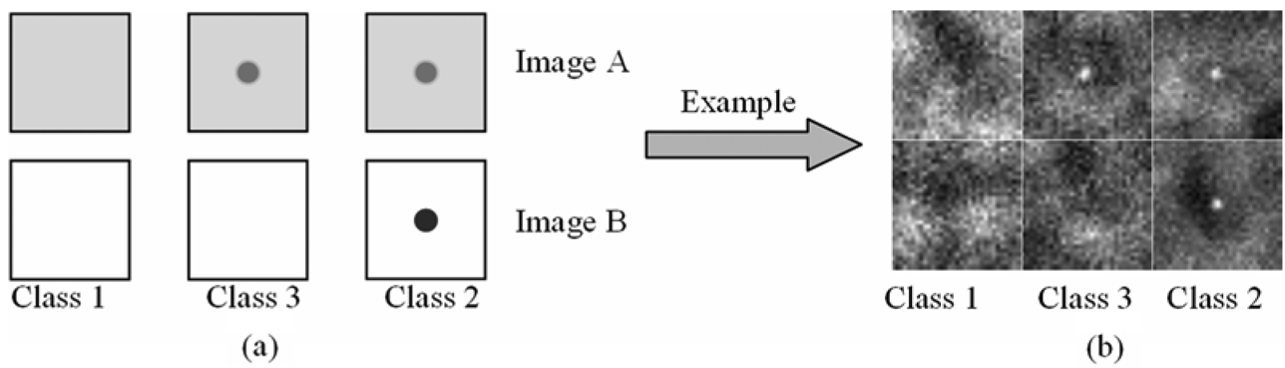 Figure: The task design allows precise control over class separability by manipulating distinct signal components.
Experimental Evidence: The Non-Monotonic Reality
The most striking finding was that 3-HT and VUS do not always move in the same direction. In "Experiment 2," the authors varied both signal-to-noise ratios.
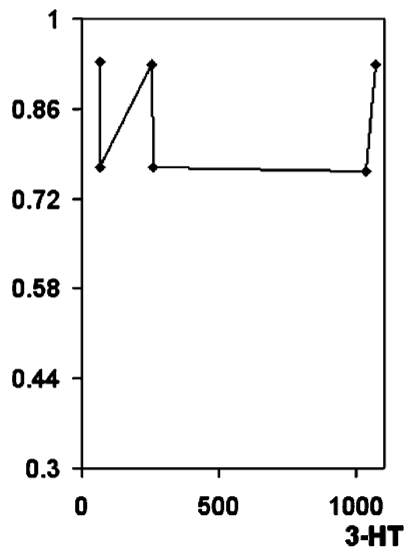 Figure: The divergent relationship between VUS and 3-HT. As performance reaches a ceiling in one dimension but fails in another, 3-HT continues to rise misleadingly.
| Data Set | 3-HT (Misleading) | VUS (Meaningful) | ||
|---|---|---|---|---|
| ii | 3 | 10 | 2.90 | 0.763 |
| iii | 3 | 15 | 5.89 | 0.768 |
In comparing sets ii and iii, the 3-HT nearly doubles, suggesting a massive leap in performance. However, the VUS (and common sense) shows that because (the bottleneck) remained constant, the overall ability to solve the three-class problem barely improved. The 3-HT was "blinded" by the improvement in .
Critical Insight: The "Evaluation of Evaluation"
This paper serves as a masterclass in Metrology—the science of measurement. It argues that a Figure of Merit (FOM) must satisfy three "pillars" inherited from the binary paradigm:
- Likelihood Ratio Stability: The metric must be based on optimal decision variables.
- Psychophysical Equivalence: The metric must have a physical interpretation (like "percent correct").
- Overlap Sensitivity: If class distributions overlap, the metric must reflect that ambiguity regardless of how well other classes are performing.
Conclusion
The 3-HT fails because it violates the psychophysical pillar; it cannot distinguish "partial perfection" from "global perfection." For researchers in AI and medical imaging, this work suggests that Volume Under the Surface (VUS) is the only reliable metric for assessing multiclass diagnostic systems. Relying on traces or simple extensions of LDA may lead to optimizing models that are fundamentally incapable of nuanced multi-class differentiation.