
UMSPL: Bridging Moving Paths and Profitability in Mobile Commerce
Discovering Valuable User Behavior Patterns in Mobile Commerce Environments
The paper introduces UMSPL (high Utility Mobile Sequential Pattern mining by a Level-wised method), a novel algorithm designed to discover valuable user behavior patterns in mobile commerce. It integrates moving paths with purchasing transactions and profit values to identify High Utility Mobile Sequential Patterns (UMSP).
TL;DR
In the world of mobile commerce, knowing where a customer goes is useful, but knowing how much profit their path generates is vital. This paper introduces UMSPL, the first algorithm to combine Mobility Pattern Mining with Utility Mining. By looking beyond how often a path is walked (Frequency) to how much money is spent (Utility), UMSPL uncovers hidden, high-value behavioral patterns that traditional algorithms miss.
Background: Beyond Frequency
Most existing studies in mobile data mining focus on "Frequent Patterns." For instance, if 100 people walk from Path A to Path B and buy a 2,000 diamond ring, traditional algorithms ignore them because they aren't "frequent."
In business, however, those 5 people are more valuable than the 100 soda buyers. The challenge is that "Utility" (Profit) does not satisfy the Downward Closure Property (i.e., a subset of a high-utility itemset is not necessarily high-utility), making the search space for these patterns mathematically difficult to prune.
Methodology: The UMSPL Framework
The authors solve this by introducing the Sequence Weighted Downward Closure (SWDC) property. They use a value called Sequence Weighted Utilization (SWU) as an upper bound to estimate whether a pattern could potentially be high utility.
The 4-Step Process:
- Mining WULIs: Identify items at specific locations that meet the minimum weighted utility threshold.
- Database Trimming: Remove all "junk" data (low-value items) from the mobile logs to create a compact, trimmed database ().
- Level-wise Candidate Generation: Use a novel "Candidate Tree" structure to store and grow sequences. Patterns are joined based on both their purchasing behavior and their physical movement paths.
- Utility Verification: A final scan to calculate the exact profit of the remaining candidates.
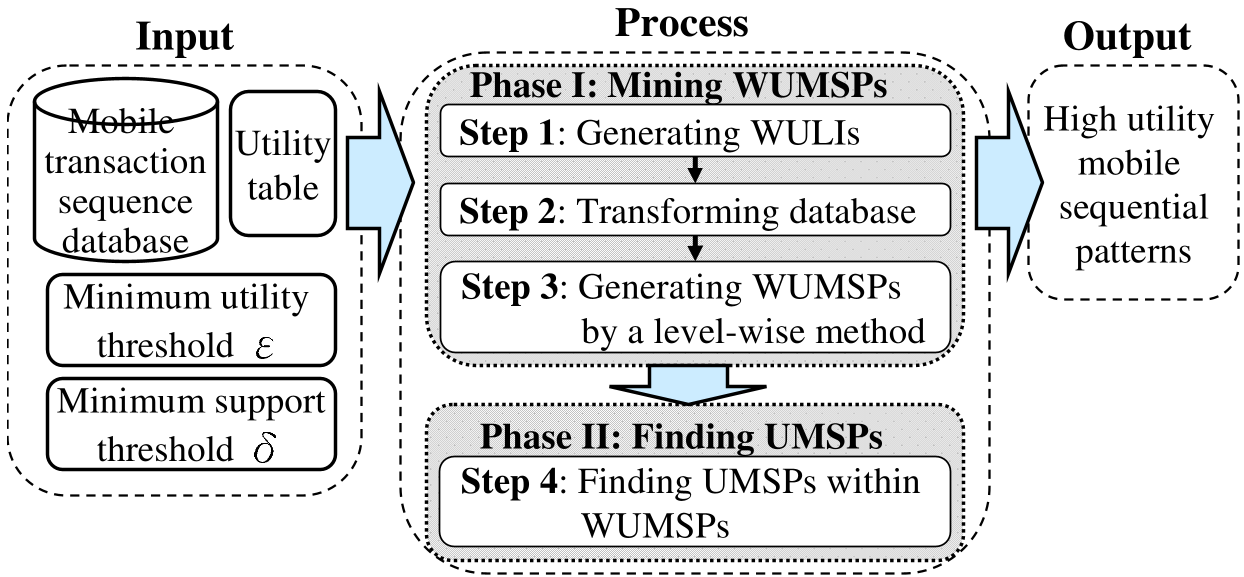 Fig 1: The high-level workflow of the UMSPL algorithm showing the transition from raw logs to high-utility patterns.
Architecture of Candidate Trees
One of the core innovations is the use of k-candidate trees. Instead of a flat list, UMSPL organizes potential patterns by their last "loc-itemset." This allows the algorithm to quickly join patterns where the movement path of one contains or overlaps with another, drastically reducing the computational overhead of sequence matching.
 Fig 2: The tree-based structure helps in efficiently managing the growth of high-utility mobile sequences.
Performance & Scalability
The authors compared UMSPL against an extended version of the standard Mobile Sequential Pattern (MSP) algorithm.
- Efficiency: UMSPL is significantly faster because it uses the utility threshold as a "second filter," pruning the search space much earlier than MSP.
- Low Support Handling: When the minimum support is set low (to find rare patterns), MSP's execution time explodes, while UMSPL stays stable due to its utility-based pruning.
- Scalability: The algorithm demonstrates a linear relationship between execution time and database size, making it suitable for big data applications in urban planning or large-scale e-retail.
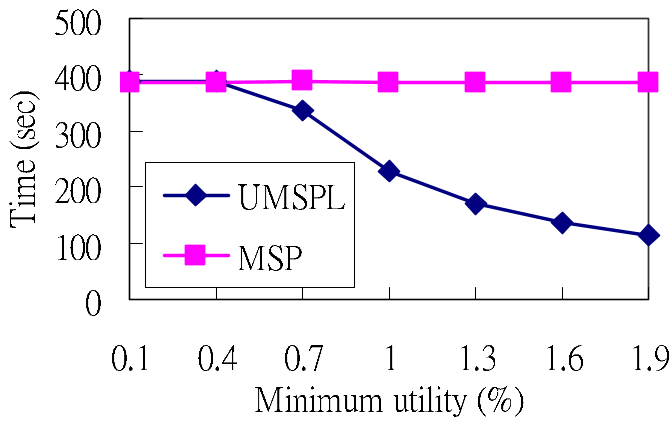 Fig 3: Performance comparison proving UMSPL's superiority under varying support thresholds.
Critical Insight & Conclusion
The true value of this paper lies in its Industrial Applicability. By integrating moving paths with unit profits (), businesses can perform "Precision Marketing." For example, if a shopkeeper knows that a customer who follows the path A -> B -> C and buys "Clothes" at A has a high probability of buying "Luxury Perfume" at C, they can trigger a personalized mobile discount exactly when the user enters location B.
Limitations: While powerful, UMSPL requires a predefined "Utility Table." In dynamic environments, profits and item importance change frequently. Future research could focus on Adaptive Utility Mining where the "value" of a behavior is learned dynamically rather than set by a human expert.