
Does Friendship Quality Matter for Peer Influence? The Redundancy of "Valued" Data in Adolescent Substance Use
Adding valued data to social network measures: Does it add to associations with adolescent substance use? ଝ
This study investigates whether augmenting standard social network measures with "valued" data (e.g., emotional closeness, parental involvement) better predicts adolescent substance use. Using data from over 4,700 students across 13 schools, the researchers compared traditional unweighted measures against weighted counterparts, finding that while peer use is a strong predictor, the addition of relationship intensity data provides no statistically significant improvement in associative strength.
TL;DR
In the study of adolescent behavior, we often assume that "closer" friends have a stronger influence on whether a teenager smokes or drinks. However, this research by Bauman et al. reveals a surprising counter-intuition: adding complex data about emotional closeness and parental involvement to social network models does not actually help us better predict substance use. Standard "who knows whom" maps are already remarkably efficient.
The Intuition: Not All Friends are Created Equal
Common sense suggests that the influence of a best friend you see every day, whose parents know your parents, should be significantly greater than a casual school acquaintance. Technically, this is the difference between unweighted (binary) ties and valued (weighted) ties.
Prior work in Social Network Analysis (SNA) has long recognized that relationships vary in intensity, but most large-scale adolescent studies use simple nominations (e.g., "Name your 5 best friends"). The authors hypothesized that by weighting these ties with a "Value Index"—closeness, interaction outside of school, and "intergenerational closure" (parents knowing one another)—they would uncover much stronger associations with substance use.
Methodology: Quantifying the "Value" of a Friend
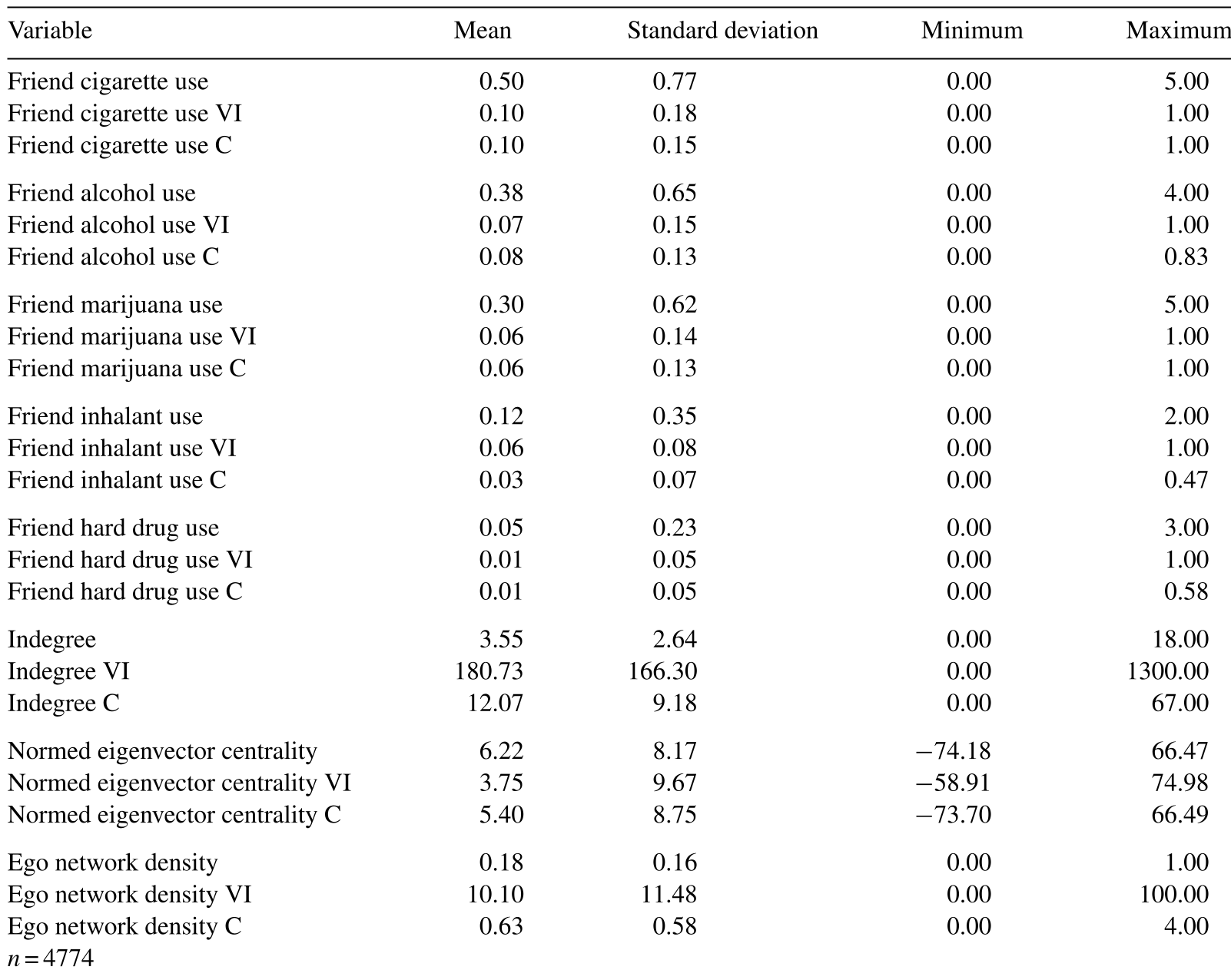
The researchers analyzed a robust sample of approximately 4,700 students (grades 6-8). They didn't just look at who was friends with whom; they measured the "thickness" of these connections using:
- Closeness: A self-reported 4-point scale of intimacy.
- Context: Whether they visited each other's homes or hung out outside of school.
- Parental Social Capital: Whether parents had met the friends or each other.
These factors were baked into standard SNA metrics like Indegree (popularity) and Eigenvector Centrality (influence based on the influence of your friends).
The Result: A Case of Statistical Redundancy
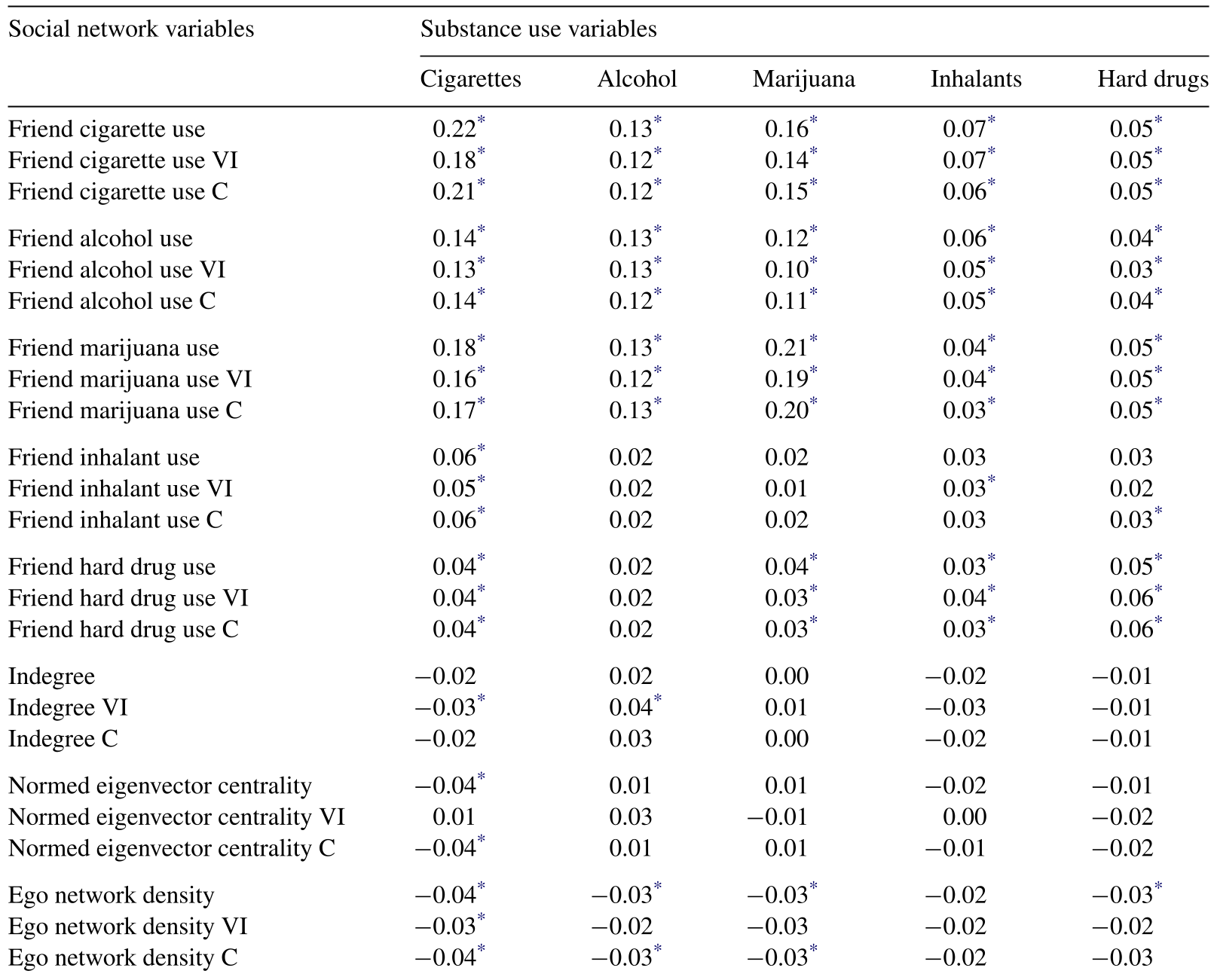
The central finding was a flat "No." The valued measures did not add significant explanatory power to the models.
Why did the hypothesis fail?
The authors suggest a fascinating psychological reason for this: Cognitive Filtering. When an adolescent is asked to name their five closest friends, they are already performing a mental "weighting" process. They naturally select the people they feel closest to and interact with most frequently. Therefore, the "Value Index" was already captured in the very act of nomination.
As shown in the table below, the correlations between ego use and peer use remained stable regardless of whether the "Value Index" (VI) was applied.
Critical Analysis & Takeaways
The Value of Simplicity
This paper provides a "blessing of dimensionality" in reverse. It suggests that researchers don't necessarily need to exhaustively survey adolescents about every facet of their domestic lives to understand peer influence. The nominative tie is a "sufficient statistic" for the relationship's influence.
Limitations & Future Work
- The Ceiling Effect: By limiting nominations to 5 friends, the study only captured "strong ties." If the limit were 20, the "value" of the 1st friend versus the 20th friend might have actually mattered.
- Evolution of Content: In 2026, many "valued" interactions happen digitally. Future research should investigate if "Digital Valued Data" (likes, mentions, streaks) provides the nuance that physical-world metrics like "meeting parents" failed to capture here.
Conclusion
While the social structure is critical to behavior, the internal quality of a friendship—at least as measured by closeness and parental oversight—does not significantly change the "influence math" in adolescent substance use research. If you know who a teenager calls their friend, you already know most of what you need to know about that friend's impact.