
ICLA-LP: Harnessing Cellular Learning Automata for Dynamic Link Prediction
A variable action set cellular learning automata-based algorithm for link prediction in online social networks
The paper proposes ICLA-LP, a novel link prediction algorithm for Online Social Networks (OSNs) based on Irregular Cellular Learning Automata (ICLA). By modeling the network as a decentralized learning system, it achieves state-of-the-art performance in predicting future connections in dynamic environments.
TL;DR
Predicting the future of social connections is no longer just about who you know, but how your "neighborhood" learns. The proposed ICLA-LP algorithm treats a social network as a living, decentralized organism. By using Irregular Cellular Learning Automata, it weights existing links based on their role in community formation over time, leading to superior accuracy in predicting new connections across dynamic datasets like Enron and arXiv.
Problem & Motivation: The Static Trap
Most link prediction (LP) research treats social networks as static graphs. However, Online Social Networks (OSNs) are innately evolutionary. Nodes and edges appear and disappear, and the underlying logic of growth is often buried in "community participation."
Existing similarity-based methods (like Jaccard or Adamic-Adar) are too "shallow"—they look at common neighbors but ignore the quality and history of those connections. The authors' insight is simple: if a link consistently helps form tight-knit communities (triangles) over time, it is a high-quality indicator of future growth.
Methodology: The ICLA Engine
The core of the paper is the mapping of a social network onto an Irregular Cellular Learning Automaton (ICLA).
1. The Architecture
Each vertex in the social network is assigned a "Cell," and each cell contains a "Learning Automaton" (LA). Unlike traditional CA, which requires a grid, ICLA adapts to the irregular, "messy" topology of real-world social graphs.
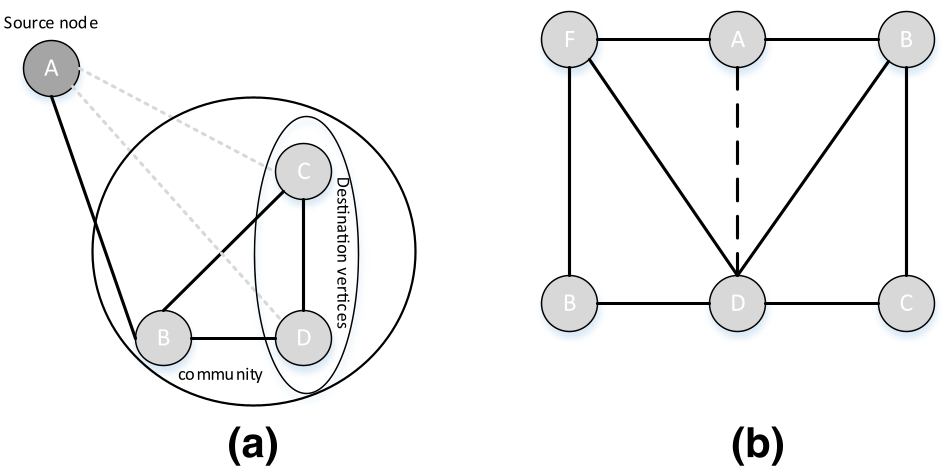 In this model, nodes learn to favor links that participate in "Triad Communities."
2. The Learning Rule
The LAs follow a Reward/Penalty system:
- Reward: If a node and its neighbor both act to form a triangular community.
- Penalty: If the connection does not result in a cohesive community structure.
This process results in a weighted graph where the edge weights represent the social dynamicity of the relationship.
3. Predicting the Unseen
To predict a link between two currently unconnected nodes (), the algorithm calculates the score based on the paths of length 2 and the weights learned by the ICLA: This formula ensures that more paths with higher "learned" weights lead to a higher probability of a future link.
Experiments & Results: Proving the Edge
The authors tested ICLA-LP against a battery of baselines across static and temporal datasets.
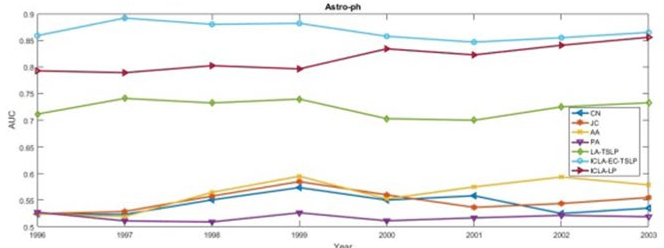 Figure 10: ICLA-LP consistently outperforms similarity-based methods (CN, JC, PA) and traditional LA approaches across various OSN datasets.
Key Results:
- Superiority over Katz/LP: By using learned link strengths instead of just path lengths, ICLA-LP achieves significantly higher AUC.
- Adaptability: In the "Change Step," the model demonstrates it can handle real-time additions and removals of links, making it viable for live OSNs.
- Correlation with Graph Features: The algorithm performs exceptionally well on networks with a high clustering coefficient, validating the "community-first" intuition.
Critical Analysis & Conclusion
The beauty of ICLA-LP lies in its decentralization. Because each node learns locally, the algorithm is inherently parallelizable, a "must-have" for massive modern networks.
Takeaway: Link prediction shouldn't be a cold calculation of common neighbors; it should be an observation of social behavior. ICLA-LP successfully bridges the gap between rule-based cellular automata and stochastic learning machines.
Limitations: The current model focuses on "triangular" (3-node) communities. While effective, real-world cliques are often larger and more complex. Future iterations incorporating higher-order motifs could push the AUC even closer to theoretical limits.