
Beyond Simple Averages: Harnessing Variational Bayes for Correlated Crowdsourcing
Variational Bayesian Inference for Crowdsourcing Predictions
The paper introduces a Variational Bayesian (VB) framework for aggregating continuous predictions from crowdsourcing tasks. It proposes two distinct noise models—one assuming independent worker noise and another utilizing a latent low-rank structure to capture worker correlations—achieving state-of-the-art performance in mitigating overfitting and handling non-independent expert opinions.
TL;DR
This research addresses the "Wisdom of the Crowd" in continuous tasks (like price prediction or age estimation). By moving away from simple averages and independent noise assumptions, the authors propose a Variational Bayesian (VB) framework that accounts for worker correlations through a latent low-rank structure. This method effectively prevents overfitting and outperforms standard Maximum Likelihood (ML) techniques in both synthetic and real-world experiments.
Context: When the Crowd is Biased together
Crowdsourcing is moving from simple "is this a cat?" labels to complex predictions like "what will this commodity cost in 2026?". The standard tool for this is Inverse Variance Weighting, which treats every worker as an independent noise source.
However, this fails in two major ways:
- The Overfitting Trap: In sparse datasets, ML-based variance estimation focuses too much on specific worker errors, leading to poor generalization.
- The "Common Source" Bias: Experts (like doctors or analysts) often use the same textbooks, data, or news sources. Their errors aren't independent; they are correlated.
Methodology: Latent Features and Bayesian Robustness
The core innovation lies in the Latent Noise Model. Instead of a simple diagonal variance matrix, the authors model worker noise using latent feature vectors (for task ) and (for worker ).
1. The Independence Model vs. The Correlated Model
The authors first provide a VB update for the independent model, but the real power comes from the Latent-VB approach. It models the prediction of worker on task as: where is the ground truth, and the product captures the structured (correlated) noise.
Figure 1: While the paper focuses on the mathematical derivation, the architecture follows a matrix-factorization style structure where ground truth and latent noise features are jointly optimized.
2. Variational Inference
Because the full posterior is analytically intractable, the authors use Block Coordinate Descent on the Variational Free Energy. This allows them to iteratively update the means and covariances of:
- The Ground Truth ()
- Task-specific noise features ()
- Worker-specific reliability features ()
Experiments: Proving the Bayesian Edge
The researchers tested their approach against "Ind-ML" (standard Inverse Variance) and "Latent-ML".
Synthetic Resilience
In tests where they varied the ratio of independent noise to latent (correlated) noise, Latent-VB remained the most robust. While ML-based methods saw their performance "dip" as iterations increased (a sign of overfitting), the VB methods reached a stable, high-accuracy equilibrium.
Real-World Case: Human Age Prediction
Using the FG-Net database (age estimation from faces), the Latent-VB method achieved a superior Mean Squared Error compared to existing state-of-the-art models like M-CBS.
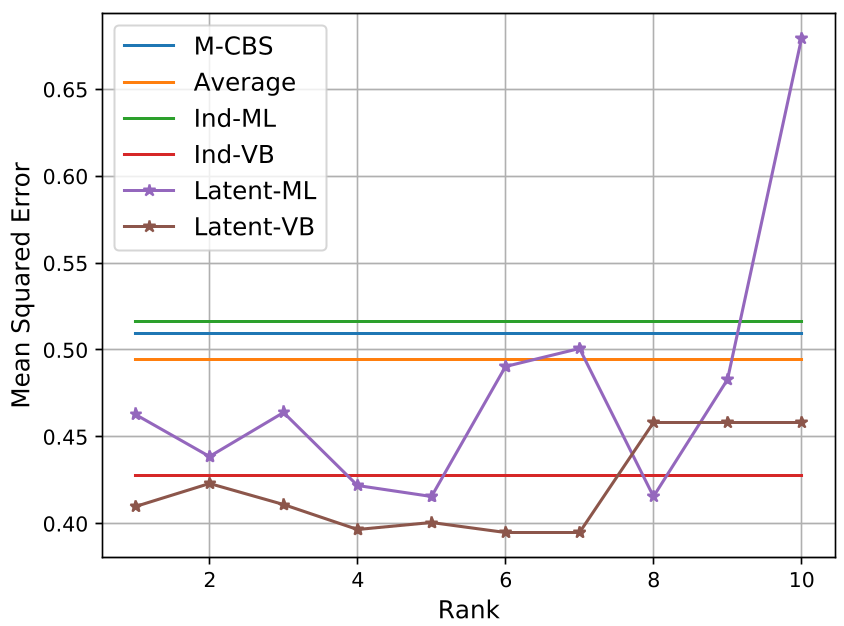 Figure 2: MSE comparison across different methods. Note how Latent-VB (the bottom-most curve) maintains consistency across different latent rank dimensions.
Critical Insight: Why This Matters
The fundamental "Aha!" moment here is the realization that correlation is information. By learning the latent structure of how workers make mistakes together, the model can "subtract" the collective bias to reveal the underlying ground truth more accurately.
Limitations & Future Work
- Computational Cost: Unlike simple weighting, the VB approach requires multiple iterations for each new prediction. The authors propose a closed-form approximate solution for real-time needs.
- Kernel Exploration: Currently, they use a linear kernel for the latent features. Moving to non-linear kernels (e.g., RBF) via Gaussian Processes could capture even more complex worker interactions.
Conclusion
This paper provides a rigorous mathematical bridge between collaborative filtering (matrix factorization) and crowdsourcing. For any technical lead building a prediction platform, the takeaway is clear: stop treating your experts as independent variables and start modeling their shared biases using a Bayesian lens.