
VCLT: Exploiting Crowdsourcing and Matrix Completion for High-Precision Trajectory Tracking in VANETs
VCLT: An Accurate Trajectory Tracking Attack Based on Crowdsourcing in VANETs
The paper introduces VCLT (Vehicular Crowdsourcing Localization and Tracking), a novel trajectory tracking attack framework for VANETs. It leverages crowdsourcing to obtain sparse location samples, Matrix Completion (MC) to reconstruct trajectories, and Kalman Filtering to refine results, achieving high-accuracy tracking without specialized hardware.
Executive Summary
TL;DR: VCLT is a sophisticated tracking framework that demonstrates how an adversary can reconstruct full vehicle trajectories in a city-scale network by crowdsourcing sparse V2V (Vehicle-to-Vehicle) data. By combining Matrix Completion (MC) to fill in missing gaps and Kalman Filtering to smooth the results, the authors achieve high tracking accuracy without needing a dense network of fixed sensors.
Positioning: This work represents a significant tactical shift in VANET security research. Rather than focusing on simple signal-strength localization, it treats trajectory recovery as a sparse data reconstruction problem, placing it at the intersection of signal processing and vehicular security.
Problem & Motivation: The "Sparse Data" Dilemma
In modern Vehicular Ad-hoc Networks (VANETs), vehicles exchange safety messages. While this improves road safety, it exposes location data. Previous tracking attempts struggled with:
- Architecture Complexity: Requiring expensive Road Side Units (RSUs) or specialized on-board sensors.
- The "Missing Gap" Problem: GPS noise (5-30m error) and intermittent connectivity lead to fragmented data matrices that are difficult to interpret as a continuous path.
The authors' insight is grounded in physical continuity: because a vehicle's motion is constrained by roads and physics, the resulting location matrix is inherently low-rank. This allows for the application of advanced mathematical recovery techniques.
Methodology: The VCLT Pipeline
The architecture is divided into three functional modules:
1. Crowdsourcing Computation Model
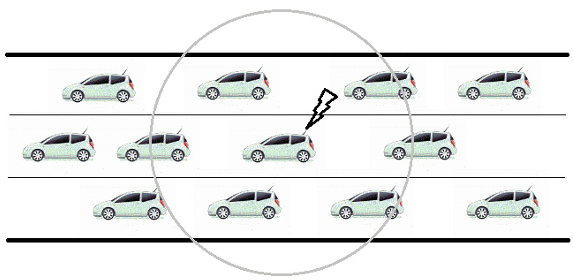
Instead of relying on a centralized authority, VCLT uses "detectors" (randomly selected vehicles) to act as mobile sensors. These detectors collect the MAC addresses and timestamps of surrounding vehicles and upload them to a server, creating a sparse map of (x, y, t) entries.
2. Matrix Completion (VTRMC)
The core of the recovery process is solving a nuclear norm minimization problem. Since rank minimization is NP-hard, the authors approximate it using the Nuclear Norm ( ), which is the sum of singular values.
3. Kalman Filter Refinement
Matrix completion can introduce "vibrations" or noise in the recovered path. VCLT applies a Kalman Filter (Prediction + Filtering phases) to align the recovered data with the kinematic realities of vehicle travel.
Experiments & Results
The authors validated VCLT using VANETsim and OpenStreetMap (OSM) data from Dalian, Changsha, and Wuhan.
- Noise Suppression: The Kalman filter proved essential in turning a jagged, recovered position curve into a smooth, realistic trajectory.
- Scalability: As the number of "detectors" increases, the relative error drops sharply. Interestingly, road complexity (e.g., Wuhan's dense intersections) affects accuracy, suggesting that environmental context is a key variable.
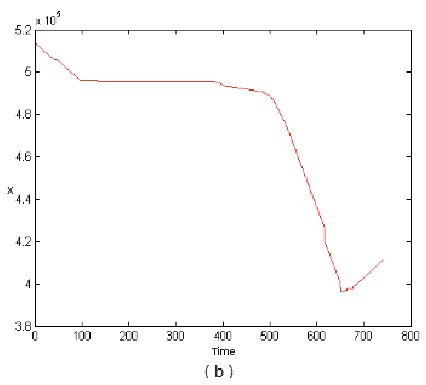 Figure: The contrast between the raw recovered coordinates (a) and the refined path after Kalman Filtering (b).
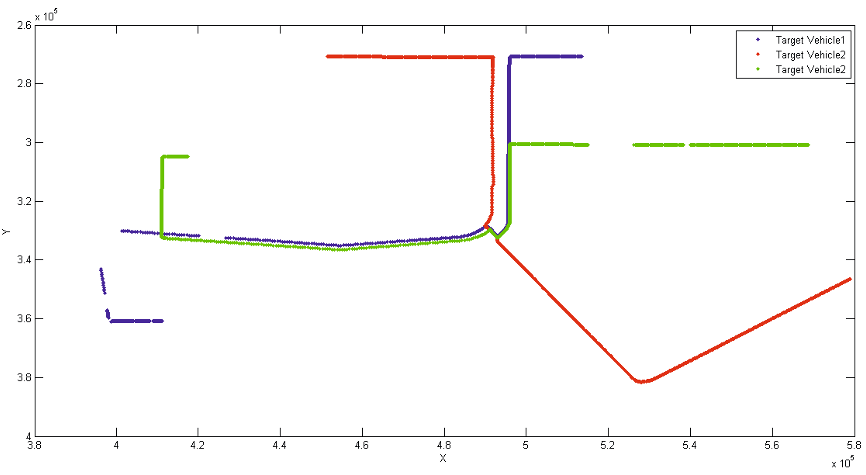 Figure: Visual representation of recovered trajectories for three target vehicles.
Critical Analysis & Conclusion
Takeaway
VCLT proves that trajectory tracking is no longer a hardware problem, but a data-processing one. By using crowdsourcing, an attacker can bypass the need for expensive infrastructure, making widespread surveillance significantly more feasible and dangerous.
Limitations
- Dynamic Matrix Rank: While the paper assumes a low-rank matrix, sudden changes in traffic (accidents, detours) might increase the rank and degrade MC performance.
- Adversarial Detectors: The model assumes detectors are honest; in a real-world scenario, the crowdsourcing model itself could be poisoned with false reports.
Future Outlook
This work sets the stage for more advanced "low-observation" attacks. The next frontier will likely involve using Recurrent Neural Networks (RNNs) to replace the matrix completion step, potentially handling non-linear motion patterns even more effectively.