
vec2Link: Bridging the Gap Between Offline Footprints and Online Friendships
vec2link: Unifying Heterogeneous Data for Social Link Prediction
vec2Link is a novel link prediction framework that unifies heterogeneous data sources by combining offline user mobility (check-in behaviors) with online social network structures. It achieves significant SOTA improvements globally, for instance, boosting AUC by up to 33% over standard LINE embeddings on the Gowalla dataset.
TL;DR
Social link prediction—the task of forecasting future connections—has traditionally been split into two camps: those looking at social graphs and those looking at GPS pings. vec2Link breaks this wall by unifying these heterogeneous data sources. By combining Probabilistic Factor Modeling (for locations) with Network Embeddings (for social circles) and using LSH-powered CNNs for prediction, it delivers a massive performance jump, including a 33% AUC improvement on specific datasets.
Context: Why Social Networks Need Physical Context
In the era of Location-Based Social Networks (LBSNs), our digital lives are mirrored by our physical movements. However, prior SOTA methods like node2vec or DeepWalk treat users as nodes in a vacuum, ignoring the fact that people who frequent the same coffee shops or gyms are statistically more likely to connect. Conversely, mobility-only models miss the latent structural influence of existing friendship networks.
The core challenge is heterogeneity: How do you mathematically combine a location preference vector (Poisson-distributed) with a social graph embedding (learned via Skip-gram)?
Methodology: The vec2Link Architecture
The vec2Link framework operates in three distinct phases to solve the fusion problem:
1. Modeling Offline and Online Preferences
- Offline (Visit Preference): The authors use a Probabilistic Factor Model (PFM). They assume user check-in frequencies follow a Poisson distribution, factorizing the user-location matrix into latent factors that capture the "why" behind a visit.
- Online (Social Representation): They remain agnostic to the specific Network Embedding (NE) tool, leveraging models like DeepWalk or node2vec to extract topological features from the social graph.
2. The LSH Unification (The Intuition)
Simply concatenating two high-dimensional, real-valued vectors often leads to the "curse of dimensionality" and slow convergence. vec2Link introduces Locality-Sensitive Hashing (LSH) with Sign Random Projections.
- Why LSH? It transforms continuous embeddings into binary Hamming codes while preserving cosine similarity. This "binarization" acts as a regularizer, distinguishing dissimilar users more sharply while significantly reducing the computational load for the subsequent layers.
3. CNN-based Interaction Learning
Instead of a simple MLP, the binary vectors are reshaped into a matrix and processed by a Convolutional Neural Network (CNN). This allows the model to learn local patterns and cross-feature interactions between the social and mobility latent spaces.
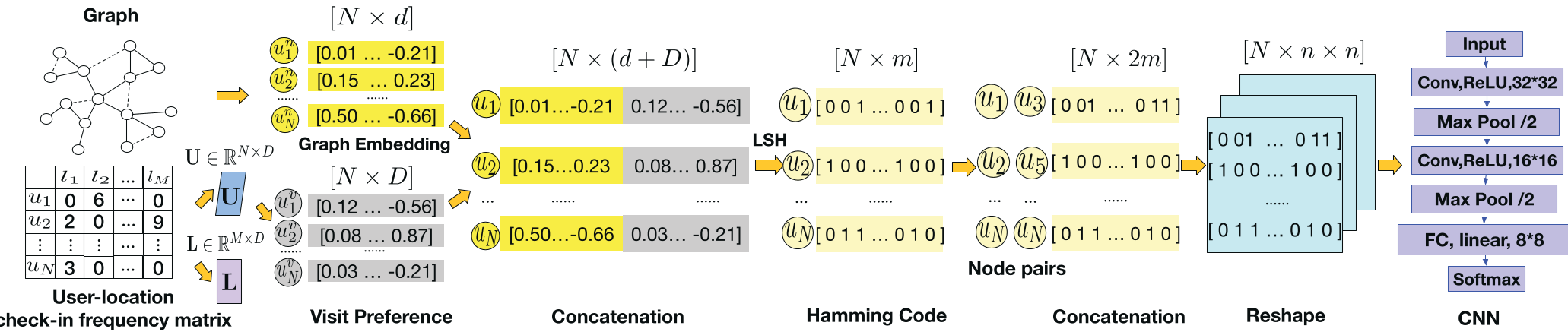 Figure 1: The vec2Link pipeline, from heterogeneous embedding to LSH-CNN prediction.
Experiments & Results: A New SOTA
The researchers tested the model on four datasets (Foursquare and Gowalla across various cities).
Key Findings:
- Fusion Wins: Comparing vec2Link to its components showed that social data + mobility data always outperforms either alone.
- Efficiency: The LSH version (vec2Link) was not only faster than the non-hashed version (vec2Link-) but actually outperformed it in accuracy (p < 0.05). This suggests that hashing helps in filtering noise from the latent representations.
- Massive Gains: In the Chicago (CHI) dataset, the improvement over the LINE model was a staggering 33.12%.
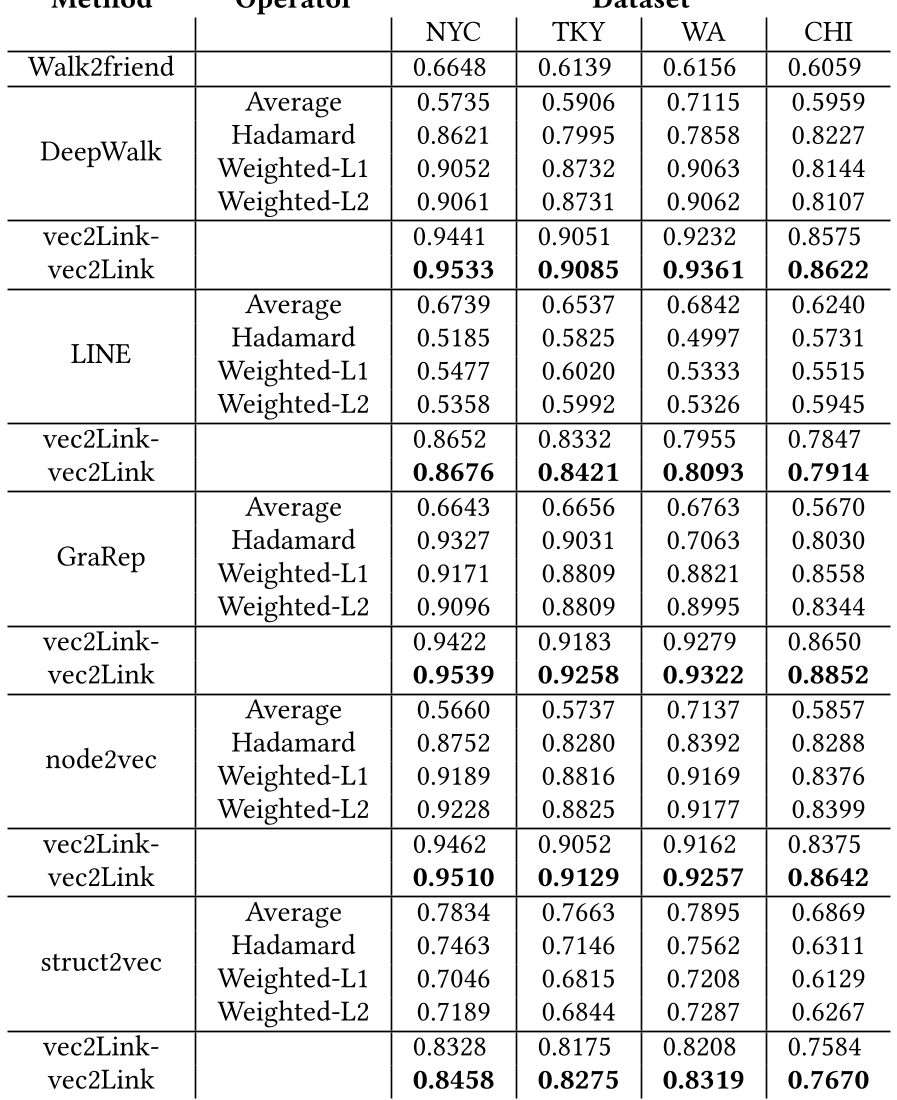 Table 2: Performance comparison (AUC) across multiple datasets and embedding baselines.
Critical Analysis & Conclusion
Takeaway
vec2Link demonstrates that the key to modern link prediction isn't just "more data," but the efficient unification of multi-modal data. By using LSH to bridge the gap between different embedding spaces, the authors provided a blueprint for scalable, heterogeneous graph learning.
Limitations
While powerful, the model treats location data as static "preferences" (frequency-based). It currently lacks the ability to capture the temporal sequence of movements (e.g., User A always goes to Point B after Point C).
Future Outlook
The logical next step is extending this to Spatio-Temporal Graph Neural Networks (ST-GNNs), where the sequential nature of check-ins could be modeled via RNNs or Transformers before being unified with the social graph. For developers, the use of LSH to binarize features before feeding them into a CNN is a brilliant trick for building high-performance, low-latency recommendation systems.