
Vector Opinion Dynamics: Decoding Consensus in Complex Social Architectures
Vector Opinion Dynamics: An Extended Model for Consensus in Social Networks
This paper introduces an extended "Vector Opinion Dynamics" model, evolving the classic Deffuant model by utilizing opinion vectors and a two-phase filtering process. Tested on Barabási-Albert and Erdős-Rényi network topologies, the method characterizes how agents with multi-dimensional beliefs reach consensus or remain polarized.
TL;DR
How do diverse opinions on politics, sports, and religion evolve into a collective consensus? This paper extends the classic Deffuant model into the vector space, utilizing Euclidean distance and a two-phase filtering process to simulate how social network topologies—specifically Barabási-Albert and Erdős-Rényi networks—dictate the speed and finality of opinion convergence.
Problem & Motivation: Beyond "Yes or No"
Most existing opinion models assume that "birds of a feather flock together" based on a single, scalar belief. However, human interaction is multi-dimensional. You might disagree with a colleague on politics but trust their opinion on dentistry.
The authors identify two major gaps in prior work (specifically the Deffuant 2002 model):
- Metric Limitation: Using Hamming distance for opinion vectors is too binary—it only checks for exact matches, which fails for real-numbered "shades of grey" in opinions.
- Topological Absence: Real opinions aren't formed in a vacuum of random pairings; they are shaped by the architecture of our social circles (hierarchies, hubs, and clusters).
Methodology: The Two-Phase Filter
The core innovation lies in the Vector Representation and the Filtering Mechanism. Instead of a single value, each agent holds a vector of six opinions.
1. Euclidean Distance Metric
The authors replace Hamming distance with a Euclidean approach to handle continuous values (0 to 1). If the distance between two agents' vector opinions is within a threshold , they influence each other.
2. The Two-Phase Filtering Process
This mimics real-world "social vetting":
- Phase 1: Checks if the agents are similar enough across 5 general topics (e.g., shared values/background).
- Phase 2: Checks if they are close enough on the 6th specific topic (the "target" decision).
This design allows for the modeling of stubbornness. An agent might be willing to listen to a friend generally but remain "polarized" on a specific, deeply held belief.
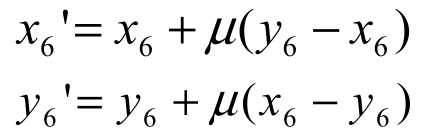 The update rule: Opinions shift toward each other controlled by the convergence parameter .
Experiments & Results: Topology is Destiny
The authors tested the model on Barabási-Albert (BA) scale-free networks and Erdős-Rényi (ER) random networks.
The Role of Network Diameter
The most striking finding was that the diameter (the longest path between any two nodes) governs consensus.
- Small Diameter (d=4): Rapid convergence to a single global opinion.
- Large Diameter (d=13): The network remains fragmented, with "islands" of differing opinions.
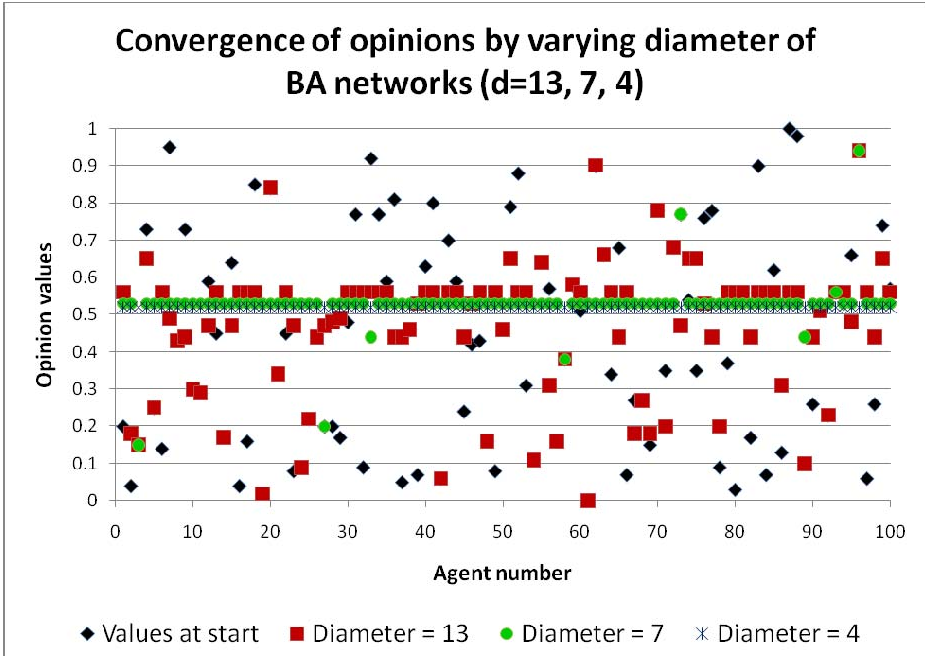 Fig 1. As diameter increases, the tight cluster of asterisks (consensus) breaks into scattered rectangles (polarization).
Loosely-Knit vs. Well-Knit Societies
Using the two-phase filter, the authors demonstrated that in "loosely-knit" societies (high initial variance), agents only interact with like-minded subgroups. This leads to polarization regardless of the total number of interactions, as shown in Fig 2.
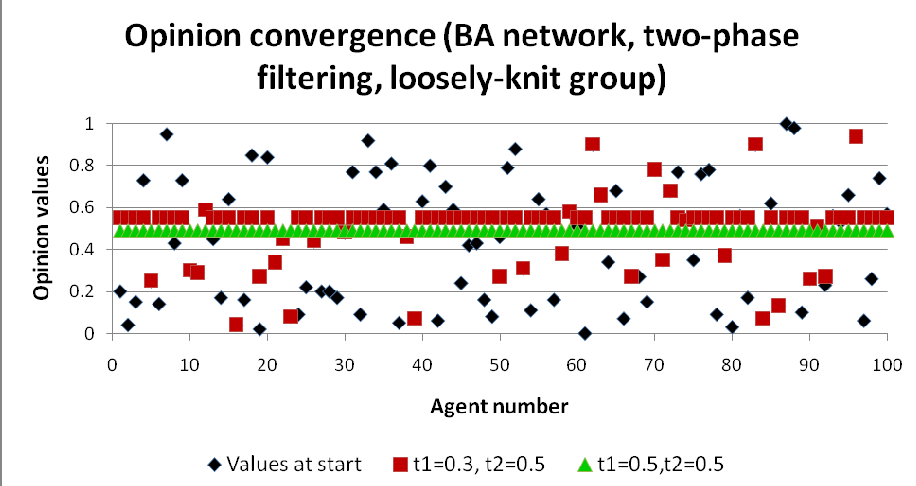 Fig 2. The emergence of distinct clusters in a BA network under selective filtering.
Critical Analysis & Conclusion
Takeaway
The study proves that achieving a "global consensus" in a society requires more than just interaction; it requires a low-diameter social structure and a high tolerance threshold. The introduction of the two-phase filter provides a much-needed nuance: it explains why experts (who have a low threshold for the opinions of non-experts) contribute to social polarization.
Limitations & Future Work
- Static Topologies: The network links are fixed. In reality, people "unfollow" those they disagree with, leading to co-evolving networks.
- Missing External Stimuli: The model ignores the "Media" effect—how a central node (TV/Internet) can force consensus or drive wedges regardless of peer interaction.
This research provides a robust framework for understanding the "Echo Chamber" effect in digital social networks, suggesting that the very architecture of our connections might be as influential as the content of our thoughts.