
Veiled Viral Marketing: Can Anonymity Save Social Health Campaigns?
Veiled viral marketing: disseminating information on stigmatized illnesses via social networking sites
The paper introduces Veiled Viral Marketing (VVM), a novel communication strategy for disseminating information about stigmatized illnesses (e.g., HPV, STDs) via social networking sites. By allowing users to send "veiled" (anonymous) invitations to known friends, the method leverages existing social trust while mitigating the personal risk of social stigma, achieving a 5x higher acceptance rate compared to traditional non-anonymous invitations.
TL;DR
Health promotion on social media often fails when the topic is "embarrassing" or stigmatized. This paper proposes Veiled Viral Marketing (VVM)—a mechanism where you can send health info to your friends anonymously. The breakthrough finding? While fewer people send these veiled invites, those who receive them are 500% more likely to actually engage with the content than if they knew exactly which friend sent it.
The "Stigma" Paradox in Social Networks
Viral marketing is built on the premise of social proof: "If my friend likes this, I might too." But what if the topic is Chlamydia, HPV, or Depression?
Users face a social cost. "Liking" an HPV awareness page might signal to your network that you have HPV. Consequently, the very people who would benefit most from sharing life-saving info stay silent to protect their reputation. Prior solutions were either:
- Fully Public: High social risk, leading to low participation.
- Fully Anonymous: High safety, but zero "viral" spread because there's no trust-based peer-to-peer channel.
Methodology: The FactCheck: HPV Experiment
The researchers developed a Facebook app called FactCheck: HPV. Its core design was a simple A/B choice during the "Invite Friends" phase.
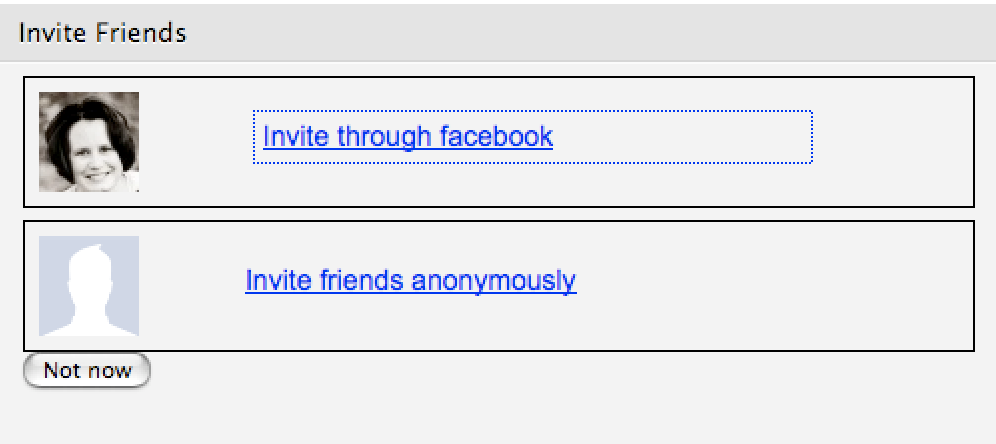 Figure 1: The dual-path invitation dialog allowing users to choose between being a "Known Friend" or a "Veiled Friend."
The "Veil" Mechanism
If a user chose the "Veiled" path, the recipient got an email stating: "One of your friends... wishes to remain anonymous." This created a unique psychological state:
- Trust: The recipient knows it’s from an actual friend (via the system's verification).
- Curiosity: The anonymity acts as a "pattern interrupt," making the recipient wonder why it was sent.
- Safety: The sender is protected from direct questioning or judgment.
Key Results: Curiosity vs. Transparency
The data revealed a fascinating behavioral split.
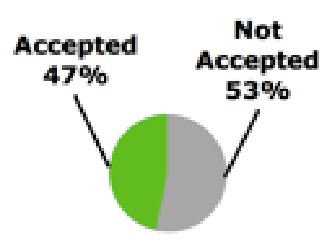 Figure 2: The acceptance rate of veiled invitations (47%) dwarfed that of unveiled invitations (8.6%).
- Selection Bias: Users were still more comfortable sending "Unveiled" invites (65% vs 35%). This suggests that "Social Hubs" (influencers) still prefer transparency.
- The "Conversion" Leap: Veiled invitations had a 47% acceptance rate. This is astronomical for viral marketing. In contrast, standard invites were ignored as "noise" or "app-spam."
- Plausible Deniability: The authors suggest that if a user has at least 5-10 friends, the "veil" provides enough cover to prevent the recipient from guessing the sender, facilitating the sharing of sensitive health tips.
Deeper Insight: Why it Works
The "Veiled" approach solves the Targeting Difficulty. You might know a friend struggles with a specific health issue, but telling them directly is awkward. A veiled message allows you to "nudge" them without the social friction of a direct confrontation.
However, there is a limitation: The authors note that veiled messages could increase stress if the recipient interprets the anonymity as a targeted "diagnosis" from a peer. To mitigate this, they suggest requiring users to send veiled invites to groups (e.g., "One of your friends sent this to you and 5 others") to reduce the feeling of being singled out.
Critical Perspective & Future Work
While the 2012 study used Facebook and Email, the logic is even more relevant today in the age of TikTok "Shadow" accounts and Instagram "Close Friends" lists.
The Takeaway for Tech Leaders: For products dealing with sensitive data (mental health, finance, sexual education), stop asking users to "Share on Facebook." Instead, build intra-platform veiled sharing. The data proves that for stigmatized content, a "veiled" nudge from a trusted peer is the most powerful tool for behavior change.
Final Conclusion
Anonymity doesn't have to mean "strangers." By "veiling" our existing social connections, we can bypass social shame to deliver critical information where it matters most.