
VEmotion: Decoding the Driver's Mood Through the Lens of Environment
VEmotion: Using Driving Context for Indirect Emotion Prediction in Real-Time
VEmotion is a novel "virtual emotion sensor" that predicts driver emotions in real-time by fusing contextual data (vehicle dynamics, weather, traffic, and road type) from a smartphone. Utilizing a Random Forest classifier, it achieves a 71.7% accuracy, significantly outperforming traditional facial expression recognition systems in real-world driving environments.
TL;DR
Researchers have developed VEmotion, a system that predicts how you feel behind the wheel not by looking at your face, but by looking at the world around you. By analyzing GPS-derived metrics like traffic flow, weather, and speed, VEmotion can predict driver emotions with over 71% accuracy, crushing the performance of standard facial recognition APIs which struggle with the "stoic" expressions drivers typically maintain.
The Problem: The "Stoic Driver" and the Intrusive Sensor
For years, affective computing in cars has faced a binary choice: be intrusive or inaccurate.
- Wearables: Sensors measuring heart rate or skin conductance are highly accurate but annoying for daily use.
- Cameras: Facial Expression Recognition (FER) works in the lab, but in a car, drivers rarely "overact." Factors like sunglasses, night-time driving, and simple lack of facial movement make FER APIs (like Microsoft Azure or Affectiva) default to a "Neutral" state, missing subtle shifts into happiness, anger, or stress.
VEmotion shifts the paradigm: If we know the context, we can infer the emotion.
Methodology: The Indirect Insight
The core intuition is that emotions in driving are often reactions to external stimuli. A sudden traffic jam causes frustration; a clear highway at sunset promotes happiness.
The System Architecture
VEmotion acts as a sensor fusion layer on a standard smartphone:
- Vehicle Dynamics: Speed and acceleration via GPS.
- Weather: Temperature, cloud coverage, and wind speed (via API).
- Traffic Flow: Comparing current speed to "freeflow" (ideal) speed.
- Road Type: Infrastructure data (highway vs. residential) from OpenStreetMap.
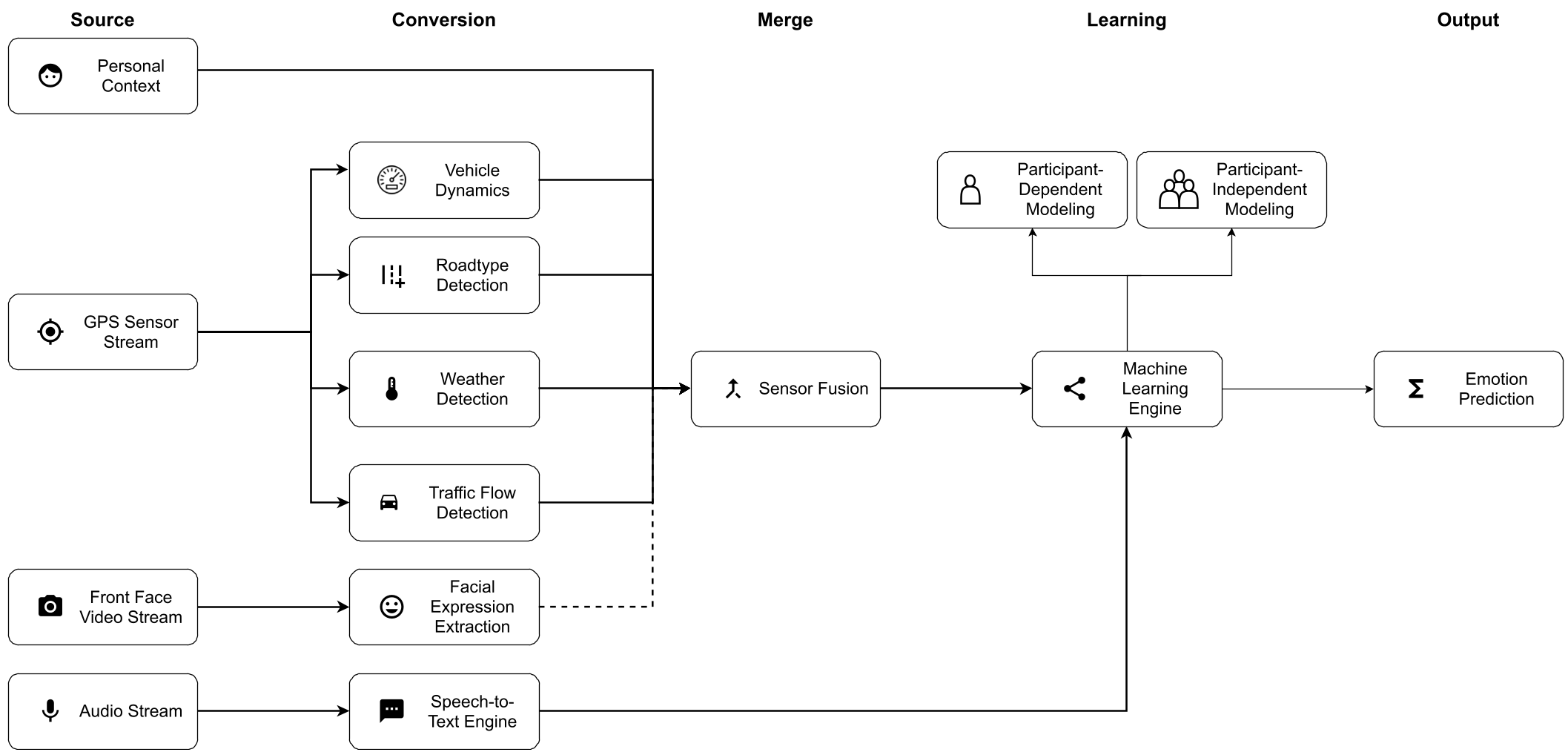
The system uses a Random Forest Ensemble to process these features. Interestingly, the researchers found that including facial expressions as a feature added negligible value, suggesting that the context alone carries the vast majority of the predictive "signal."
Experiments & Results: Context vs. Camera
The study involved 12 participants in real-world driving conditions (not simulators).
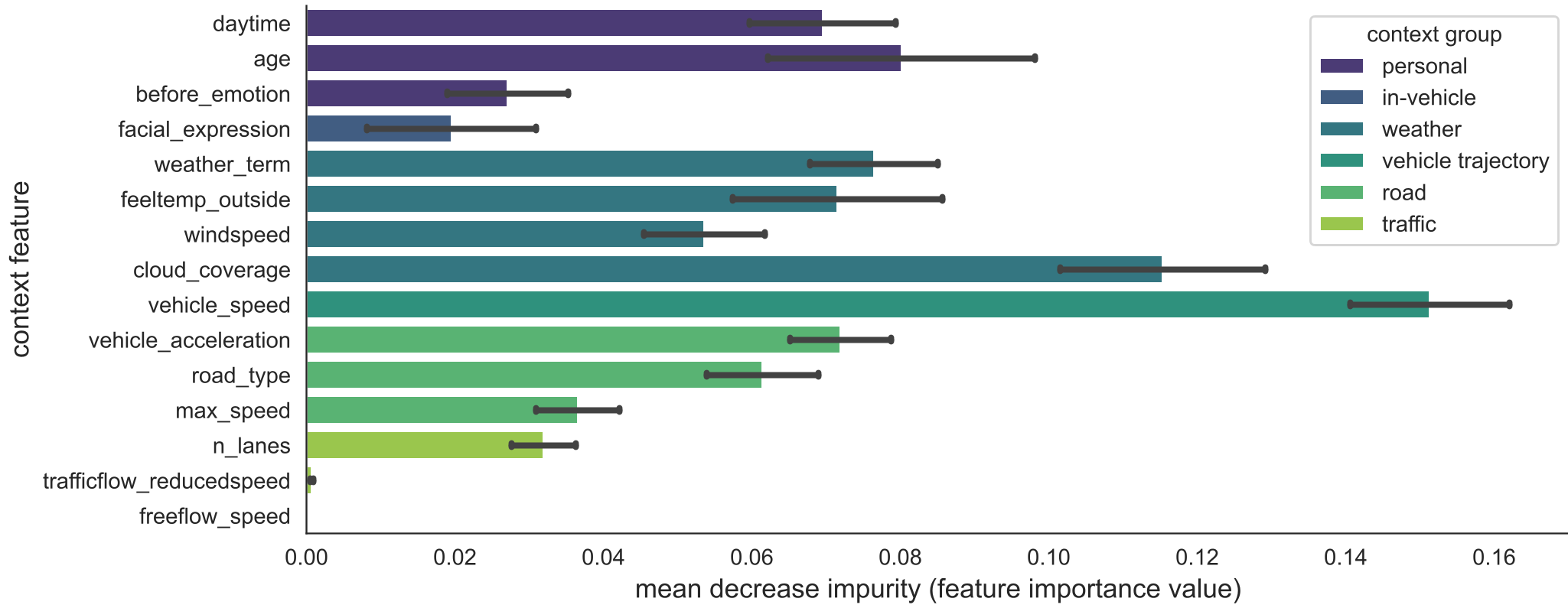
1. Feature Importance
Contrary to intuition, the most important feature wasn't the driver's face—it was Vehicle Speed. "Happy" emotions strongly correlated with unhindered speed, while unexpected traffic variations triggered negative states.
2. Performance Comparison
When evaluating accuracy, VEmotion outperformed facial expression engines by a massive margin.
- Face-only: Accuracy ~55%.
- VEmotion (Context-only): Accuracy ~71.7%.
The facial recognition systems failed most spectacularly on "Surprise" and "Happiness," misclassifying them as "Neutral" nearly 80% of the time. VEmotion, however, successfully discriminated between these states by recognizing the driving conditions that typically elicit them.
3. Calibration
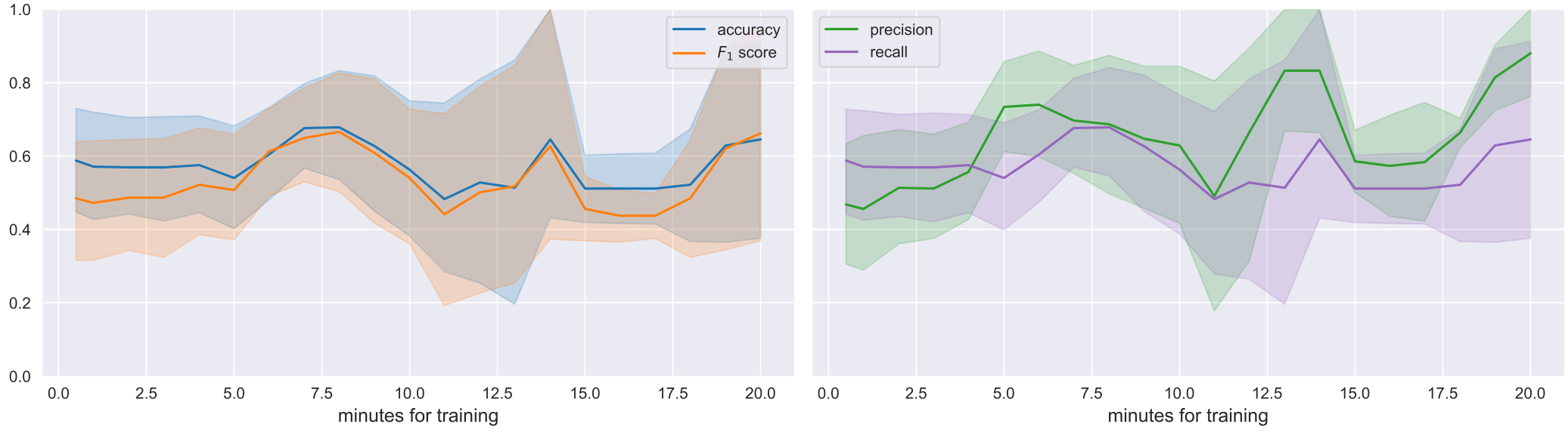
The team found that VEmotion requires about 5 to 10 minutes of driving data to calibrate to a specific individual to reach peak precision.
Critical Insight: The Privacy-Performance Win-Win
The most profound takeaway from this research is ethical. Facial recognition is often seen as "the plutonium of AI"—powerful but toxic to privacy. VEmotion proves that we can achieve better results by using non-sensitive metadata (GPS and weather) than by recording a driver's face.
This enables "Empathic Car Interfaces" that can:
- Reroute you to a "scenic" road if you're bored.
- Suggest a calming playlist if the traffic dynamics indicate high stress.
- Adjust safety intervention thresholds if the driver is likely frustrated.
Conclusion & Future Work
VEmotion demonstrates that the environment is a window into the mind. While limited by the sparsity of certain emotions (like "Gross Disgust" or "Extreme Anger") in their small sample size, the proof of concept is robust. Future iterations will likely include "outside-view" cameras to analyze other cars' behaviors, further refining the "contextual trigger" model of emotion.
Source Code & Data: The authors have released the source code and dataset to encourage further development of unobtrusive, empathic automotive systems.