
Venue2Vec: Engineering Efficiency in Fine-Grained Human Mobility Prediction
Venue2Vec: An Efficient Embedding Model for Fine-Grained User Location Prediction in Geo-Social Networks
Venue2Vec is an efficient embedding-based framework designed for fine-grained user location prediction in Geo-Social Networks (GSNs). It leverages a random-walk-based Skip-gram model to unify spatial-temporal context, semantic information, and sequential relations, achieving state-of-the-art results in both "Next Check-in" and "Anytime" location prediction tasks.
TL;DR
Venue2Vec is a unified embedding framework that treats physical locations like "words" in a sentence to predict user movements. By combining random walks, hierarchical Skip-gram, and Kernel Density Estimation, it achieves a massive jump in accuracy (+13.2% to +41.8% Acc@1) while being 5x faster to train than previous sequential models.
The Granularity Gap in Geo-Social Networks
In the era of Foursquare and mobile-first services, predicting where a user will go is the "holy grail" for personalized marketing and urban planning. However, researchers have long faced a trade-off between precision and unification.
Most existing models are either "Next Check-in" specialized (short-term) or "Anytime" specialized (long-term), and they often predict at a coarse level—like telling you someone is going to "a restaurant" rather than "The Blue Note Jazz Club." The challenge lies in the "Heterogeneity of Factors": how do you mathematically marry a user's historical habits, the semantic category of the venue, the physical distance between spots, and the cyclic nature of time into one coherent vector?
Methodology: Architecture and Intuition
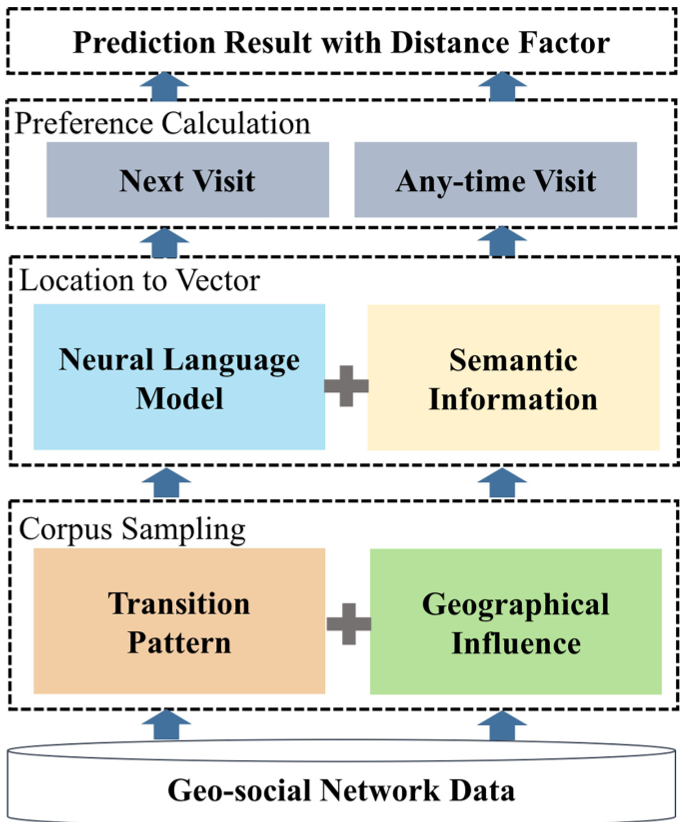
Venue2Vec approaches this by assuming human mobility follows a "language" of sorts. If a "check-in" is a word, then a user's trajectory is a sentence.
1. Sequence Sampling via Random Walks
Instead of just looking at raw check-ins, the authors build a location network. The probability of moving between nodes accounts for:
- Sequential Relation: How often do people actually go from Location A to B?
- Geographical Influence: Based on Waldo Tobler’s First Law of Geography, near things are more related.
2. The Learning Core: Modified Word2Vec
The model uses a Skip-gram with Hierarchical Softmax to learn the latent representations.
- Architecture Insight: Post-training, the authors concatenate semantic category vectors to the location embeddings. This ensures that if two venues are near each other and both are "Jazz Clubs," their vectors are extremely similar in the latent space.
3. User Preference Modeling
- Next Visit: Uses exponential decay. Recent visits are exponentially more "weighted" than visits from a month ago.
- Anytime Visit: Uses a time-windowed frequency check (e.g., "What does this user usually do at 7:00 PM on Fridays?").
Experimental Breakdown: SOTA Performance
The model was tested against heavyweight baselines like PRME-G and GE on datasets from New York (NYC), Tokyo (TKY), and California (CA).
Key Findings:
- Clustering Success: Using t-SNE visualization, the authors proved that locations of the same type naturally cluster in their embedding space, confirming the model "understands" venue semantics.
- Accuracy Surge: Venue2Vec achieved significantly higher Acc@1 scores. This is the hardest metric—it means the model's top-1 guess was the correct location out of thousands of candidates.
- Temporal Dynamics: Prediction is easiest at 8:00 AM and 7:00 PM (commute times) and harder on weekends when human behavior becomes more "stochastic" and less routine.

Efficiency: The Multi-Worker Advantage
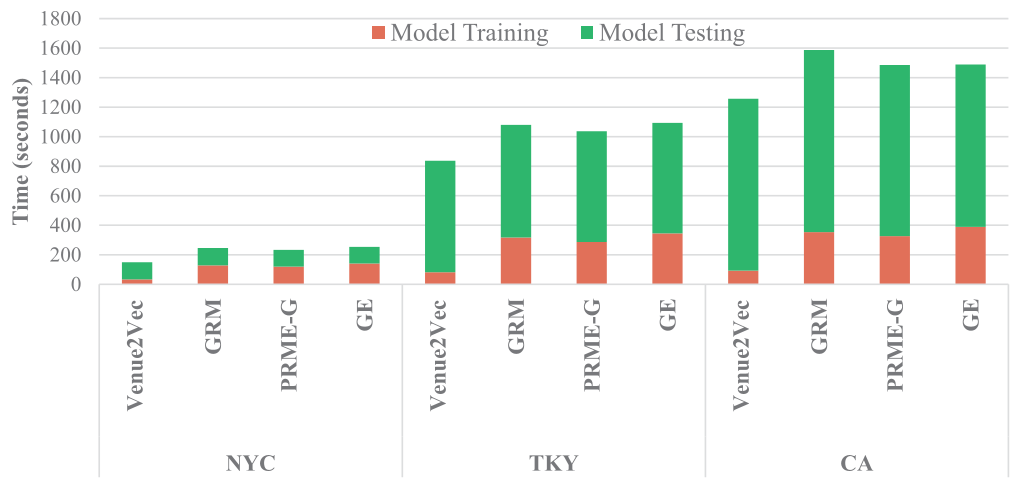
A stand-out feature of Venue2Vec is its scalability. By utilizing a parallelizable multi-threading strategy (similar to modern NLP libraries), the model reduces training time by up to 80%. In the world of Big Data, where models need to be retrained frequently as new venues open, this efficiency is a game-changer.
Deep Insight & Conclusion
Venue2Vec’s success highlights a critical insight: Geographical influence is often "baked into" sequential data. During hyper-parameter tuning, the authors found the best performance occurred when the explicit geographical influence factor () was set to zero in the embedding stage. Why? Because if you are going from A to B, they are likely already close.
Takeaway: Venue2Vec succeeds by not over-complicating the fusion. It lets the sequential data do the heavy lifting for the embedding, then applies a "spatial correction" using KDE at the final prediction step. This modular approach is far more robust than trying to force-fit everything into a single weighted sum.
Limitations: The model does not yet account for social friendship graphs, which we know influence where people hang out. Future iterations combining this embedding with Graph Neural Networks (GNNs) could potentially crack the remaining "cold-start" challenges for new users.