
Sensing the Human: Decoding Emotional Cues in Speech
Verbal and non-verbal cues in the communication of emotions
This paper presents a computational approach to emotion detection using a corpus of several thousand speech segments from English movies. The author develops emotion-specific language and prosodic models to classify "sad", "angry", and "neutral" states, achieving an accuracy comparable to human performance.
TL;DR
In the landscape of Human-Computer Interaction (HCI), computers have historically been "expressive but deaf" to human emotions. This research by Thomas Polzin (CMU) shifts the focus from emotion synthesis to detection. By training statistical models on movie data, the work demonstrates that machines can identify anger, sadness, and neutrality by analyzing both lexical choices (Bigram Language Models) and prosodic features (GMMs) with performance approaching human levels.
The "One-Sided" Interaction Problem
Early HCI research was obsessed with "talking heads"—avatars that could smile, frown, or gesture. However, Polzin argues this creates a "dangerously one-sided" interface. If a computer emotes heavily while remaining oblivious to a frustrated or sad user, the interaction becomes unnatural and even off-putting. The core challenge lies in the dual nature of speech: it carries both verbal content (words) and non-verbal cues (tone, rhythm, intensity).
Methodology: The Anatomy of an Emotion
The study breaks down emotional communication into two distinct channels:
1. Verbal Information (The "What")
The author hypothesized that certain word combinations are more probable when expressing specific emotions.
- Mechanism: Emotion-specific back-off language models.
- Intuition: By computing the probability of a word given its predecessor within an emotional context (e.g., "I hate" vs. "I am"), the system learns the "vocabulary of affect."
2. Non-Verbal Information (The "How")
Prosody is the musicality of speech. The research identifies 8 key features:
- Pitch (F0): Mean and variance of fundamental frequency (normalized by gender).
- Intensity: Volume dynamics normalized across different movie environments.
- Micro-perturbations: Jitter (pitch instability) and Tremor (intensity instability).
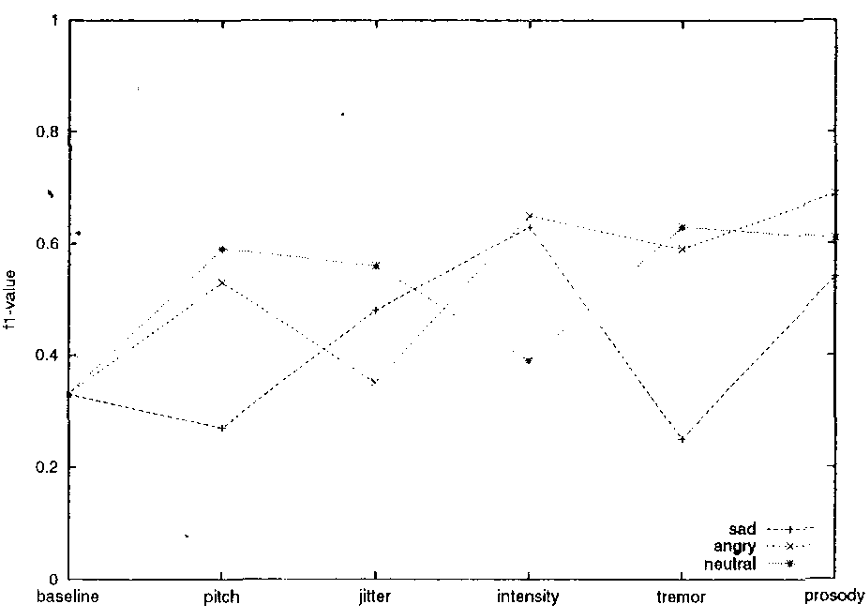 Figure 1: Comparison of F1-scores across individual prosodic features, showing how combined features (Prosody) stabilize detection across categories.
Experimental Results: Man vs. Machine
To benchmark the AI, Polzin conducted experiments with human listeners.
- Human Performance: Listeners were 70% accurate using audio and 55% accurate using only text.
- Machine Performance: The prosodic GMM reached 60.4% accuracy, while the language model hit 46.7%.
| Emotion | Human (Audio) | System (Prosody) | System (Verbal) |
|---|---|---|---|
| Angry | 0.80 | 0.69 | 0.47 |
| Neutral | 0.70 | 0.61 | 0.50 |
| Sad | 0.60 | 0.54 | 0.42 |
One striking insight is that both humans and machines find Anger the easiest to detect, followed by Neutrality and Sadness. This suggests that the acoustic "profile" of anger (typically higher intensity and pitch variance) is more distinct than the subtle markers of sadness.
Critical Analysis & Conclusion
While this work was a pioneer in using "real-world" movie data (instead of highly controlled laboratory recordings), it revealed a significant "accuracy gap." The machine models lagged behind humans by roughly 10%.
Takeaway: Effective emotion sensing cannot rely on a single feature. As seen in Figure 1, individual features often fail on specific emotions; only by aggregating multiple prosodic and verbal cues can a system achieve the robustness required for "natural" HCI.
Future Outlook: Modern developments in Deep Learning (e.g., Wav2Vec 2.0 and Large Language Models) have significantly surpassed these early statistical models. However, Polzin's fundamental insight remains: an interface that speaks but doesn't "feel" its user is structurally incomplete.