
GDE3: The New Gold Standard for Automated Analog Circuit Sizing?
Versatility and Population Diversity of Evolutionary Algorithms in Automated Circuit Sizing Applications
This paper evaluates five state-of-the-art Evolutionary Algorithms (EAs)—NSGAII, NSGAIII, GDE3, IBEA, and SPEA2—for automated analog circuit sizing. The study identifies GDE3 (Generalized Differential Evolution 3) as the most versatile and robust method, achieving superior population diversity and convergence on complex multi-objective voltage regulator design tasks.
TL;DR
Automating the "black magic" of analog circuit sizing is a holy grail in EDA. This study benchmarks five elite evolutionary algorithms (EAs), revealing that GDE3 (Generalized Differential Evolution 3) strikes the best balance between convergence and population diversity, outperforming the famous NSGA series in handling complex constraints and process variations.
Background: Moving Beyond Manual "Trial-and-Error"
In modern semiconductor design, engineers often spend weeks manually tweaking transistor widths and bias currents. This process is increasingly unsustainable as we move to leading-edge technological nodes. The industry is shifting toward simulation-based AI solutions, but the challenge remains: How do we navigate a multi-objective space (Gain, Power, Bandwidth, Noise) without getting stuck in local optima?
The Core Conflict: Exploration vs. Exploitation
The authors analyze a crucial trade-off in Multi-Objective Optimization Problems (MOOP). A designer doesn't just need one "best" solution; they need a Pareto front—a range of optimal trade-offs.
- The Problem: Many algorithms (like NSGAII) tend to cluster around specific points, losing "population diversity."
- The Metric: The study introduces the Distribution Metric (DM), which evaluates how uniformly the algorithm spreads its potential solutions across the design space.
Methodology: A Two-Step Evolutionary Approach
The task focused on a 2.5V voltage regulator with 8 parameters and 6 responses. The authors compared:
- NSGAII/III: The "industry standards" based on non-dominated sorting.
- SPEA2: Known for high-dimensional objective performance.
- IBEA: An indicator-based approach (highly accurate but slow).
- GDE3: A differential evolution hybrid.
Algorithm Calibration
Before testing on real circuits, the algorithms were tuned using the Walking Fish Group (WFG) benchmark.
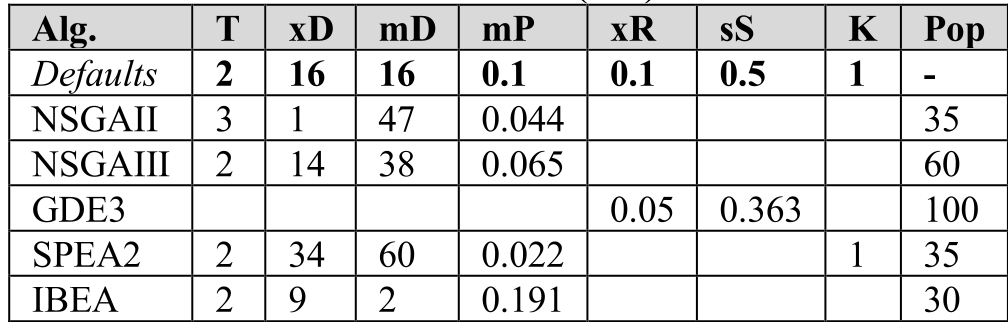 Insight: GDE3 thrives with larger populations (100+), allowing for a broader search of the design space.
Experimental Showdown: GDE3 vs. The World
The researchers tested the algorithms under two conditions: Nominal (ideal) and Process Corners (real-world variation).
1. The Power of Diversity
In nominal conditions (Figure 2), IBEA and GDE3 dominated in Hypervolume, meaning they found the most "optimal" area in the hyperspace. However, IBEA's computational cost makes it a "lab curiosity" for large-scale designs.
2. Handling the "Hard" Problem
When process corners (10 simulations per candidate) were introduced, the search space became significantly more rugged.
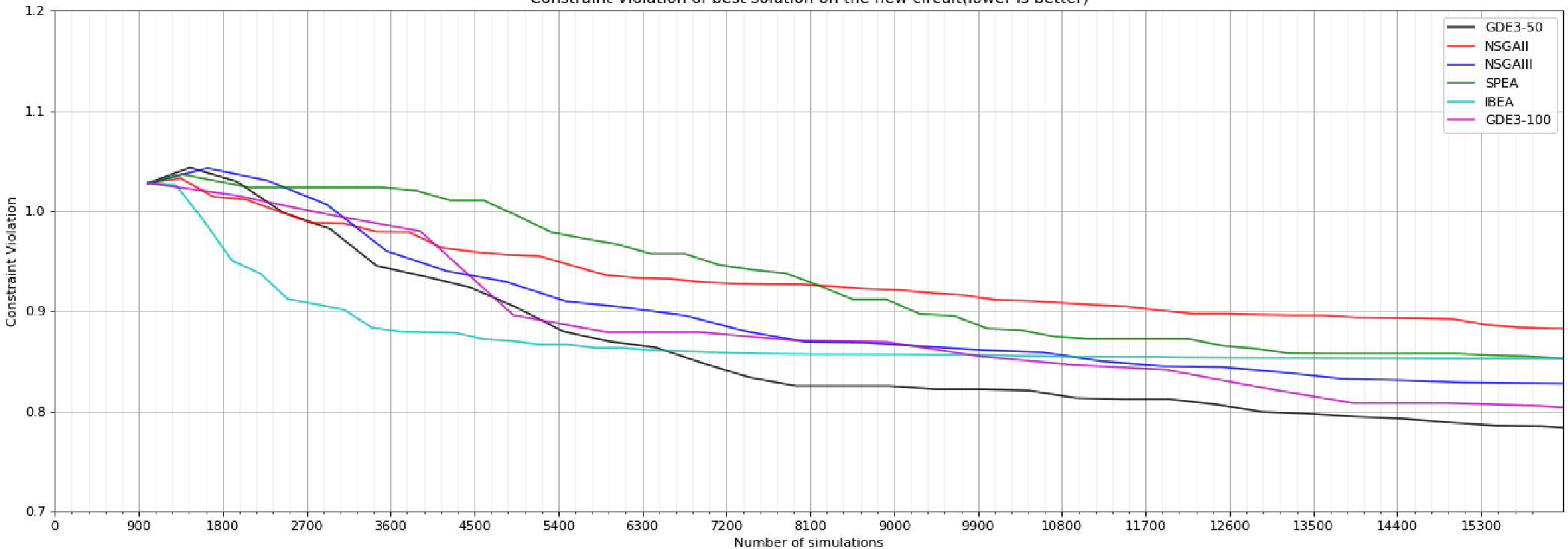 Figure: GDE3 (50 and 100 population) consistently achieved lower Constraint Violation (CV) than NSGAIII and SPEA2.
3. Consistency is King
One of the paper's most vital insights is standard deviation. GDE3 showed lower variance across different random seeds in later epochs. In professional EDA tools, reliability is paramount—engineers cannot rely on an algorithm that only works "every other Tuesday."
Critical Analysis: Why GDE3 Wins
Why does Differential Evolution (DE) succeed where Genetic Algorithms (GA) struggle?
- Differential Mutation: GDE3 creates new solutions based on the distance between existing members. This naturally scales the "step size" of the search: as the population converges, the search fine-tunes itself.
- Diversity Preservation: Unlike NSGAII’s "crowding distance," which can be brittle, GDE3’s pruning process maintains a more robust distribution of solutions (as shown in the DM analysis in Figure 4).
Summary & Future Outlook
The study concludes that GDE3 is the most versatile choice for automated circuit sizing. While it might converge slightly slower than aggressive-tuned methods, its stability and population diversity provide designers with a far more useful set of choices on the Pareto front.
The Next Frontier: The authors suggest that the future lies in Surrogate-Assisted Evolutionary Algorithms. By training a Machine Learning model to "mimic" the circuit simulator, we could potentially reduce the simulation budget from 16,000 runs to a few hundred, making AI-driven design faster than even the most experienced human engineer.
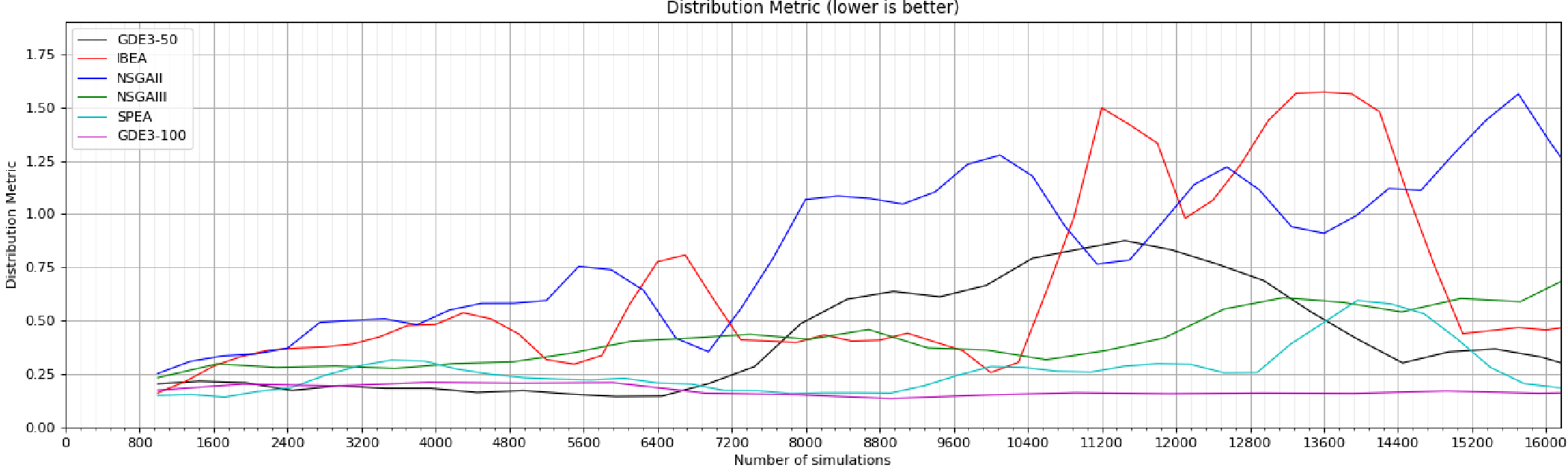 Figure 4: GDE3-100 maintaining superior population diversity through the end of the optimization process.