
Beyond Flat Selection: Unleashing Gene Ontology Structures for Aging Research
The version of record is available from
This paper presents a comprehensive empirical evaluation of Hierarchical Feature Selection (HFS) methods for gene classification in bioinformatics. It identifies the "Select Hierarchical Information Preserving" (HIP) method as the superior approach, achieving SOTA predictive performance on aging-related gene datasets by exploiting Directed Acyclic Graph (DAG) structured dependencies in the Gene Ontology.
TL;DR
Researchers have long treated Gene Ontology (GO) terms as a flat list of attributes, but this ignores the rich "is-a" hierarchy that defines biology. This paper proves that Hierarchical Feature Selection (HFS)—specifically the HIP method—massively outperforms traditional methods by exploiting these relationships. By integrating HFS with Bayesian Networks, the authors achieved superior accuracy and remarkable robustness against the "class imbalance" plague common in genomics.
The "Flat" Fallacy in Bioinformatics
In supervised learning for bioinformatics, we often encounter datasets where features are GO terms. If a gene is annotated with "Transport," it is inherently annotated with its parent "Localization."
- The Problem: Standard feature selection treats these as independent. This creates massive hierarchical redundancy.
- The Consequence: Classifiers get "confused" by redundant noise, and high-dimensional spaces lead to over-fitting, especially when positive samples (e.g., pro-longevity genes) are rare.
Methodology: The Logic of HIP and MR
The paper focuses on transition from "flat" to "hierarchical" logic. The standout method is HIP (Select Hierarchical Information Preserving Features).
1. The Logic of HIP (Lazy Selection)
HIP is "lazy," meaning it selects features for each gene individually during testing.
- If a feature is "1" (present), all its ancestors are removed (as they are implied).
- If a feature is "0" (absent), all its descendants are removed.
- Physics Intuition: It finds the "frontier" of information in the DAG—the most specific truths and most general falsehoods—stripping away everything else.
2. Bayesian Augmentation
The authors don't just use Naïve Bayes; they use BAN (Bayesian Network Augmented Naïve Bayes). Instead of learning dependencies from scratch, they bake the Gene Ontology DAG structure directly into the network edges. This saves computation and leverages decades of biological expertise.
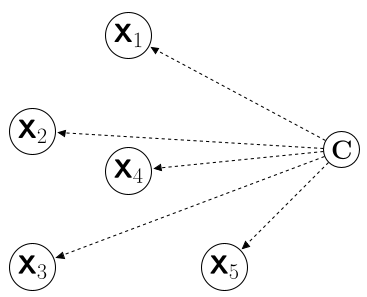 Figure 1: Comparison of NB, TAN, and BAN architectures. Note how BAN (c) allows complex dependencies derived from the GO DAG.
Experimental Showdown
The authors tested these methods on 28 datasets across four organisms (C. elegans, Fly, Mouse, Yeast).
Key Breakthrough: Robustness to Imbalance
One of the most impressive findings is shown in the correlation between GMean accuracy and class imbalance. In datasets like S. cerevisiae (yeast), the imbalance is extreme (84%).
- Flat Methods: Accuracy plummeted as imbalance increased (Correlation ).
- HIP Method: Maintained nearly flat performance (), proving that structural awareness acts as a natural regularizer.
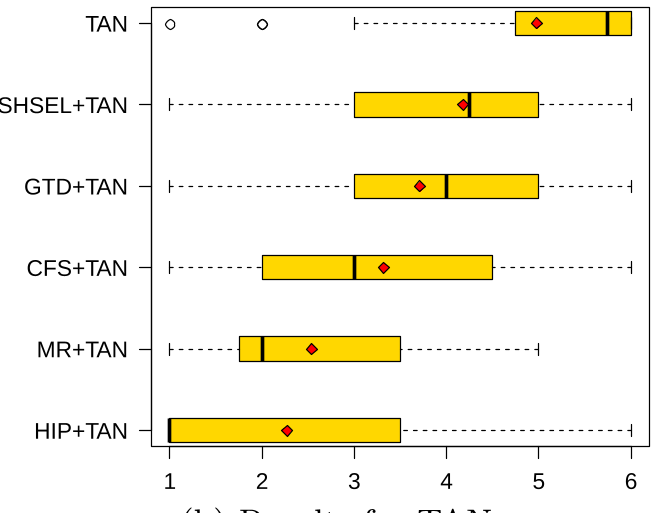 Figure 2: Rank distributions for different Feature Selection methods. HIP (bottom) consistently maintains the lowest (best) rank.
Biological Insights: What did the AI find?
The HIP method didn't just provide numbers; it identified "hub" GO terms that drive aging classification across species:
- Synapse (GO:0045202) and Extracellular Region (GO:0005576) appeared as top predictors across Worms, Flies, and Mice.
- Antioxidant Activity (GO:0016209) was confirmed as a primary "Pro-Longevity" feature, validating the Free Radical Theory of Aging through an algorithmic lens.
Critical Analysis & Conclusion
Why it Works
The success of HIP lies in its Information Preservation. Unlike other methods (like MR or GTD) that might discard a relevant feature because its "score" is low, HIP only discards what is logically redundant. This ensures the classifier has the most complete, yet lean, representation of the biological state.
Limitations
- Computational Overhead: Because HIP is "lazy," it runs at test time. For massive real-time systems, this might be slower than "eager" methods.
- Binary Constraint: The current logic relies on binary (present/absent) annotations. Extending this to continuous expression data remains a challenge.
Final Takeaway
This research is a masterclass in Informed Machine Learning. By respecting the hierarchical nature of biological data, we can build models that are not only more accurate but significantly more resilient to the data quality issues (like class imbalance) that plague the life sciences.