
Designing Search for the Next Generation: Vertical Selection for Children
Vertical Selection in the Information Domain of Children
The paper explores "vertical selection" in aggregated search tailored for children (ages 7-12). It introduces a novel test collection of 25 verticals and 3.8K queries, proposing a social-media-based representation and a child-suitability ratio (ReDDe-R) that significantly outperforms state-of-the-art baselines like Clarity and standard ReDDe.
TL;DR
Search for children isn't just about filtering the web; it's about finding the right type of content (coloring pages, stories, videos) across diverse platforms. This paper introduces a specialized framework for Vertical Selection that ignores traditional query-log-heavy methods in favor of social media tags and child-suitability ratios, achieving SOTA results for the 7-12 age demographic.
The "Visual Bias" Trap in Children's Search
When evaluating search results, researchers often use Paired Comparisons—showing a user "Vertical A" and "Web Results B" side-by-side. However, this study uncovers a critical flaw: Visual Bias. When children (or adults judging for children) see a list of colorful video thumbnails next to a list of blue text links, they almost always pick the colorful one, regardless of actual relevance.
To solve this, the authors propose a Single Vertical Assessment protocol. By judging verticals independently on a 5-point scale, they found a much more balanced and accurate distribution of what actually helps a child learn or play.
Methodology: Beyond Simple Crawling
The core of the paper's technical contribution lies in two areas:
1. The Child-Suitability Ratio (ReDDe-R)
Instead of just measuring how big a vertical is, the authors estimate its "Child Density." They use a "Capture-Recapture" statistical method with two sets of queries:
- Kids Queries: Extracted from AOL logs landing on Dmoz Kids/Teens categories.
- Adult Queries: General web queries.
By calculating the ratio of estimated sizes between these two, they could mathematically "boost" verticals like LiveScience or ScienceKids while penalizing massive general-purpose sites that are mostly adult-oriented.
2. Social Media Tag Representation
This is the most innovative part of the workflow. Because they couldn't see the internal index of third-party verticals (like Amazon or Wikipedia), they turned to Delicious (social bookmarking) tags.
- The Logic: If thousands of humans have tagged a URL as "math" or "lessons," that's a stronger signal for a child's "science fair" query than just the raw text on the page.
- The Implementation: They built a Language Model (LM) on these tags to rank how well a vertical's "flavor" matches the query's "intent."
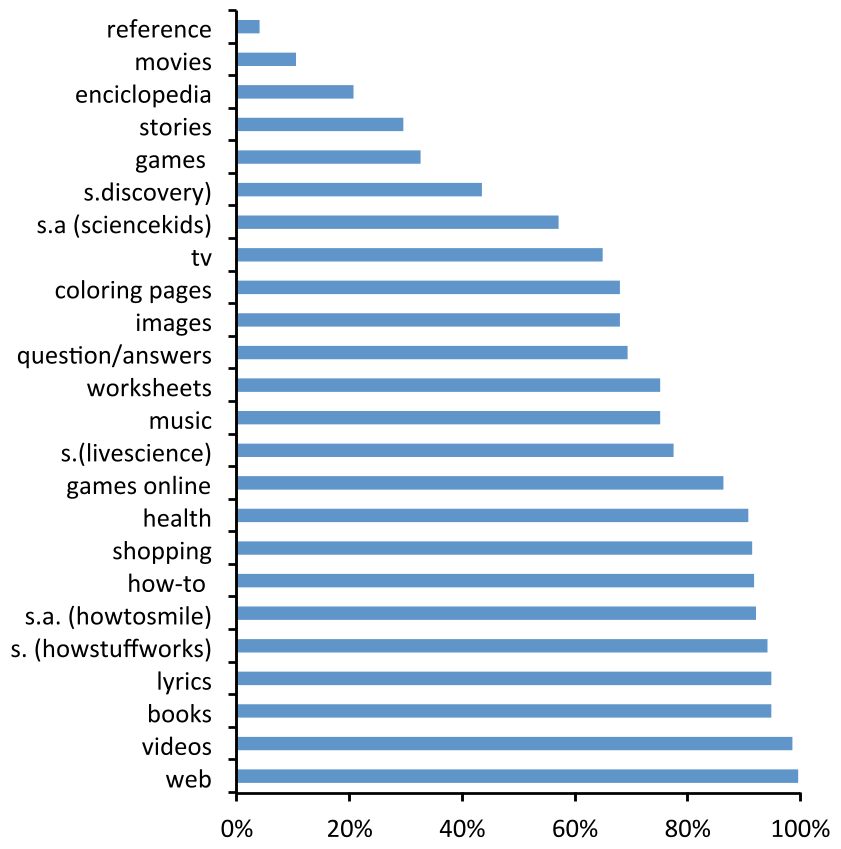 Figure 1: Query coverage across various verticals showing the dominance of Web/Video but the high relevance of niche services.
Experiments and Results
The authors tested several models, including Clarity and the standard ReDDe. Their combined model, LMReDDe-R (Language Model + ReDDe + Ratio), outperformed everything else.
| Method | MAP (Protocol A) | MAP (Protocol B) |
|---|---|---|
| Clarity | 0.242 | 0.305 |
| Standard ReDDe | 0.527 | 0.552 |
| LMReDDe-R (Proposed) | 0.564 | 0.564 |
Interestingly, when the "Web" vertical (Google) was removed from the experiment to focus on the difficulty of choosing between specialized services, the Social Media Tag (LM) method became the strongest performer. This suggests that for niche content, community-driven tags are more accurate than general search indexes.
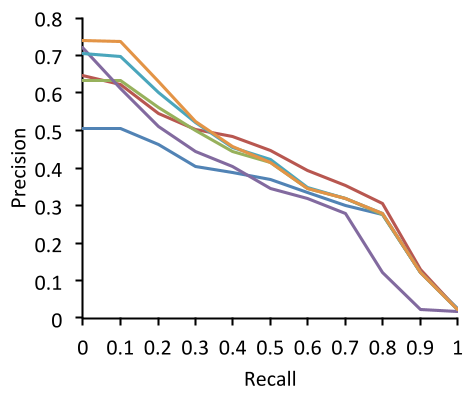 Figure 2: Precision-Recall curves showing the clear superiority of the proposed LM-based methods over traditional Clarity baselines.
Critical Analysis & Conclusion
Takeaway
The paper proves that "Vertical Selection" in specific domains requires domain-specific evidence. You cannot rely on general web-crawling statistics to serve sensitive or specialized demographics like children.
Limitations
- Adults as Proxies: The study used adults to judge what is "good for children." While adults can filter "bad" content, they might not always identify what is truly "engaging" for a 7-year-old.
- Tag Decay: The reliance on social media tags (Delicious) is brilliant but risky, as social bookmarking platforms evolve or disappear.
Future Impact
This work sets a blueprint for Aggregated Search in any specialized field—be it Medical Search for doctors or Legal Search for lawyers—by highlighting the need to balance multi-modal content (visuals) with topical depth.