
VGGT-Ω: Scaling Feed-Forward Reconstruction to the 10-Billion Parameter Frontier
VGGT- Ω
VGGT-Ω is a state-of-the-art feed-forward 3D/4D reconstruction model that scales geometric understanding to unprecedented model (up to 10B parameters) and data sizes. It achieves significant SOTA results across static and dynamic benchmarks, notably improving camera estimation accuracy on Sintel by 77%.
TL;DR
The "foundation model" era has finally arrived for 3D/4D reconstruction. VGGT-Ω demonstrates that the quality of 3D reconstruction scales predictably with model and data size. By optimizing the Transformer architecture for memory efficiency and curating a massive dataset of 4 million sequences, the authors have created a model that is not only 50x faster than optimization-based methods but also significantly more accurate.
The Motivation: Why Scale Reconstruction?
While Large Language Models (LLMs) have clear scaling laws, 3D computer vision has lagged behind. Existing feed-forward models like VGGT were limited by high GPU memory requirements—storing high-resolution activations and computing global attention across many frames made scaling nearly impossible.
The authors argue that reconstruction isn't just about depth maps; it's a foundational proxy task for spatial understanding. If a model can reconstruct a dynamic street scene, it inherently understands geometry, motion, and object permanence—knowledge essential for robotics and video generation.
The Method: Efficiency via "Register Attention"
The breakthrough in VGGT-Ω comes from solving the global attention bottleneck.
1. Register Attention
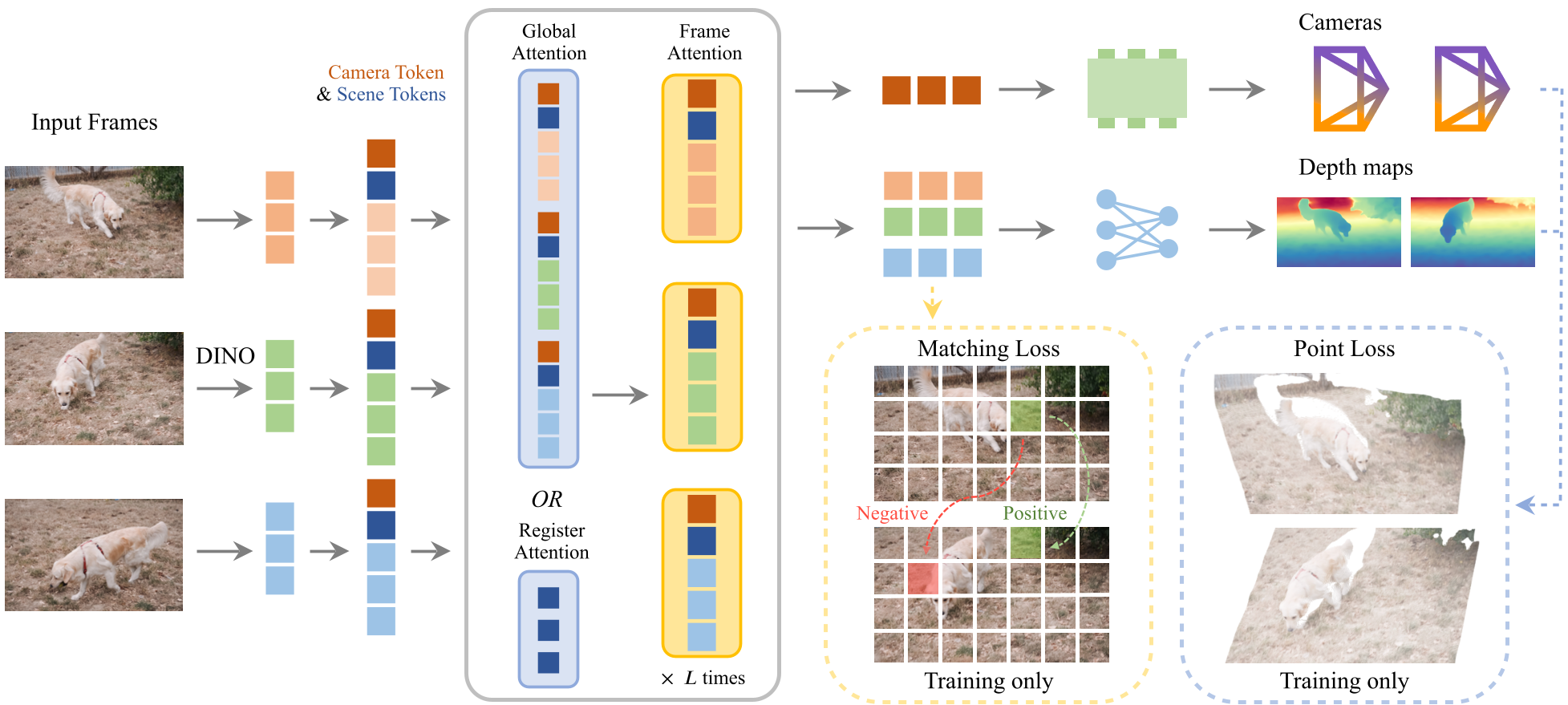
Instead of every pixel token in every frame attending to every other pixel token in the sequence, VGGT-Ω introduces Register Attention. In specific layers, tokens only exchange information via 16 "scene tokens" per frame. These registers act as a latent bottleneck, aggregating global scene context and redistributing it locally.
- Impact: Savings of ~23% FLOPs and 16% training memory without performance loss.
2. Streamlined Architecture
The authors removed redundant high-resolution convolutional layers in the prediction heads, replacing them with a simple MLP and a pixel-shuffle operator.
- Result: The model uses only 30% of the memory of the original VGGT during training.
Data: The 40-Million Video Filter
Scaling requires data. The team built a pipeline to harvest Internet-style videos, using Vision-Language Models (VLMs) for pre-filtering and COLMAP/VGGSfM for high-precision labeling. By prioritizing "quality over quantity," they filtered 40M videos down to 0.8M gold-standard sequences, augmenting them with synthetic data to reach 4M total training sequences.
Experiments & Results
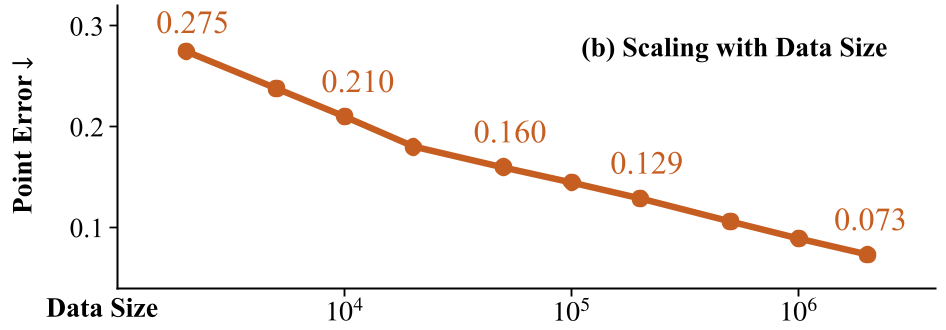
VGGT-Ω's scaling behavior follows a clear power-law distribution. As parameters increase from 0.2B to 10B, the 3D point error drops dramatically.
Quantitative Dominance
On the challenging Sintel benchmark (dynamic data):
| Metric | MegaSaM (Optimization) | DA3 (Feed-forward) | VGGT-Ω (10B) |
|---|---|---|---|
| AUC@3° | 22.5 | 16.2 | 40.0 (+77% jump) |
| δ1.25 | 74.1 | 86.1 | 93.5 |
Visual Fidelity
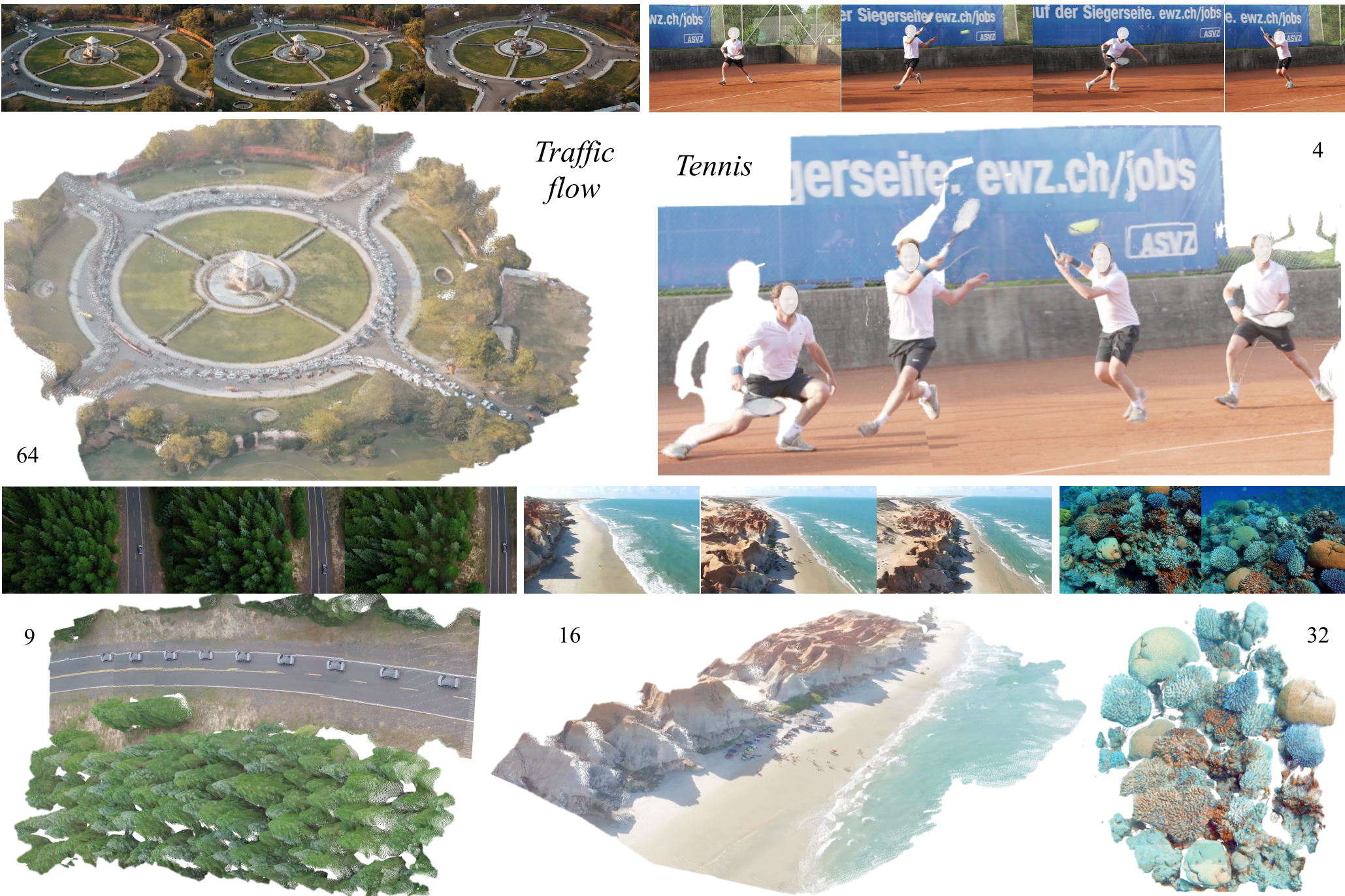
The model thrives where others fail: repetitive textures (snow fields), fast camera rolls (drone footage), and non-rigid motion (dancing).
Deep Insights: Beyond Geometry
Perhaps the most exciting discovery is that these "Registers" aren't just technical tricks—they are Semantic Vessels. When used as plug-and-play tokens for a Vision-Language-Action (VLA) model, they improved robotic manipulation task success rates. The authors even successfully aligned these registers with natural language descriptions in a zero-shot retrieval task.
Summary & Future Outlook
VGGT-Ω proves that 3D perception can benefit from the same "bigger is better" philosophy as NLP. While limitations remain—such as struggles with extreme motion blur or "fake" synthetic backgrounds—the move toward an "Omni-model" where reconstruction, generation, and language are trained together seems inevitable.
For the vision community, VGGT-Ω provides a new backbone for 3D tasks that is robust, lightning-fast, and semantically rich.