
VIB-Probe: Distilling Internal Attention for Faithful Vision-Language Generation
VIB-Probe: Detecting and Mitigating Hallucinations in Vision-Language Models via Variational Information Bottleneck
VIB-Probe is a novel framework for detecting and mitigating hallucinations in Vision-Language Models (VLMs) by analyzing internal attention head outputs. It leverages Variational Information Bottleneck (VIB) theory to distill compact, hallucination-predictive latent representations, achieving state-of-the-art performance across multiple benchmarks including POPE and M-HalDetect.
Executive Summary
TL;DR: VIB-Probe is a sophisticated framework that looks inside the "black box" of Vision-Language Models (VLMs) to identify the internal signals that lead to hallucinations. By applying Variational Information Bottleneck (VIB) theory to multi-layer attention head outputs, it filters out syntactic noise to detect when a model is about to "lie." Furthermore, it uses gradient-based attribution to suppress "hallucination-sensitive" heads during inference, significantly improving the truthfulness of generated content without requiring model retraining.
Academic Positioning: This work moves beyond shallow output-layer heuristics (like entropy) towards Mechanistic Interpretability. It treats hallucinations as an internal informational drift that can be regularized and controlled through information theory.
Problem & Motivation: Why Do VLMs "Hallucinate"?
Despite their prowess, VLMs like LLaVA or Qwen-VL often describe objects not present in an image—a phenomenon known as hallucination. Current detection methods usually check the model's confidence (logits) or use another model to verify the output.
However, the authors argue that the seeds of hallucination are sown much earlier, within the internal attention dynamics. The problem is that these internal states are incredibly noisy, mixing complex linguistic syntax with actual visual grounding. Directly probing these states is like trying to hear a whisper in a crowded room; VIB-Probe act as the "noise-canceling headphones" that isolate the signal of unfaithfulness.
Methodology: The Information Bottleneck Approach
The core innovation lies in treating attention head outputs as a high-dimensional signal that needs compression.
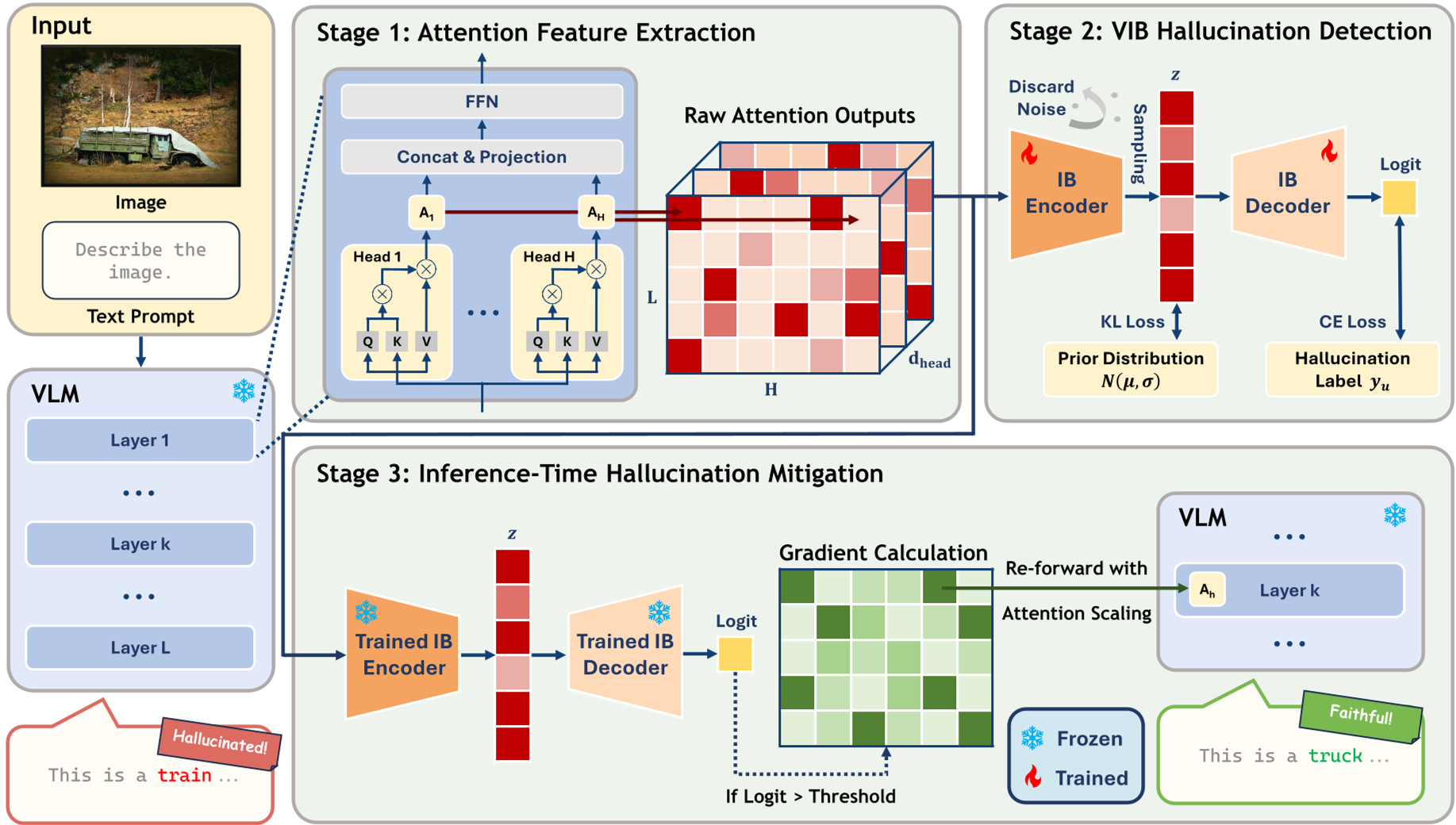
1. Feature Extraction
The framework extracts the pre-projection attention head outputs () from every layer and every head during each decoding step. This creates a rich representation tensor that captures how the model is currently relating text to image tokens.
2. The Variational Information Bottleneck (VIB)
Instead of a simple classifier, the authors use VIB theory. The goal is to find a latent representation that:
- Maximizes predictive power: must accurately predict if the current token is a hallucination.
- Minimizes retained information: must discard "semantic nuisances" (irrelevant syntactic patterns) from the raw attention signals.
3. Inference-Time Mitigation
When the VIB-Probe detects a high risk of hallucination (logit ), it triggers an intervention. By calculating gradients from the probe's output back to the attention heads, the system identifies which heads are the most "guilty" of causing the hallucination. It then applies a suppression update, down-weighting these heads before regenerating the token.
Experiments & Results: SOTA Performance
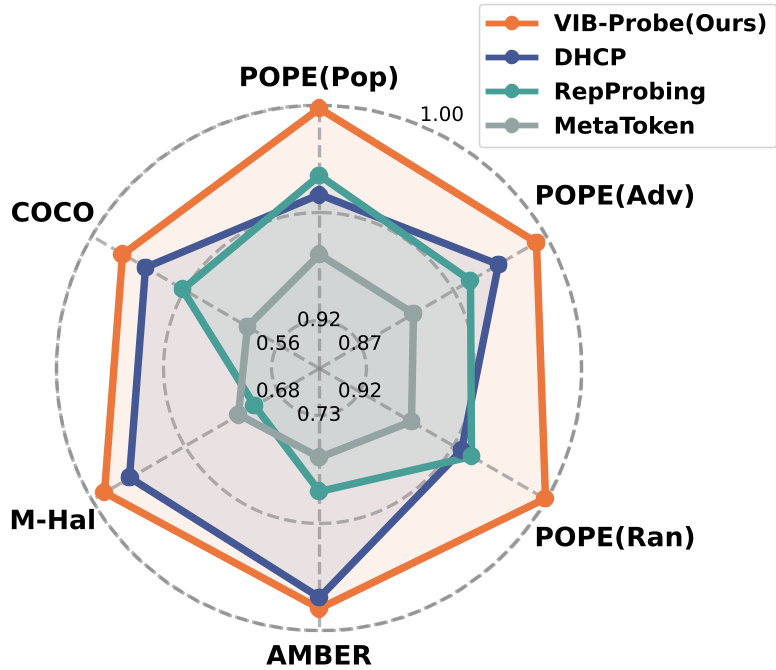
VIB-Probe was tested against strong baselines like DHCP and MetaToken across diverse benchmarks:
- Detection Accuracy: On the POPE benchmark, VIB-Probe achieved an AUPRC of up to 96.96%, outperforming traditional uncertainty-based methods.
- Generative Excellence: In complex, free-form tasks (M-HalDetect), it showed a +2.84% average improvement over existing SOTA methods.
- Robustness: The probe remains effective even when images are perturbed with Gaussian blur or rotation, proving it captures core internal states rather than just low-level visual features.
Ablation Insight: The Power of KL-Divergence
A key finding in the ablation study was that removing the KL-loss (the bottleneck constraint) caused performance to drop significantly. This confirms that the compression aspect of VIB is what allows the probe to generalize so well across different tasks and architectures.
Critical Analysis & Conclusion
Takeaway: VIB-Probe proves that we don't necessarily need more training data or bigger models to solve hallucinations; we need better ways to monitor and regulate the models' internal "thought process."
Limitations:
- White-box access: The method requires access to internal attention weights, making it unusable for closed-source APIs like GPT-4o or Claude 3.5.
- Computational Overhead: While "lightweight," extracting all attention head outputs for every token adds latency compared to simple greedy decoding.
Future Work: Extending this "probing-as-control" paradigm to non-Transformer architectures (like Mamba or modern SSMs) could be a game-changer for the next generation of multimodal agents.