
Intelligent IC Engine Diagnostics: Bridging Vibration Analysis and Tree Classifiers
Vibration Based IC Engine Fault Diagnosis Using Tree Family Classifiers - A Machine Learning Approach
This paper presents a machine learning-based approach for monitoring and diagnosing faults in a Compressed Ignition (CI) engine fueled by fish oil biodiesel. By extracting statistical features from raw vibration signatures and applying the Tree family of classifiers (J48 and Hoeffding Tree), the study achieves a state-of-the-art diagnostic accuracy of 97% using the Hoeffding Tree algorithm.
TL;DR
Predictive maintenance is the backbone of modern automotive engineering. This research demonstrates a highly efficient pipeline for diagnosing faults in CI engines using biodiesel: capturing high-frequency vibration signatures, extracting critical statistical markers, and classifying them with Hoeffding Trees. The result? A 97% accuracy rate that paves the way for real-time, on-board engine health monitoring.
Problem & Motivation: The Noise in the Machine
Internal Combustion (IC) engines are inherently chaotic environments. The combination of unbalanced rotating parts, reciprocating masses, and varying gas pressures creates a complex vibration profile. For engines running on alternative fuels like fish oil biodiesel, these profiles become even more nuanced.
The core challenge isn't just "finding a fault"—it's doing so efficiently. Previous methods often suffered from computational bloating (processing too many useless features) or static learning limitations (inability to handle data streams). The authors sought to identify which specific "fingerprints" in the vibration data matter most and which algorithm can process them with the highest precision.
Methodology: From Raw Signals to Decision Trees
The study utilized a single-cylinder CI engine equipped with a piezoelectric shear accelerometer. Data was funneled through an NI-9234 DAQ system at a 25 kHz sampling rate.
The Pipeline:
- Feature Extraction: Converting raw time-domain signals into 12+ statistical features (Mean, Variance, Kurtosis, etc.).
- The Hoeffding Advantage: Unlike standard decision trees (like J48) that need the full dataset to find a split, the Hoeffding Tree uses a mathematical bound to make decisions based on a small subset of data. This "incremental" nature makes it ideal for real-time streaming data from an engine sensor.
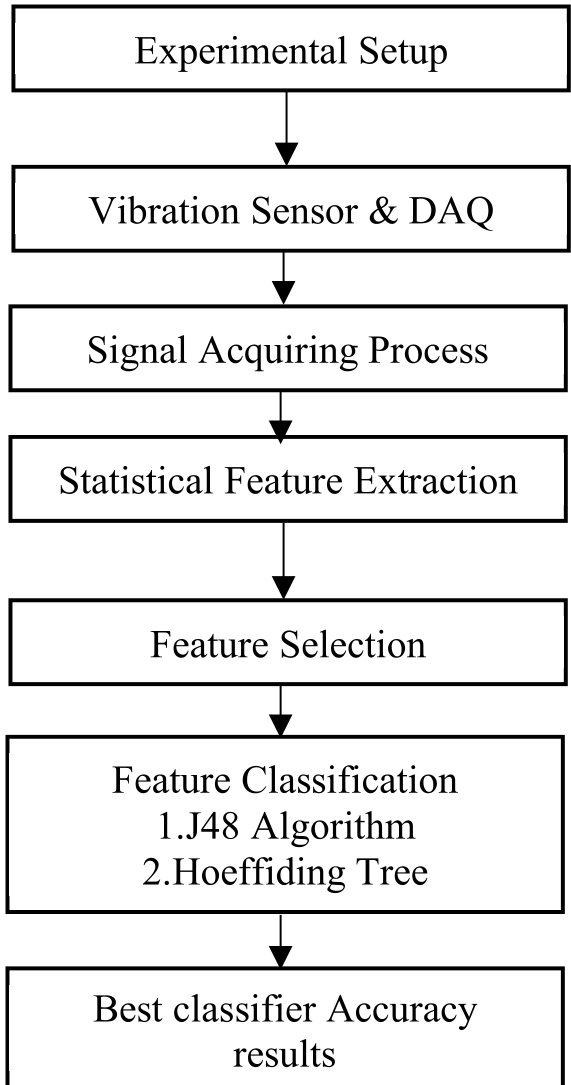 Figure 1: The proposed diagnostic workflow from vibration acquisition to classification.
Experiments & Results: Efficiency Wins
The researchers compared two primary models: J48 (a C4.5 implementation) and the Hoeffding Tree.
- J48 Performance: Reached 95.4% accuracy. It performed well but was sensitive to the number of features used, requiring careful pruning (sub-tree replacement/raising) to avoid overfitting.
- Hoeffding Tree Performance: Achieved a superior 97% accuracy. Remarkably, it only required four key features—Standard Error, Kurtosis, and Skewness—to reach this peak.
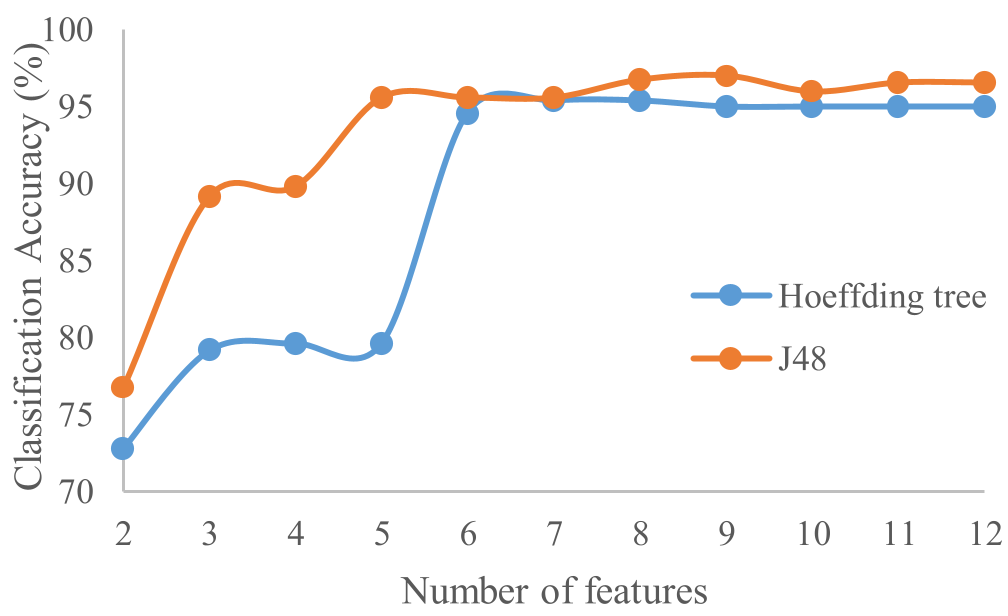 Figure 2: Analysis showing how J48 accuracy fluctuates with feature count, highlighting the importance of feature selection.
Looking at the confusion matrices, the Hoeffding Tree showed exceptional robustness in distinguishing between different load conditions (L0 to L20), with very few misclassifications compared to the J48's tendency to confuse mid-load categories.
Critical Insight & Conclusion
The true value of this paper lies in the validation of Kurtosis and Skewness as dominant indicators of mechanical health. In vibration analysis, these "higher-order moments" are sensitive to the "peakedness" and asymmetry caused by impacts or irregular combustion—far more so than simple averages.
Takeaway for Engineers:
If you are building an edge-computing device for engine monitoring, don't throw deep learning at it first. This study proves that a lightweight Hoeffding Tree combined with just three or four well-chosen statistical features can outperform more complex models while remaining computationally inexpensive enough to run on simple microcontrollers.
Limitations: The study was conducted at a constant speed (1800 rpm). Future research must address variable speed profiles, where vibration frequencies shift dynamically, potentially requiring more advanced time-frequency domain features (like Wavelets).