
Scaling Human Intelligence: The Cascade Microtask Approach to Video Annotation
Video Annotation by Cascading Microtasks: a Crowdsourcing Approach
This paper introduces a microtask-based crowdsourcing framework for video annotation, proposing a "cascading" workflow that decomposes complex enrichment tasks into simple, sequential micro-steps. The method achieves high-quality video augmentation—including image overlays and hyperlinks—using untrained workers rather than experts or complex automated systems.
TL;DR
While AI continues to advance, high-quality video understanding still relies heavily on dense metadata. This paper proposes a crowdsourcing architecture that replaces expensive experts with a "cascade" of simple, unskilled microtasks. By breaking down the complex act of video enrichment into four distinct, sequential steps—Identify, Suggest, Rank, and Position—the researchers demonstrate that a heterogeneous crowd can produce sophisticated, interactive video content using only basic web tools.
The "Complexity vs. Effort" Paradox
In the realm of video annotation, we often face a trade-off: Automation is fast but lacks semantic nuance in "unstructured" scenarios, while Manual Annotation is accurate but becomes exponentially more expensive as tasks grow complex.
The authors argue that prior crowdsourcing attempts failed because they asked too much of the worker. When a contributor is asked to identify an object, find a source, and position an overlay all at once, the task becomes "tedious and time-consuming." The research intuition here is simple: High-quality output doesn't require high-skill workers; it requires a high-quality process.
Methodology: The Cascading Pipeline
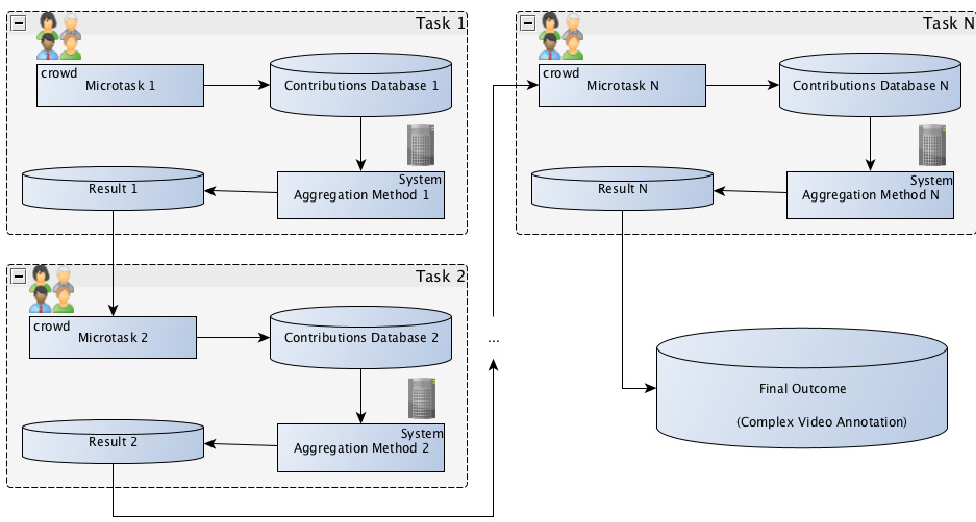
The architecture is built on a modular "Step-by-Step" philosophy. Instead of a single worker doing everything, the "Knowledge" flows through a pipeline:
1. The Workflow (Three-Step Process)
The system follows a linear progression through Preparation, Annotation, and Presentation. The genius lies in the Annotation step, where microtasks are cascaded.
2. The Four-Cell Cascade
To turn a raw video into an "enriched" multimedia experience, the paper splits the labor:
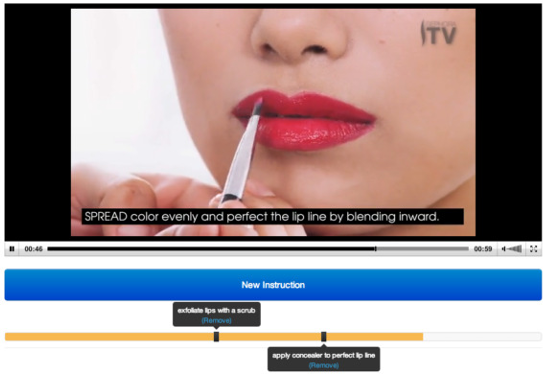
- Cell 1 (Identification): Workers mark "Points of Interest" (e.g., a term needing a definition).
- Cell 2 (Suggestion): New workers suggest content (text/images) for those specific points.
- Cell 3 (Ranking): A third group votes on the most appropriate suggestion to ensure quality.
- Cell 4 (Positioning): A final group determines exactly where the metadata should appear on-screen to avoid occluding the main action.
Each cell includes an Aggregation Method (like Average Coordinates or Ranking by Voting) to filter out "noise" and "spam" from the crowd before the data reaches the next stage.
Experimental Evidence: Success in the Wild
The researchers tested this with two one-minute videos and a volunteer crowd recruited via social media. The results validated their "lower the bar" strategy:
- Worker Efficiency: The simplest task (Task 4: Clicking a position) garnered 541 contributions in 24 hours compared to only 68 for the more cognitively demanding Task 1.
- Scalability: By keeping each microtask active for only 24 hours, they proved the system could rapidly iterate from raw video to a finished presentation.
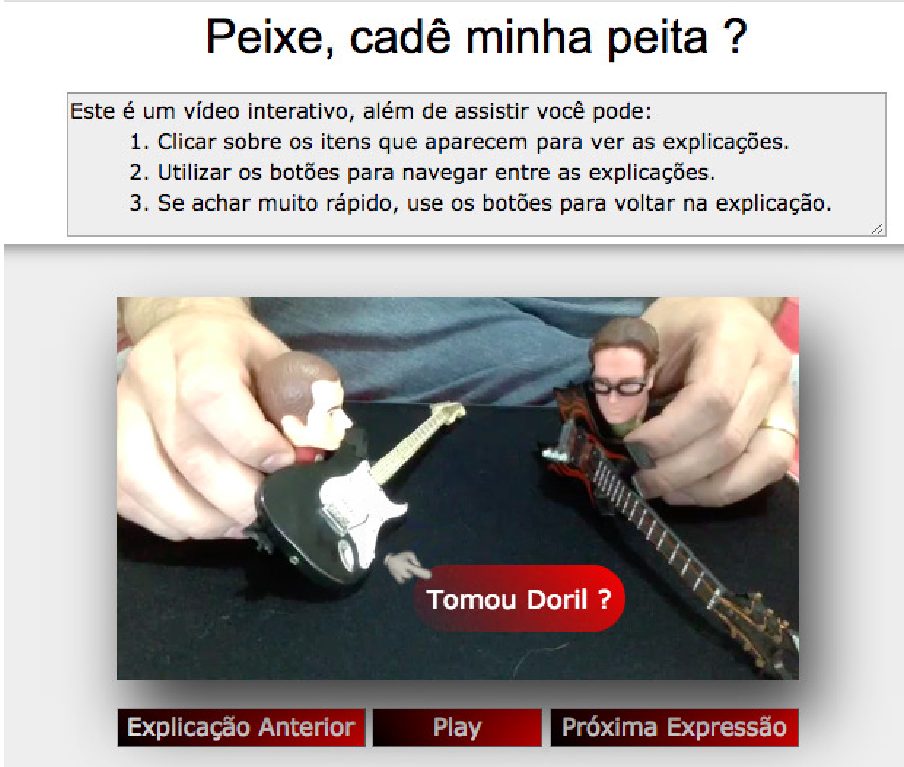
- Outcome: The final product was an interactive video player where users could click on "enriched" content to see side-bar explanations—a result typically requiring professional editing.
Depth Insight: Why Cascading Matters
The primary academic value of this work is the verification of the "Wisdom of Crowds" through a pipeline rather than a snapshot. By decoupling the tasks:
- Inductive Bias of Tasks: The system creates an "assembly line" for digital work, where the "Expertise" is embedded in the structure of the tools, not the mind of the worker.
- Modular Extensibility: As shown in the experiment, the authors could add a "Positioning" task after the initial experiment was done to improve the UI. This modularity is a massive advantage over monolithic annotation systems.
Conclusion and Outlook
This 2017 study serves as a foundational blueprint for modern data labeling services. While we now use AI to assist these workers, the "Microtask Cascade" remains the gold standard for ensuring diverse, high-fidelity datasets. The limitation, however, remains the bottleneck of manual aggregation—moving forward, integrating Large Language Models (LLMs) to perform the "Ranking" and "Merging" (Tasks 3 and 1) could make this system truly autonomous.
Takeaway: If a task feels too hard for the crowd, don't find a smarter crowd—build a smaller task.