
GenCeption: Can Video Generation Models Become the 'Next-Token Predictors' of Vision?
Video Generation Models are General-Purpose Vision Learners
GenCeption is a unified general-purpose vision model that repurposes large-scale text-to-video diffusion backbones (e.g., WAN 2.1) into efficient feed-forward perception engines. By leveraging spatiotemporal world priors from generative pre-training, it achieves SOTA performance across diverse tasks including depth estimation, surface normals, and 3D keypoint prediction, outperforming specialized models like DepthAnything3 and SAM3.
Executive Summary
In the world of NLP, the "next-token prediction" objective acted as a catalyst, transforming specialized models into the generalist giants we know as LLMs. Computer Vision, however, has remained largely fragmented, relying on task-specific heads for depth, segmentation, and pose. GenCeption fundamentally challenges this status quo by positing that large-scale text-to-video generation is the missing universal pre-training paradigm.
By repurposing a video diffusion model (WAN 2.1) into a single-step feed-forward architecture, GenCeption masters a spectrum of vision tasks—from 3D geometry to expressive segmentation—using a unified head and a single loss function. It doesn't just synthesize pixels; it understands the physical "world model" underlying them.
The Core Motivation: Beyond Specialized Perception
Current vision foundation models like Segment Anything (SAM) or Depth Anything are impressive but remains "narrow." They require architectural modifications for new tasks. The authors argue that a true generalist vision model requires three ingredients:
- Spatio-Temporal Evolution: Internalizing 4D causality and physics.
- Vision-Language Alignment: Native instruction-following.
- Scalability: A paradigm where data and compute lead to emergent intelligence.
Text-to-video generation satisfies all three. Generating a consistent video requires a model to "know" about gravity, object permanence, and 3D structure.
Methodology: Repurposing Diffusion for Speed and Precision
The technical brilliance of GenCeption lies in its transition from Iterative Generation to Feed-Forward Perception.
1. The Feed-Forward Shift
Instead of the slow 50-step denoising process typical of diffusion models, GenCeption uses a single forward pass. By setting the timestep (the noise-free limit in Rectified Flow) and negating the predicted velocity, the model acts as a powerful feature extractor that maps directly from input video to the target modality.
2. Unified Task Representation
GenCeption treats all visual tasks as sequence-to-sequence mapping.
- Dense Tasks: Depth, surface normals, and segmentation are all projected into a 3-channel RGB "ambient space." Even high-dimensional camera poses are mapped to a 3-channel "Rothko" Raymap.
- Sparse Tasks: For coordinates like 3D keypoints, the model appends learnable tokens to the Latent Diffusion Transformer (DiT), which are decoded via a simple MLP.
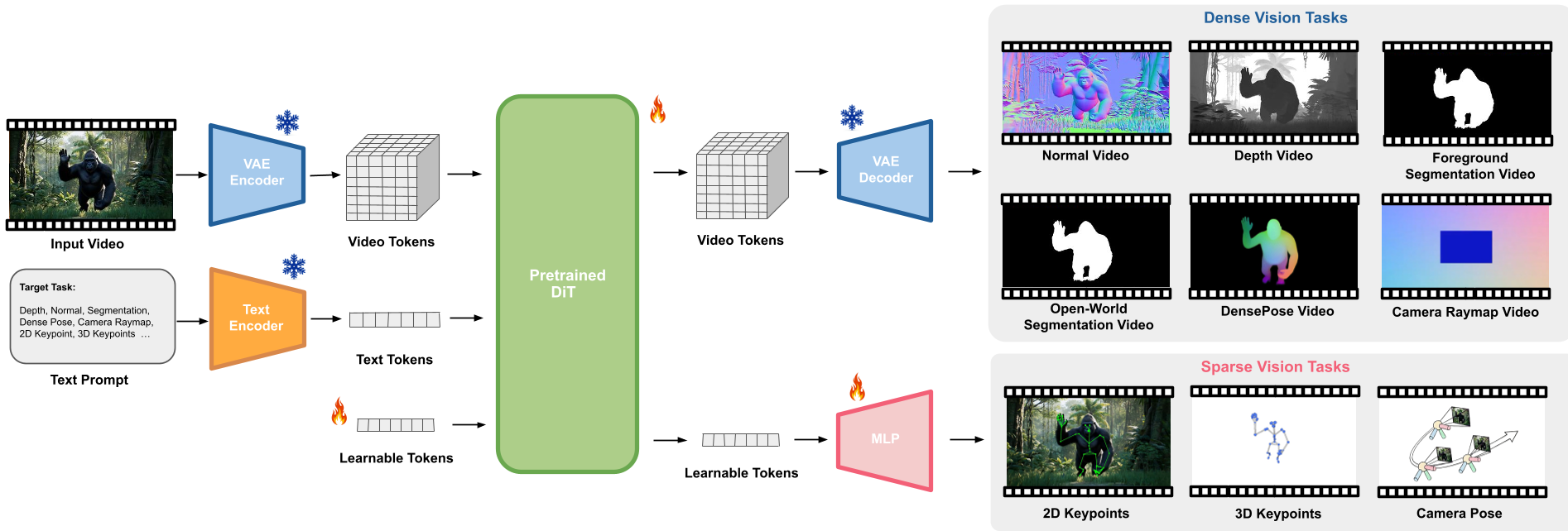 Figure 1: GenCeption Architecture. The input video and text prompt steer the unified DiT to output the desired modality in a single pass.
Experimental Breakthroughs: SOTA and Efficiency
GenCeption was trained primarily on 7,500 synthetic videos of humans, yet its performance on real-world benchmarks is staggering.
- SOTA Parity: It matches or exceeds specialized models like DepthAnything V3 and Lotus-2 across multiple benchmarks (Sintel, KITTI, ETH3D).
- Data Efficiency: Most impressively, GenCeption achieves SOTA results with 7x to 500x less training data than previous leaders like D4RT. This suggests the generative pre-training provides a "head start" that discriminative methods like VideoMAE lack.
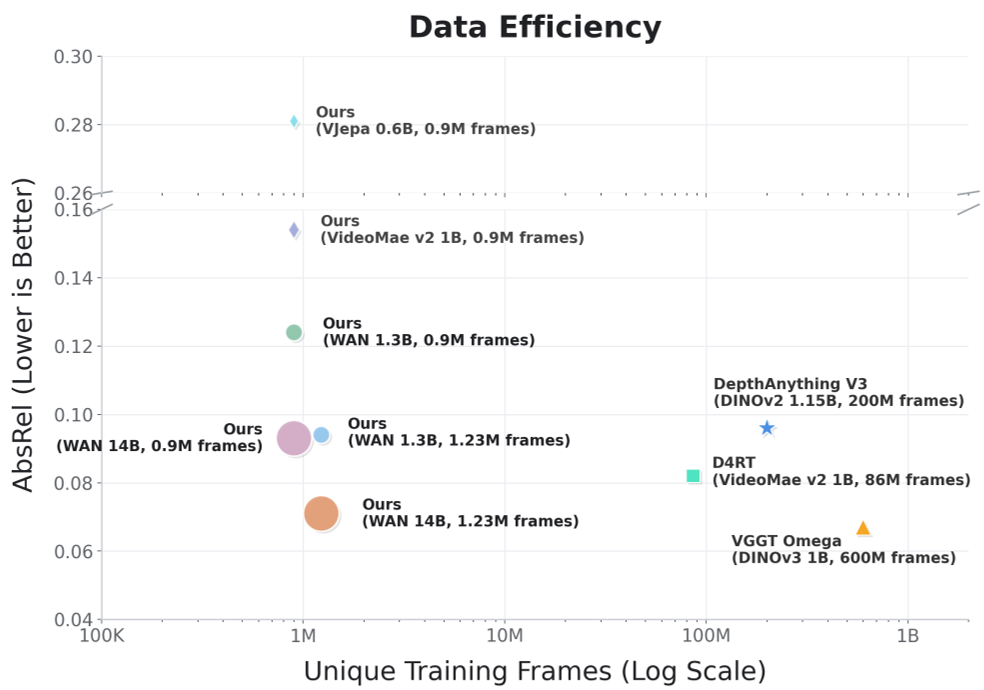 Figure 2: Scaling and Efficiency. The generative backbone (WAN 2.1) significantly outperforms V-JEPA and VideoMAE V2 under identical fine-tuning conditions.
Emergent Behaviors: The World Model at Work
The most exciting aspect of GenCeption is its emergent intelligence. Despite being trained only on synthetic humans:
- Sim-to-Real: It generalizes perfectly to real-world footage.
- Out-of-Distribution (OOD): It accurately predicts depth and segmentation for cats, robots, and anthropomorphic characters—categories it never saw during post-training.
- Complex Instruction Following: It outperforms SAM3 in understanding complex linguistic queries for video segmentation.
Critical Analysis & Conclusion
Takeaways: GenCeption marks a paradigm shift. It proves that we don't need task-specific losses or complex encoders. If a model can generate a physically plausible world, it can perceive it.
Limitations: The authors noted that joint training with sparse tokens (for coordinates) can sometimes degrade dense task performance. This suggests that "pixel-space" remains the most natural domain for diffusion backbones, and forcing them into coordinate regression requires further architectural refinement.
Future Work: As video generation models scale (Sora, Kling, etc.), the perception capabilities "hidden" within them will likely become the foundation for autonomous robotics and general-purpose visual AI. GenCeption is the first robust step into this new era.