
Deciphering the Viral Code: How Videos Propagate in Online Social Networks
Understanding video propagation in online social networks
This paper presents a large-scale measurement study of video propagation across RenRen (OSN) and Youku (VSS). It proposes a modified Galton-Watson stochastic branching model to simulate how video links spread through social friendship networks, achieving a high-fidelity match with real-world viral structures.
TL;DR
Why do some videos explode into global sensations while others, equally good, die in obscurity? By analyzing millions of interactions between RenRen (China's Facebook) and Youku (China's YouTube), researchers have found that video popularity in social networks is far more skewed and random than previously thought. This paper uncovers that a mere 0.31% of videos account for 80% of total views, driven not by the number of people who start the trend, but by the "height" of the resulting propagation tree and pure stochastic luck.
The "Social" Difference: VSS vs. OSN
Historically, videos on sites like YouTube (Video Sharing Sites, or VSS) were discovered via search bars or related-video sidebars. In Online Social Networks (OSN), the discovery mechanism is fundamentally different: The News Feed.
The authors identified a critical disconnect: many videos popular on Youku are ignored on RenRen, and vice versa. In an OSN, a video’s fate is determined by the "Friendship Graph." This leads to an extreme Pareto distribution—OSNs amplify the "winner-takes-all" effect even more aggressively than traditional video platforms.
Deep Dive into Methodology: The Branching Forest
The study defines the lifecycle of a video as a Forest of Trees.
- Initiators: Users who bring the link from Youku to RenRen.
- Viewers: Those who watch.
- Spreaders: Those who watch and reshare.
Contrary to intuition, the authors found that the number of original initiators has a very weak correlation (ρ=0.189) with the video's eventual success. You don't need many people to "start" a fire; you need the fire to reach the right "Super Spreaders" (influencers) who can sustain the branching process.
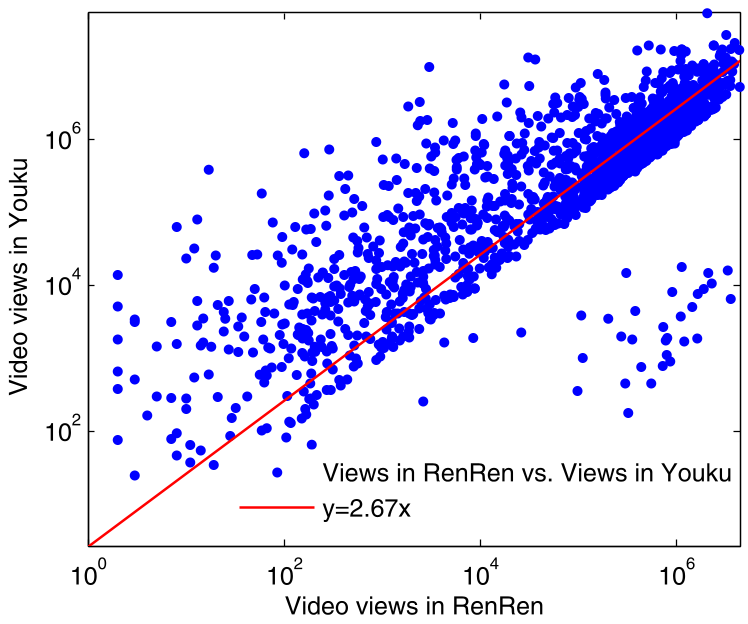 The correlation between VSS and OSN popularity is positive but far from linear, showing that social dynamics override algorithmic recommendations.
The Model: Modified Galton-Watson Process
To explain the randomness, the researchers adapted the Galton-Watson stochastic branching process. Standard models assume a uniform branching factor. This paper modifies it by introducing:
- Branching Factor (BrF): How many friends a spreader reaches.
- Share Rate (ShR): The probability that a viewer becomes a spreader.
The key insight? These factors are largely level-independent. Whether you are the 1st person or the 10th person in a chain to see a video, your likelihood of sharing depends more on the content's inherent "virality" and your social circle than your distance from the source.
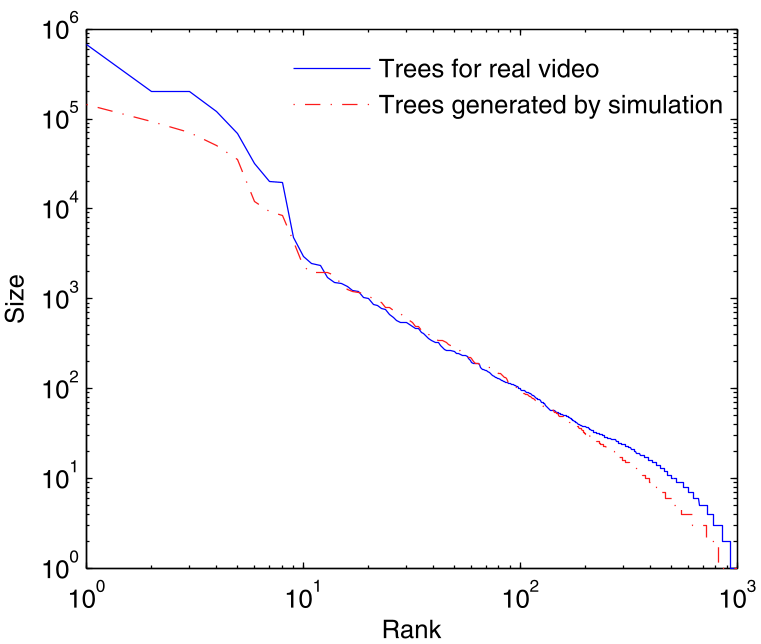 The simulation (bars) matches real-world data (line) remarkably well, proving that stochastic branching is the primary driver of video spread.
Experiments & Results: The Power of Randomness
The researchers tracked a representative popular video with over 995,000 viewers. They observed that the largest "tree" in its forest didn't necessarily start earlier; it simply hit "Super Nodes"—users with millions of followers—at the right time.
| Metric | Correlation with Views |
|---|---|
| Initiators | 0.1895 (Low) |
| Share Rate | 0.0092 (Near Zero) |
| Tree Height | 0.564 / 0.856 (High) |
| Total Shares | 0.9138 (Very High) |
The data suggests that the "Interest Duration" (reflected in the Tree Height) is the true north star. If a video can survive the first few rounds of sharing without the chain breaking, it enters a "supercritical" state where it can reach massive audiences.
Critical Insight & Future Outlook
This work provides a logical foundation for why viral marketing is so hit-or-miss. Because the process is stochastic (random), the same video could go viral in one social cluster and die in another purely based on whether it hits a "super node" early on.
Limitations: The model assumes a static interest in the video. In reality, "Internet Fatigue" exists—after a week, even the best video loses its sharing steam. Future work should integrate temporal decay into the branching factors to predict when a viral trend will eventually "burn out."
Takeaway for Engineers: If you are designing CDN or caching systems for social-heavy traffic, focus 100% of your resources on the top 1% of content. For social platforms, identifying "Tree Height" early is a better predictor of infrastructure load than counting the number of initial shares.