
OSN Video Dynamics: Why Your News Feed is a Massive Popularity Amplifier
Video requests from Online Social Networks: Characterization, analysis and generation
This paper presents a large-scale measurement study of video traffic originating from Online Social Networks (OSNs). By analyzing four months of user logs from a major Facebook-like OSN, the authors introduce a video viewing and sharing emulator that captures the unique power-law popularity distributions and highly dynamic request patterns of social video.
TL;DR
Social media has fundamentally changed how we consume video. This paper reveals that Online Social Networks (OSNs) act as "super-amplifiers," creating a popularity skewness significantly more extreme than YouTube. By modeling the "word-of-mouth" mechanism, the authors demonstrate that just 2% of videos command 90% of all views, and they provide an emulator to predict these volatile, high-speed traffic patterns.
The Shift from Search to "Word-of-Mouth"
Historically, we found videos via search bars or categories. In the era of OSNs, we find them because a friend shared them. This shift is not just a UI change; it alters the fundamental physics of network traffic.
Prior work on YouTube suggested a "power-law waist" with a truncated tail—meaning unpopular videos still grit out some views over time. However, in an OSN, if a video isn't reshared, it disappears from the News Feed and essentially dies. This leads to a "winner-take-all" environment that is much more aggressive than traditional video sites.
Methodology: Modeling the "Social Ripple"
The authors move beyond simple historical-view models. Their insight is that a video's future potential is tied to its Current Exposure ().
They define a video's request probability based on:
- Sharing Rate (ShR): The probability a viewer will reshare.
- Out-degree (): How many friends the sharer has.
- Viewing Rate (ViR): The probability a friend actually clicks the link in their feed.
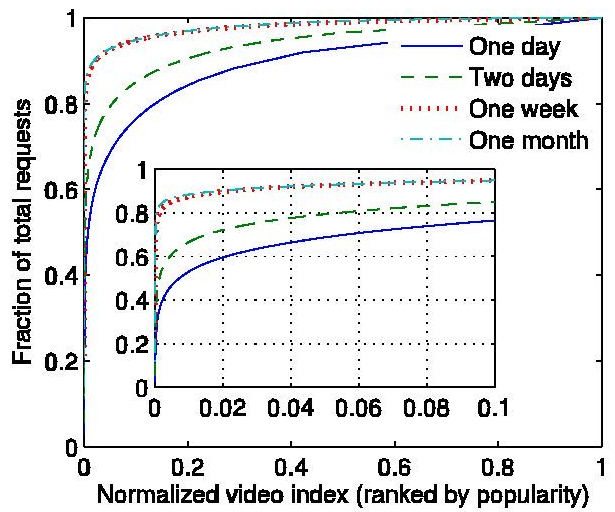 Fig 1. The "Perfect Power-Law": Unlike YouTube, OSN video popularity follows a strict power-law distribution without the truncated tail, indicating that unpopular videos vanish almost instantly.
Key Findings: The 2/90 Rule
The most striking discovery is the degree of skewness. While the "80/20 rule" is a standard benchmark, OSNs push this to the edge:
- The OSN Skew: 2% of videos = 90% of views.
- YouTube Comparison: 10% of videos = 80% of views.
- Volatility: Unlike YouTube, where early views correlate well with long-term popularity, OSN videos are "flashes in the pan." If a video doesn't sustain a high resharing rate across "generations" of friends, its viewing rate collapses rapidly.
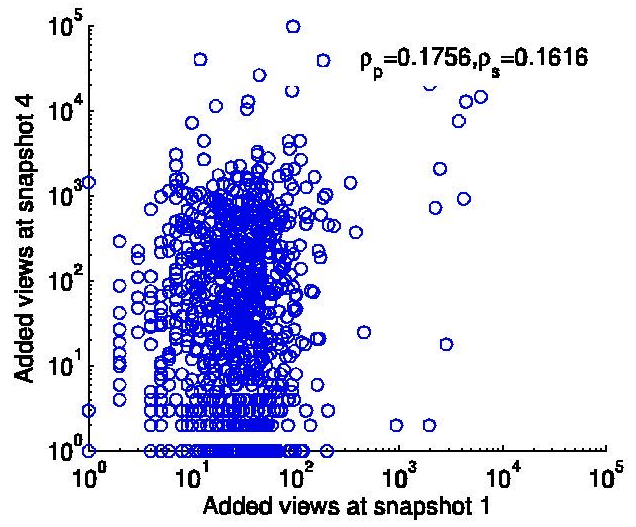 Fig 2. Added Views Correlation: The drop in correlation between Snapshot 1 and Snapshot 4 shows that being popular now is a poor predictor of popularity in the distant future within a social context.
Critical Insight: High $
eq$ High Popularity Interestingly, the emulator proves that a high Sharing Rate is a necessary but not sufficient condition for virality. A video can have a 20% reshare rate, but if it happens to be shared by users with few friends (low out-degree) early on, it will fail to hit the "tipping point." This highlights the inherent randomness and role of "influencers" (high-degree nodes) in social video dissemination.
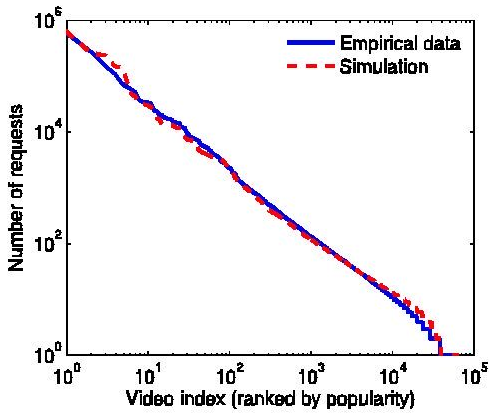 Fig 3. Sharing Rate vs. Views: High sharing rates are present in all top videos, but many videos with high sharing rates still fail to gain significant total views due to network topology randomness.
Conclusion & Implications
This research provides a vital blueprint for Content Delivery Networks (CDNs).
- Caching Strategy: Because the top 2% of videos are so dominant, even a small cache can achieve a 90% hit rate.
- Dynamic Replication: Because popularity shifts so fast, those caches must be updated in real-time based on social sharing triggers, not just historical view counts.
Limitations: The study focuses on a 2011-2012 chronological feed. In the modern era of "For You" algorithmic discovery (TikTok), the skewness is likely even more extreme, as AI replaces friends as the primary filter.