
Designing for Feeling: Videogames as the Next Frontier in Emotion Recognition
Videogame design as a elicit tool for emotion recognition experiments
This paper presents a 2D platform videogame designed as an active elicitation tool for emotion recognition experiments, targeting specific Arousal-Valence quadrants. The study validates the game's effectiveness in inducing diverse emotions, ranging from excitement to boredom, using a structured level design based on the MDA and 6-11 frameworks.
TL;DR
Researchers from the Tokyo Institute of Technology have developed a 2D space-alien platformer specifically engineered to "hack" human emotions for scientific study. By systematically varying game mechanics and aesthetics, the tool successfully elicits a wide range of Arousal-Valence states, though it reveals a critical challenge: maintaining player engagement over time is much harder than inducing a momentary spark of frustration or joy.
The Passive Stimulus Problem
For decades, emotion recognition research has relied on the International Affective Picture System (IAPS) or movie clips. While standardized, these are "passive" experiences. You watch a movie; you don't interact with it. In the context of Human-Computer Interaction (HCI), this is a major flaw. If we want to build AI that understands how a user feels while working or playing, we need data from "active" scenarios where choices and failures matter.
Methodology: Engineering Emotion via Mechanics
The researchers mapped game design to Russell’s Circumplex Model of Affect, which categorizes emotions based on Valence (pleasantness) and Arousal (intensity).
Level Design Logic:
- Excitement (HAHV): High speed, normal controls, and rewarding tokens.
- Frustration (HALV): Inverted controls, high asteroid density, and decreased ship speed.
- Calm (LAHV): Slow melodies, no "bad" tokens, and simplified navigation.
- Boredom (LALV): Extremely slow speed and a total absence of tokens/interactions.
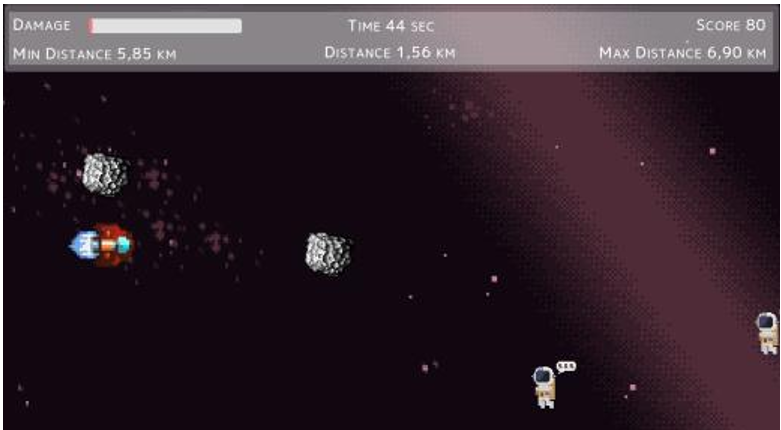 Fig 1: The game interface features a spaceship controlled along the Y-axis, navigating through a field of varied "tokens."
Experimental Results: Success and the "Boredom Drift"
The study involved 21 participants and utilized Self-Assessment Manikins (SAM) to quantify emotional responses.
1. High Precision in Initial States
In the first stage (Elysian), the levels performed remarkably well. 81% of players felt "Excited" during the intended HAHV levels, and 66.7% felt "Disgust/Anger" (HALV) during the high-difficulty asteroid levels. This proves that game mechanics alone can reliably shift a user's position in the emotional coordinate system.
2. The Longitudinal Decay
The most striking finding was the comparison between Stage 1 and Stage 3. Even when new enemies were introduced (like the moving aliens in Stage 3), the participants' arousal levels trended downward.
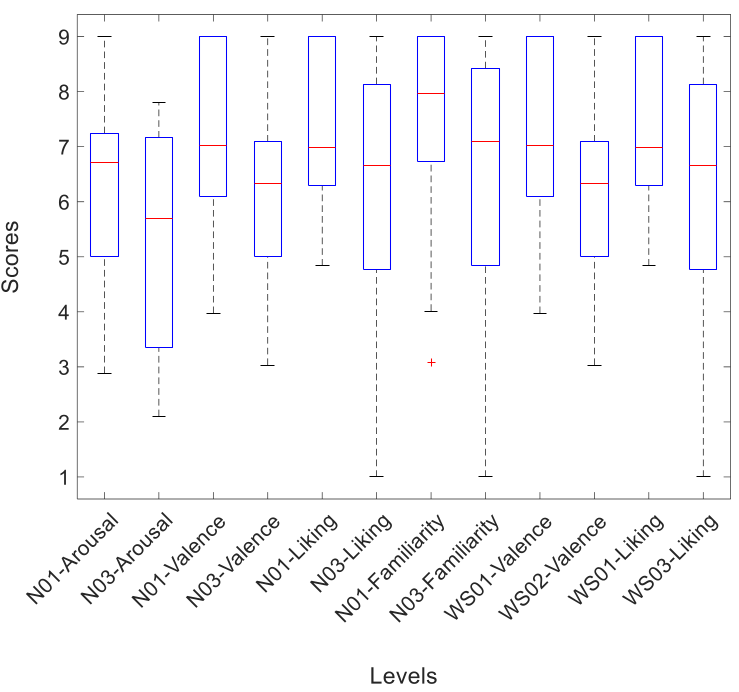 Fig 2: Statistical comparison showing significant decreases in Arousal and Valence for the same level types across different segments of the experiment.
As the game structure became familiar, the "Hard" levels—which initially caused frustration—started causing "Boredom." The lesson? Challenge without a greater narrative purpose eventually leads to disengagement.
Critical Insight: The "Why" Matters
The authors conclude that for a videogame to be a viable long-term elicitation tool, it cannot just be a series of isolated tasks. It requires:
- Environmental Narrative: Using "History of Art and Cinema" references to create more immersive aesthetics.
- Clear Meta-Objectives: A goal that persists across levels to prevent the "repetitive task" feeling.
Academic Takeaway
This work highlights the Inductive Bias of game design in HCI research. While mechanics (the "How") can trigger immediate survival instincts like fear or excitement, the systemic engagement (the "Why") is what keeps the data clean over long sessions. For future emotion recognition datasets, the "gamified" approach remains the most promising path toward capturing authentic human affect in digital environments.
Keywords: Emotion Recognition, Human-Computer Interaction, Game Design, Russell’s Model, SAM Questionnaire.