
VideoMec: Transforming Crowdsourced Video Search via Sensor-Driven Metadata
VideoMec: A Metadata-Enhanced Crowdsourcing System for Mobile Videos
The paper presents VideoMec, a metadata-enhanced crowdsourcing system for mobile videos that replaces blind file uploading with a sensor-driven indexing approach. By leveraging embedded mobile sensors (GPS, IMU) to generate spatial-temporal metadata, it enables efficient video querying and selective uploading, achieving high search precision while minimizing bandwidth and energy consumption.
TL;DR
VideoMec is a system designed to solve the "bandwidth vs. utility" paradox in mobile video crowdsourcing. Instead of uploading massive video files to the cloud, it first uploads lightweight sensor data (GPS, orientation, FOV). The server uses this metadata to index the videos' visual "coverage" in 3D space, allowing applications to fetch only relevant clips. It results in a dramatic reduction in network load while maintaining superior search accuracy compared to standard computer vision techniques.
The Problem: The High Cost of "Blind" Uploading
The proliferation of high-definition smartphones has made everyone a potential mobile reporter. However, using these videos for crime investigation or traffic analysis is currently impractical for two reasons:
- Bandwidth Exhaustion: Uploading a 1-minute UHD video can take 40 minutes on a 1Mbps connection.
- Search Inefficiency: Existing systems like YouTube rely on tags which are often missing or wrong. Content-based search requires processing petabytes of data, much of which is just "noise."
Methodology: Seeing Through the Lens of Sensors
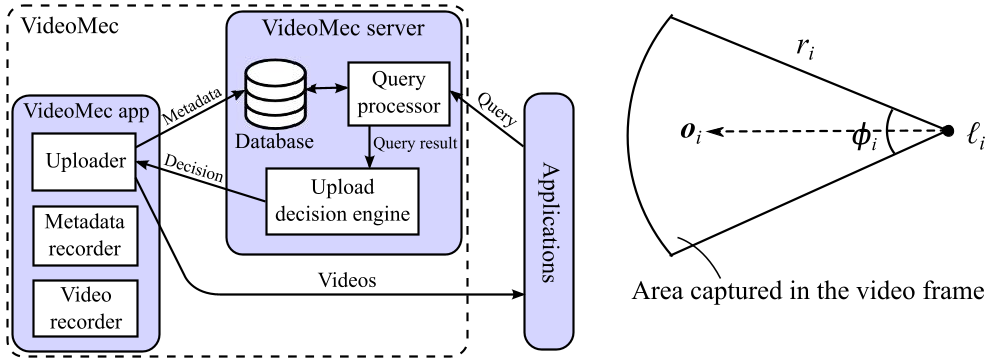
The core insight of VideoMec is that we don't need to see the video to know what is in it. By combining the GPS location, IMU (Inertial Measurement Unit) orientation, and lens focal length, the system can geometrically calculate the exact "pyramid" of space the camera is capturing.
1. The Metadata Engine
Each second of video is tagged with:
- (Orientation): Where the camera is facing.
- (Field of View): How wide the lens is set.
- (Coverage Range): How far objects remain recognizable.
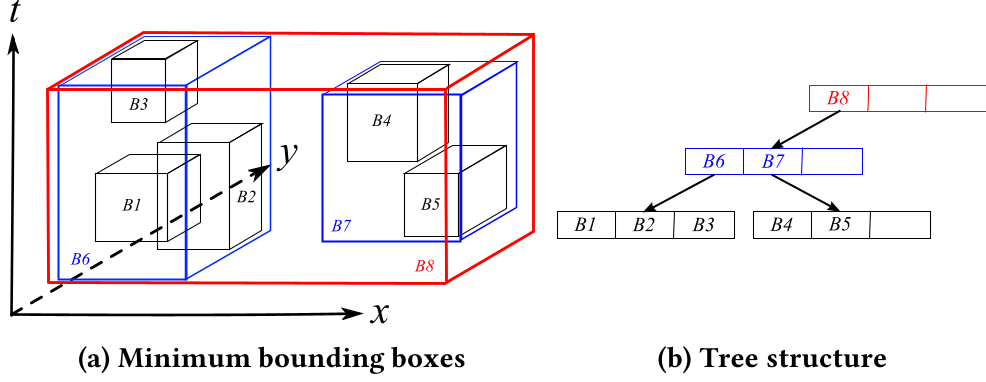
These are indexed in an R-tree*, a spatial data structure modified to include the Time (t) dimension. This allows query speeds to find any video that "looked at" a specific event.
2. Intelligent Selection (TBS & LBS)
When bandwidth is limited, the server must decide which segments to upload. VideoMec models this as a variation of the Knapsack Problem:
- Time-Based Strategy (TBS): Maximizes unique time coverage. It uses a greedy heuristic to pick segments that don't overlap with already-uploaded videos.
- Location-Based Strategy (LBS): Maximizes visual quality. It prioritizes clips taken at the best angles and closest distances to the event.
Experiments & Results: Sensors Over SOTA Vision
The researchers compared VideoMec against an OCR-based search (finding store logos).
The findings were startling:
- Recall Gap: OCR often failed (57% recall) because text is hard to read from side angles. VideoMec maintained >95% recall because it knew the camera was pointed at the right spot regardless of text clarity.
- Efficiency: Preparation time for VideoMec was virtually zero (0.24s) compared to 730s for uploading all videos for OCR processing.
Critical Analysis & Conclusion
Takeaway
VideoMec proves that metadata is not just a label, but a geometric filter. By uploading just 150KB of sensor data, we can avoid uploading 10GB of useless video files.
Limitations
- Indoor Accuracy: GPS and Magnetometers struggle inside metal-reinforced buildings.
- Dynamic Objects: The current system assumes static events (like a crash or a stationary suspect). Tracking a moving target would require predicting trajectories and updating the R*-tree dynamically.
Future Outlook
The next logical step for this technology is Privacy-Preserving Crowdsourcing. By using local device processing to blur faces before the metadata-driven upload, systems like VideoMec could finally bridge the gap between public safety and personal privacy.