
Vignettes of Sweden: The Hidden Pioneers of Computer Graphics
Vignettes of Sweden's Computer Graphics History
This article provides a comprehensive historical review of Sweden's pioneering contributions to computer graphics, covering milestones from the 1953 BESK computer to modern shared virtual environments. It highlights key innovations like Hertz's high-resolution color ink jet plotter, ASEA's Tesselator semigraphical interface, and Håkan Lans's foundational patent for fast color graphics displays.
TL;DR
While Silicon Valley often takes the spotlight in tech history, Sweden was a powerhouse of early computer graphics innovation. From the BESK computer outperforming ENIAC in 1953 to the invention of high-resolution color ink jet printing and the birth of "Participatory Design," Swedish engineers and researchers laid much of the groundwork for the visual computing world we inhabit today. This article explores the evolution of these technologies and the sometimes tragic legal battles that followed.
Problem & Motivation: The Need for Visual Intuition
In the mid-20th century, computers were essentially "black boxes" of numbers. The primary motivation for Swedish pioneers was the transformation of raw data into intuitive visual information. Whether it was Bo Lindestam trying to represent the human body for medical purposes in 1962 using paper sheets or ASEA needing real-time monitoring for power plants, the bottleneck was always the same: how to bridge the gap between human perception and machine calculation.
The challenge was twofold:
- Hardware Constraints: Computers like the ALWAC III-E were so slow that a single multiplication took 50ms.
- Interface Rigidly: Early displays were strictly alphanumeric, making complex spatial data almost impossible to interpret.
Methodology: Engineering the Visual Breakthrough
1. The BESK and Early Curve Drawing
Sweden’s first electronic computer, BESK (Binary Electronic Sequence Calculator), completed in 1953, was a marvel of efficiency. It could process a 3-day weather forecast in just one hour—a task that took the American ENIAC 24 hours. By 1954, it was equipped with a display for drawing curves on film, marking the transition from pure computation to visual representation.
2. Semigraphical Mastery: The Tesselator
One of the most unique Swedish contributions was the concept of semigraphical interfaces. Engineers at ASEA found standard terminals too restrictive. They developed the Tesselator (1980), which used an "object-oriented" approach to graphics. Instead of being locked to a grid, symbols (composed of 3x3 pixel "Tessels") could be assigned to arbitrary locations on the screen.
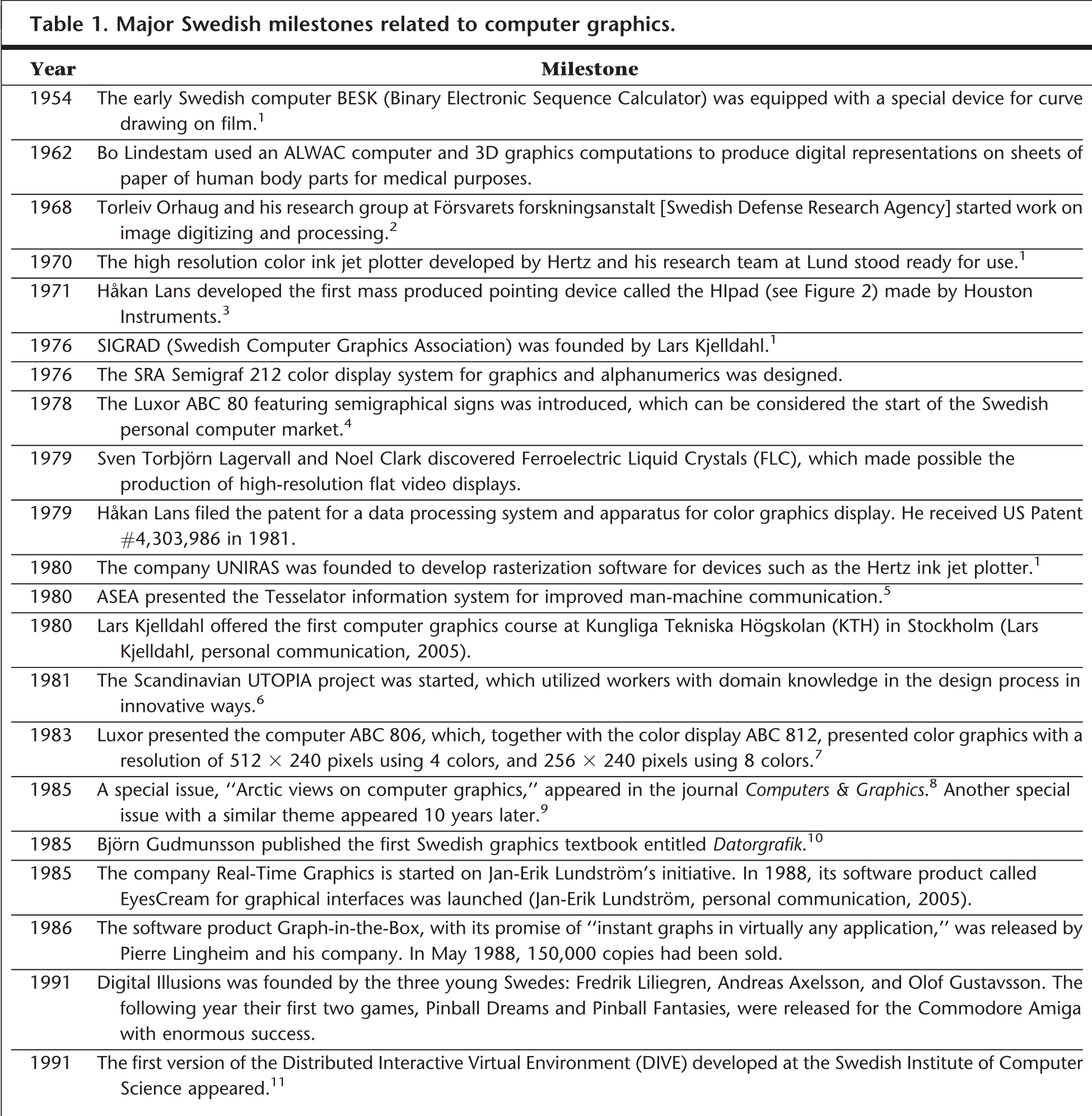 Table 1: Key milestones in Swedish Computer Graphics history.
3. The Lans Patent: A Foundation for Modern Color
Håkan Lans developed a system for fast, efficient random access to color picture memory. His US Patent (#4,303,986) described the video memory controller architecture that allowed for high image update rates on CRT monitors—a fundamental requirement for the PC revolution.
Experiments & Results: From Lab to Market
Sweden's research didn't stay in the lab; it moved rapidly into industry:
- Printing: Helmut Hertz's ink jet plotter (1970) achieved 125-dpi resolution in color, an astonishing feat for the era. This technology was later sold to Applicon in the US.
- Personal Computing: The Luxor ABC 80 and subsequent ABC 806 (1983) brought high-resolution color (up to 512x240 pixels) to Swedish schools and businesses, predating the widespread adoption of similar capabilities in many other regions.
- Virtual Reality: By 1991, the DIVE system (Distributed Interactive Virtual Environment) was already exploring peer-to-peer 3D synthetic environments where users were represented by "avatars."
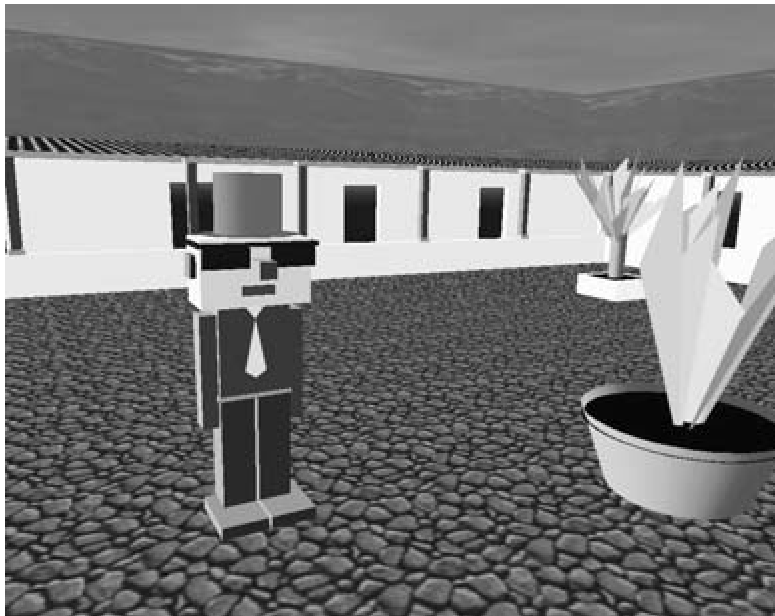 Figure 8: A screenshot from a DIVE application showing an early 3D avatar.
Critical Analysis & Conclusion
The Swedish history of computer graphics is a mix of brilliant technical foresight and commercial cautionary tales.
- The Legacy of Design: Perhaps the most lasting "soft" innovation was the UTOPIA project, which birthed Participatory Design. It argued that users should be equal partners in the design process, a philosophy that now underpins modern UX design.
- The Patent Tragedy: The case of Håkan Lans serves as a somber reminder of the complexities of global IP. Despite inventing foundational tech used by IBM and Hitachi, legal technicalities and jurisdictional hurdles resulted in massive personal financial loss for the inventor.
Takeaway: Sweden’s journey shows that computer graphics evolved not just through hardware power, but through a constant drive for better man-machine communication. While the hardware companies (like Luxor and Facit) may have vanished or merged, the methodologies they pioneered continue to define how we interact with screens today.