
VIMPO: Bridging the Gap Between GRPO and Actor-Critic for LLM Reasoning
VIMPO: Value-Implicit Policy Optimization for LLMs
VIMPO (Value-Implicit Policy Optimization) is a critic-free reinforcement learning method designed for LLM post-training in verifiable rewards (RLVR) tasks. By deriving a policy-implied value function from KL-regularized optimality conditions, it achieves dense token-level credit assignment without the instability of training an explicit critic, reaching new SOTA results on mathematical reasoning benchmarks.
TL;DR
VIMPO (Value-Implicit Policy Optimization) is a novel RL framework that provides the dense credit assignment of Actor-Critic methods with the simplicity and stability of CRPO-style critic-free training. By deriving an implicit value function directly from the policy's log-ratios against a reference model, VIMPO eliminates the need for a separate critic network while significantly boosting performance on complex math reasoning tasks like AIME and MATH-500.
Problem & Motivation: The "Credit Assignment" Trap
In the world of RL for Large Language Models (LLMs), researchers usually pick between two poisons:
- Actor-Critic (PPO): Great for pinpointing exactly which token was the breakthrough in a solution, but the "critic" (value model) is notoriously hard to train and often collapses.
- Group-Relative (GRPO): Simple to implement because it has no critic, but it treats the entire reasoning chain as one unit. If a model writes 500 tokens of perfect logic followed by one silly calculation error, GRPO punishes all 501 tokens equally.
VIMPO’s researchers at UC Berkeley and Yale asked: Can we get token-level precision without the headache of a critic?
Methodology: The Math Behind the Intuition
VIMPO treats LLM generation as a deterministic-transition MDP. The core insight comes from the optimality condition of a KL-regularized objective. Instead of training a separate model to predict the value , they express the value function implicitly using the log-ratio between the current policy and a frozen reference policy .
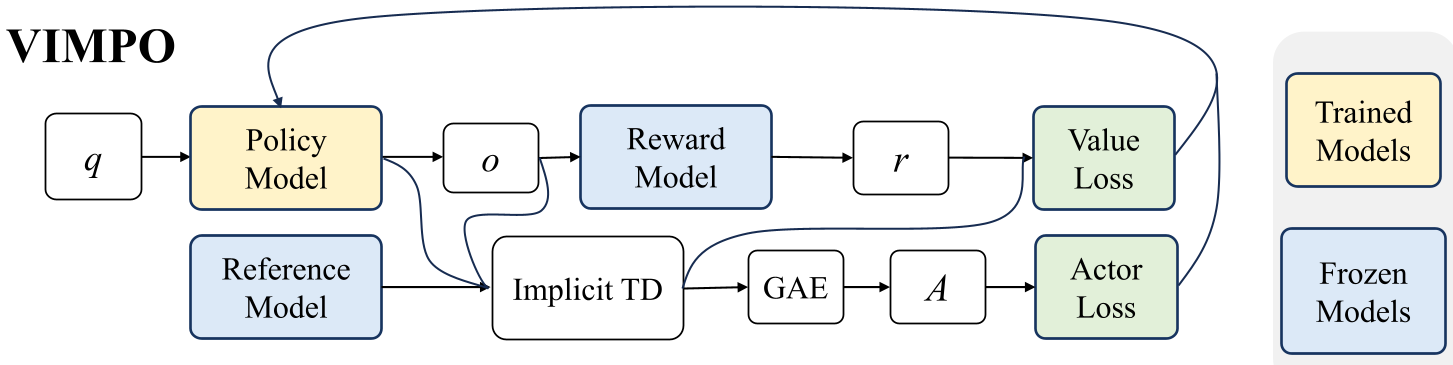
The Two-Headed Objective:
- Value Loss via Terminal Anchor: Because we know the reward at the very end of a reasoning chain (the terminal state), VIMPO enforces a constraint that the accumulated policy-reference log-ratios must match the final outcome reward.
- Actor Advantage: This derived value recurrence yields a closed-form one-step Temporal Difference (TD) advantage. This allows VIMPO to perform "micro-updates" to specific reasoning steps without ever needing a critic to tell it what each step is worth.
Experiments: Superior Reasoning & Noise Robustness
The authors tested VIMPO on the "Gold Standard" of LLM reasoning: Math.
Breaking the GRPO Ceiling
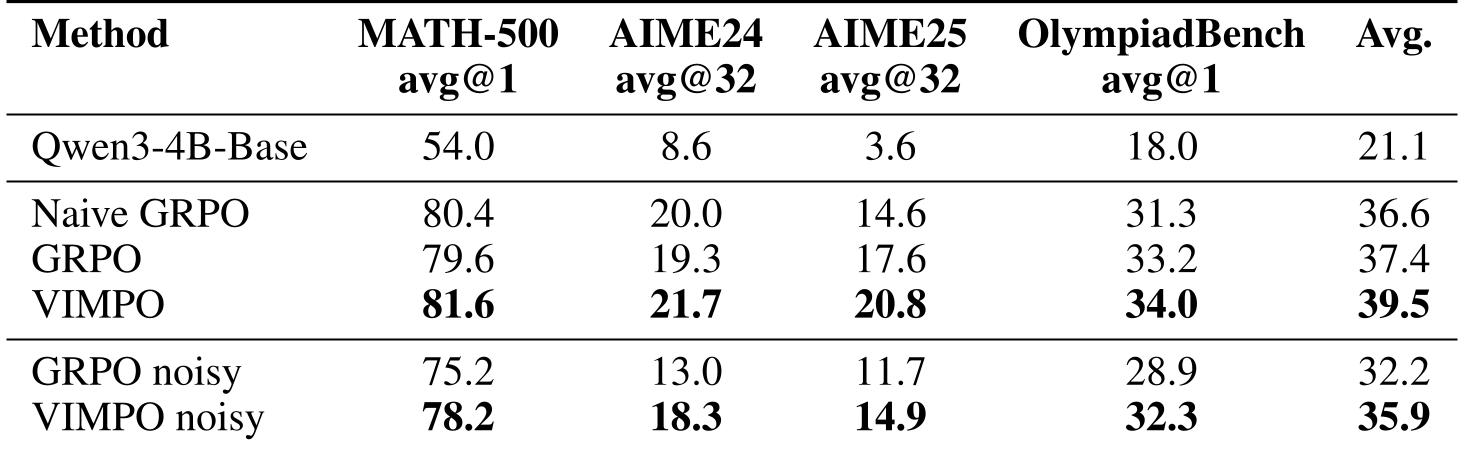
Using the Qwen3-4B-Base model, VIMPO consistently outperformed GRPO across all benchmarks. Most impressively, on the high-difficulty AIME 2025, it achieved a 20.8% accuracy compared to GRPO's 17.6%.
Fighting Dirty Rewards
Real-world verifiers (like code executors or math checkers) are often noisy. In a stress test with 25% reward noise (flipping correct to incorrect randomly), VIMPO's performance degraded significantly less than GRPO. This is because VIMPO's actor update is buffered by the implicit value signals, making it less reactive to individual corrupted labels.
Deep Insight: Visualizing the Token-Level Signal
One of the most compelling parts of the paper is the qualitative case study. In a combinatorics problem, VIMPO was able to identify the exact moment a model "hallucinated" an extra counting option.
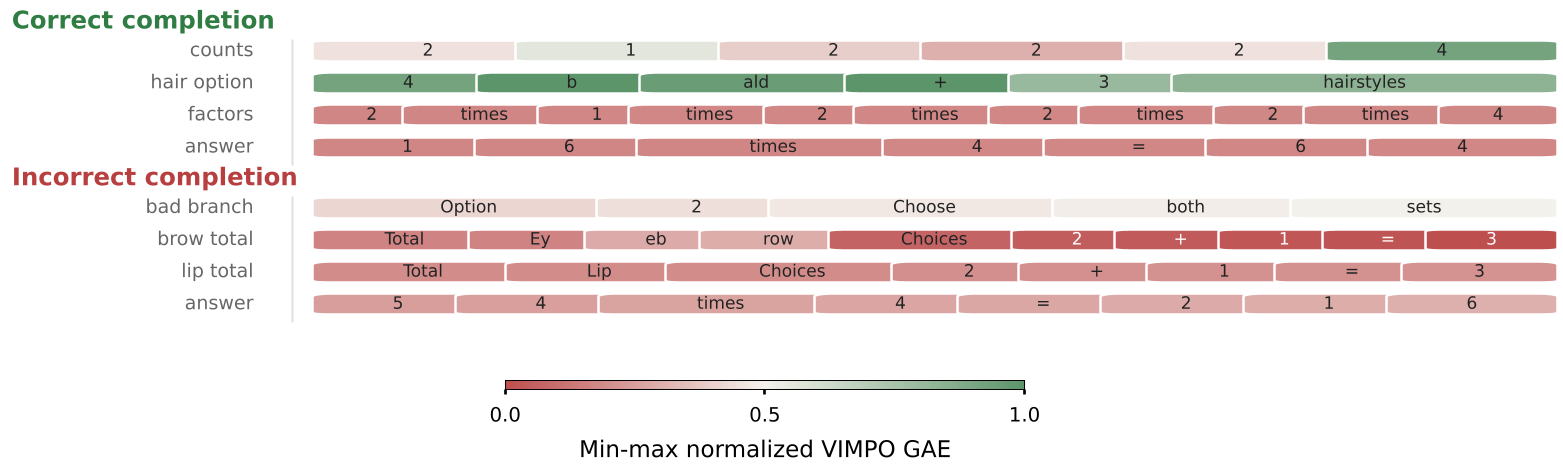
As shown above, the "Incorrect Span" receives strongly negative (red) signals at the exact tokens where the logic fails, while "Correct Spans" are reinforced (blue). This is behavior typically only seen in complex Actor-Critic setups, now achieved without a critic.
Conclusion & Future Outlook
VIMPO is a powerful reminder that there is still much to be "mined" from the mathematical structure of Transformer policies. By moving value estimation inside the policy itself, we gain efficiency and robustness.
Future Work:
- Scaling: Will this hold up at 70B+ parameters?
- Dynamic Referencing: How do we update the reference policy as the model evolves?
- Broadening Domains: Can this improve code generation or even agentic tool-use?
VIMPO effectively offers a "free lunch" in LLM RL: better credit assignment with fewer moving parts.