
VIP Delegation: Solving Cellular Congestion through Socially-Aware Data Offloading
VIP delegation: Enabling VIPs to offload data in wireless social mobile networks
This paper introduces VIP Delegation, a data traffic offloading framework that leverages social mobility patterns to select a small subset of "VIP nodes" to act as data bridges. By using structural social attributes like PageRank and Betweenness Centrality, the method achieves up to 90% traffic offload using as few as 7% of users in campus settings and 1% in vehicular networks.
TL;DR
Mobile networks are suffocating under the weight of "big data" apps. Instead of building more cell towers, why not use the natural movement of people? This paper proposes VIP Delegation, a strategy that selects a handful of socially influential users (VIPs) to carry data and distribute it to others via local Wi-Fi/Bluetooth. Using PageRank and "Greedy" selection, they can offload 90% of a network's traffic using only 6-7% of the user base.
Impact & Background
As smartphones became ubiquitous, carriers like AT&T and T-Mobile famously struggled with network straining. While 4G and 5G provide more bandwidth, the demand remains exponential. VIP Delegation positions itself as a "social-opportunistic" solution. It is not just about moving data; it's about predicting where consumers will be based on where they usually go.
The Core Problem: The Efficiency Gap in Offloading
Prior works often relied on multi-hop forwarding, where every phone acts as a relay. While elegant in theory, it fails in practice because:
- Selfishness: Users don't want to drain their battery for strangers' data.
- Reliability: Multi-hop paths are extremely fragile.
- Data Volume: You can't send a 1GB software update through 10 different phones reliably.
The authors' insight? Don't ask everyone to help. Instead, pick the "Social VIPs"—the people who naturally act as the "connectors" or "anchors" of their communities.
Methodology: Mining Social Intelligence
The researchers define a VIP not by their status, but by their mobility graph. They used a one-week "Training Period" to map out who meets whom. They then tested four social centrality metrics:
- Betweenness: Nodes that act as bridges between groups.
- Closeness: Nodes that are "near" everyone else in the social chain.
- Degree: The "popular" nodes with the most contacts.
- PageRank: Nodes that are connected to other influential nodes.
The Winning Strategy: Greedy Promotion
Simply picking the "top" nodes leads to "clumping"—all your VIPs might be in the same social group, leaving others in the dark. The paper introduces Greedy Promotion: once a VIP is selected, all its neighbors are marked as "covered," and the algorithm recalculates the rankings of the remaining nodes.
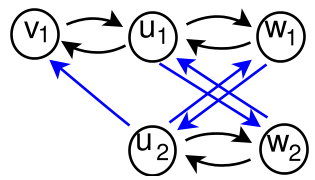 Figure: The "Benchmark" construction method used to evaluate the VIP selection accuracy against the theoretical optimum.
Experimental Results: Near-Optimal Performance
The researchers validated their approach using the Dartmouth Campus trace (WiFi logs) and SF Taxi data (GPS).
- Campus Scenario: Using the PageRank-Greedy strategy, they reached 90% coverage with only 5.93% of nodes.
- Comparison: The theoretical optimal (Benchmark), which requires knowing the future, needed 3.92%. For a real-world heuristic, being this close to the "Omniscient" optimal is a massive achievement.
- Vehicular Scenario: In the Taxi dataset, the mobility is so high that less than 1% of nodes could cover 90% of the fleet.
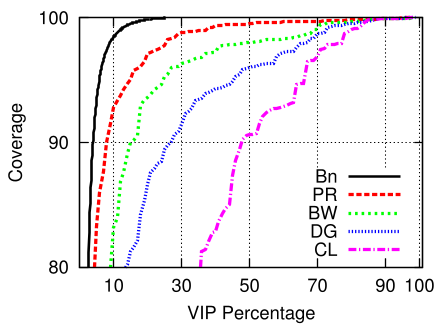 Figure: Coverage trend showing how PageRank and Greedy strategies outperform traditional centrality metrics.
Deep Insight: Stability Over Time
A critical finding of this study is that social importance is stable. A VIP selected based on week one remains an effective VIP for months. This means the overhead of re-calculating the social graph is very low, making it a viable feature for network operators to implement in their standard service apps.
Critical Analysis & Future Outlook
Limitations
- Storage & Privacy: Forcing VIPs to carry large amounts of other people's encrypted data requires significant local storage and raises trust concerns.
- Incentives: While the paper suggests "upgrading VIP devices to fancy new models," a more granular micro-payment or data-credit system would likely be required for widespread adoption.
Conclusion
VIP Delegation shifts the burden of 3G/4G offloading from expensive, static infrastructure (like Wi-Fi hotspots) to the dynamic, social "gravity" of the users themselves. By targeting the top 5-7% of socially active individuals, network providers can dramatically reduce peak congestion with minimal investment.
Takeaway: Your social life isn't just a collection of memories; it's a latent backbone for the next generation of wireless networks.